
Inner Signal research & practice
When Not to Use Self-Hypnosis Alone
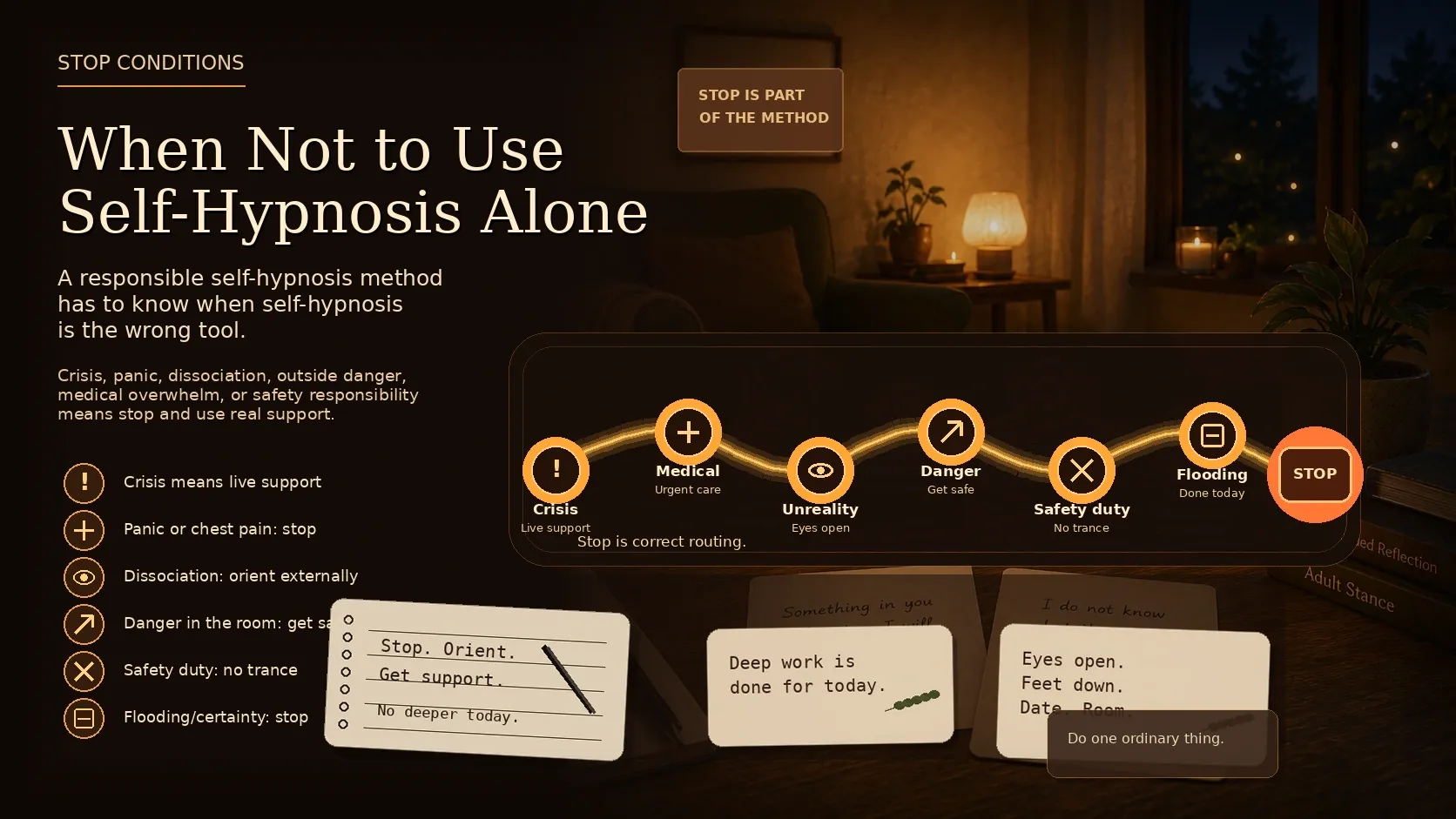
Stop conditions
A responsible self-hypnosis method has to know when self-hypnosis is the wrong tool.
Do not use self-hypnosis as crisis support
If you may hurt yourself or someone else, feel unsafe, have a plan, or cannot trust yourself to stay safe, do not use self-hypnosis as your main support. Use emergency services, a crisis line, or a trusted person near you.
Do not go deeper during panic or medical overwhelm
If your heart is racing, you are shaking badly, you cannot catch your breath, you feel faint, or you have chest pain, stop. Ground minimally and use urgent or emergency care if symptoms are concerning or not easing.
Do not practice while dissociating
If the room feels unreal, you feel outside your body, or you cannot orient, use external grounding. Eyes open. Feet down. Objects. Date. Room. Deep work is done for today.
Do not use hypnosis to recover memories
Trance can produce vivid content, but vivid content is not evidence. Do not use it to decide what happened or who did what.
Do not practice when danger is outside you
If someone nearby is threatening you, a partner or parent is escalating, or you are physically unsafe, get to safety. “Stay with the feeling” is wrong when the danger is in the room.
Do not practice while driving or responsible for safety
No trance, induction, visualization, or deep inward focus while driving, supervising children, operating machinery, or responsible for another person’s safety.
Use caution with mania, psychosis, severe destabilization, and substances
Do not use self-hypnosis to amplify certainty, visions, downloads, grandiosity, or inner commands. If reality-testing, sleep, safety, or functioning is weakening, stop and involve real support.
If you are already altered but medically safe and oriented, Inner Signal may still be useful as a small stabilizing or integration tool — not as a way to go deeper, get dosing advice, prove memories, or act on commands. Read the altered-state use guide →
Do not use it to avoid life
If another session is replacing the call, boundary, meal, sleep, medical help, or practical task you need, stop and do one ordinary thing.
Signs to stop
- you feel pressured to continue
- you are chasing a state
- you are trying to prove something
- a protector is clearly saying no
- you are getting flooded
- you feel unsafe or less real
Start smaller than your problem.
Try the preview when you are stable enough for gentle self-practice. Use one phrase, one body signal, and one small action. No breakthrough required.
Evidence note: crisis means live support, not more inner work
When someone may be in immediate danger or at risk of self-harm, the safest role for an app is narrow: stop the practice, name the limit, point to live human help, and encourage distance from lethal means. The app should not become the safety plan.
- 988 Suicide & Crisis Lifeline. If you need to talk, the 988 Lifeline is here.
- Suicide Prevention Resource Center. Reduce Access to Means of Suicide.
How this page uses the evidence: Acute self-harm, danger in the room, serious medical symptoms, or inability to stay oriented should route away from self-hypnosis and toward emergency services, crisis lines, or a nearby trusted person.
Evidence note: practice can destabilize some users
Meditation and related inward-attention practices are not risk-free for everyone. Reports and studies of adverse meditation-related effects include anxiety, dysregulated arousal, dissociation, and depersonalization/derealization-like experiences. That is why Inner Signal treats panic, unreality, and physical overwhelm as stop signals.
- Britton WB et al. Defining and measuring meditation-related adverse effects in mindfulness-based programs. 2021.
- Farias M et al. Adverse events in meditation practices and meditation-based therapies: a systematic review. 2020.
- Castillo RJ. Depersonalization and meditation. Psychiatry. 1990.
How this page uses the evidence: When the room feels unreal, the body feels over-activated, or the user feels too open, the safer move is exit, orientation, ordinary sensory grounding, and real-person support if it does not settle—not deeper self-hypnosis.
Evidence note: memory humility
The public safety line here follows mainstream memory caution: hypnosis, guided imagery, dreams, and body sensations may produce vivid inner material, but vividness and certainty are not the same as factual verification. Inner Signal therefore treats inner material as meaningful experience, not as proof of a specific event or person.
- American Psychological Association. Questions and Answers about Memories of Childhood Abuse.
- Leo DG et al. The role of hypnosis in memory recall and false memories. 2025.
- Muschalla B et al. Induction of false beliefs and false memories in laboratory studies: a meta-analysis. 2021.
- Johnson MK, Hashtroudi S, Lindsay DS. Source monitoring. Psychological Bulletin. 1993;114(1):3–28.
How this page uses the evidence: Do not use the app to recover hidden memories, identify perpetrators, or convert a dream, image, twitch, or body sensation into factual certainty. Work from known facts and seek qualified support for trauma or legal questions.
Evidence note: bounded method, not AI therapy
Current mental-health and AI guidance supports a conservative boundary: generative AI tools can be useful for structured reflection, but they should not be relied on as psychotherapy, crisis response, diagnosis, or a sole emotional support system. Youth and vulnerable users require extra caution.
- American Psychological Association. Health advisory on the use of generative AI chatbots and wellness applications for mental health.
- World Health Organization. Ethics and governance of artificial intelligence for health: guidance on large multi-modal models. 2025.
- American Academy of Pediatrics. Counseling Patients and Families on Using AI Chatbots. 2026.
- McBain RK et al. AI Chatbot Use and Disclosure for Mental Health Among US Adolescents and Young Adults. JAMA Pediatrics. 2026.
- Sobowale K et al. Evaluating Generative AI Psychotherapy Chatbots Used by Youth: Cross-Sectional Study. JMIR Mental Health. 2025.
How this page uses the evidence: Inner Signal should remain a bounded self-practice tool: source-visible logic, clear refusal lines, adults-only deep practice, privacy limits, and redirection to real people when the situation exceeds the method.