
Inner Signal research & practice
Hearthwork peer-counseling manual for Groups
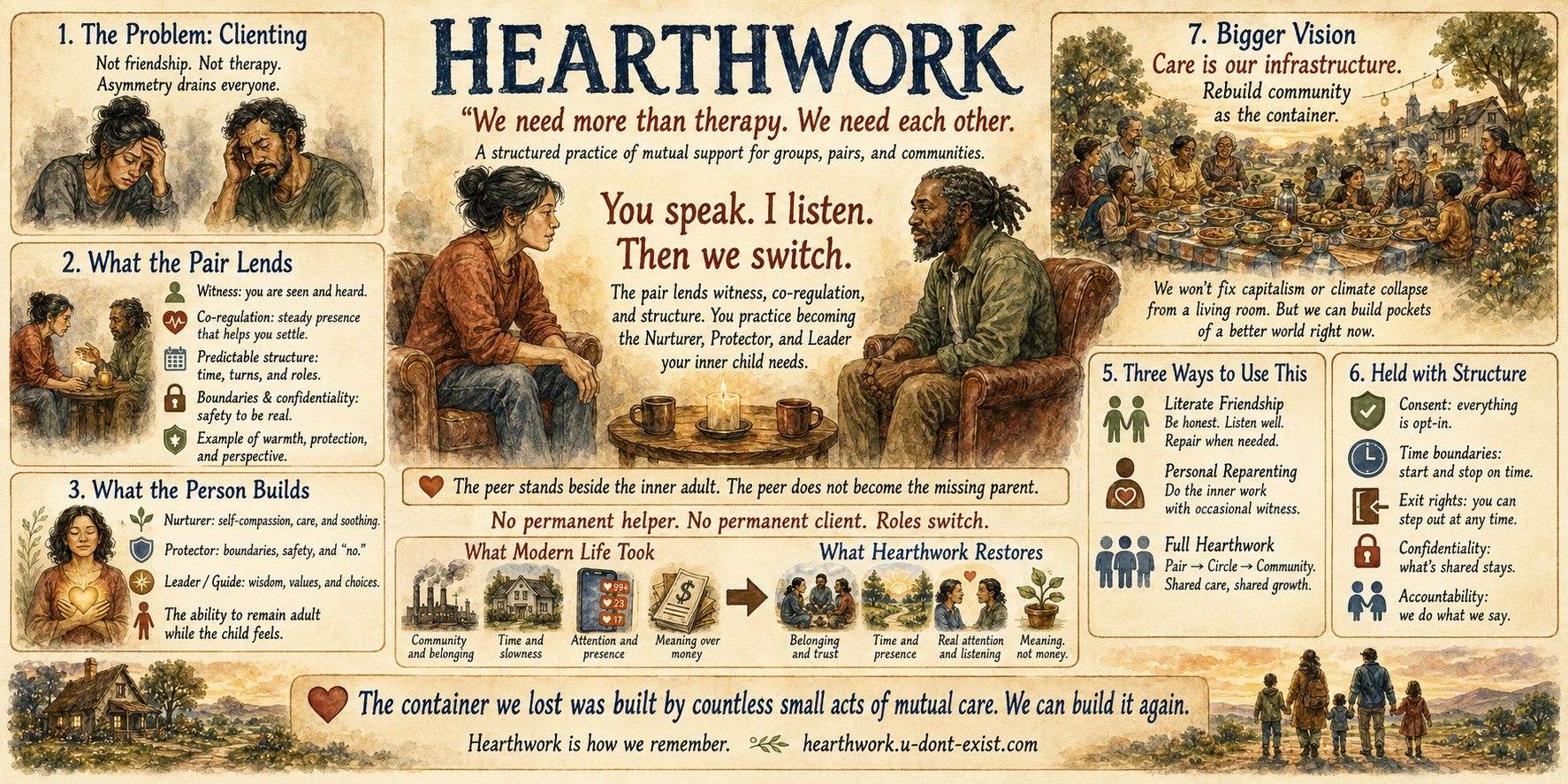
Hearthwork for Groups and Communities
This is the full manual for circles, groups, and intentional communities. For the main guide and the shorter manual for pairs, return to the Hearthwork guide.
Open the main guide and find the pairs manualPeer Counseling and Circle Practice for Groups and Communities
Integrating Re-evaluation Counseling, Inner Child Reparenting, Gendlin Focusing, and Circle Practice
By Joel and Key, with contributions from others named in the preface
Simplified Approaches To Begin With
Hearthwork has three useful depths. Choose the smallest one that serves the people in front of you.
Literate friendship. People learn to notice clienting, ask before unloading, schedule hard conversations, and bring in another kind of support when friendship has reached its limit. The Hearthwork article covers this level.
Personal reparenting with occasional witness. The inner adult is built through practice, ordinary action, and trusted relationship. A pair can witness the process without joining a full group. The shorter pair manual is the better fit.
Full Hearthwork. Weekly pairs live inside a circle with shared training, rotating roles, conflict practice, exit rights, and outside accountability. This manual is written for that level.
Reparenting remains the common center. The container grows from one person, to a pair, to a circle, and eventually to community. Each layer adds capacities the earlier one cannot provide.
Contextual Risk vs Benefit Expectations
Hearthwork is a recent synthesis built from older practices: Re-evaluation Counseling, inner-child reparenting, Gendlin Focusing, Quaker clearness committees, restorative circles, somatic trauma practice, and several community traditions. Each source contains methods worth keeping and failures worth studying.
Re-evaluation Counseling developed disciplined equal-time listening and discharge, while underdeveloping protectors, reparenting, and safeguards against concentrated authority. Inner-child traditions understand the adult–child relationship but often lack a rigorous peer container. Restorative circles address harm between people; they do not repair the relationship inside one person. ZEGG and Tamera learned a great deal about witnessed group process and also show how charismatic authority and boundary failures can damage a community.
Hearthwork grew from those gaps. Reparenting accompanies discharge because release without a trustworthy inner adult can repeat abandonment. Rotating roles, exit rights, and outside accountability matter because healing groups have repeatedly protected their leaders instead of their members. The pair switches because permanent helpers and permanent clients eventually distort each other.
No manual can guarantee that a group will flourish. Results depend on the people, coordinator, culture, timing, power relations, and willingness to recognize the edge of peer scope. Some groups will last for years. Some will dissolve. Some will reveal failure modes this manual has not imagined. The methodology has to remain open to correction from lived use.
Hearthwork also treats interpersonal malice described as witchcraft, experiences of entity attachment, and damage from unjust social systems as real sources of suffering. Participants may understand those experiences through different metaphysics. The group begins by respecting the experience, strengthening the inner adult, and using the person’s own cultural, spiritual, political, and professional resources where needed.
Preface
Hearthwork is peer-distributed psychological and spiritual support: Equal time. Attention without interpretation, advice, or fixing. You speak. I listen. Then we switch. Presence, Warmth, Discipline, Confidentiality.
The name points to the home fire—the slow center where people return, sit down, and become known across time. Hearthwork rebuilds that kind of care deliberately, using methods that peers can learn and communities can hold without placing one healer above everyone else.
The methodology draws from Re-evaluation Counseling, inner-child reparenting, Gendlin Focusing, Quaker Clearness Committees, Dominic Barter’s Restorative Circles, somatic trauma practice, and Circle Way. ZEGG and Tamera’s Forum informs the community analysis but remains outside the core curriculum because it requires a much stronger residential and facilitation container.
Each source contributes a different capacity. Equal-time counseling gives disciplined attention. Reparenting develops the inner adult. Gendlin Focusing reaches felt experience before words. Clearness protects discernment from advice. Restorative Circles address harm. Somatic practice teaches pacing. Circle gives the methods a social home.
Who this is for. Adults building a mutual-support group or intentional community who want to carry difficult psychological and spiritual material without turning peers into patients.
Who needs another container first. People in acute psychiatric crisis, active addiction in crisis, recent severe destabilization, or situations requiring specialized care. Hearthwork can continue beside outside help once enough stability exists.
- No guru and no permanent helper class. Coordinators teach and hold an arc; they remain peers and can be questioned, replaced, or left.
- Equal time in pair sessions. Social status outside the session does not buy more attention inside it.
- Explicit safeguards. Consent, financial clarity, exit rights, conflict protocols, and outside accountability belong in the container from the beginning.
The word coordinator names a temporary function rather than a higher rank. The words client and counselor name the two roles inside a pair session. Everyone uses both.
On the people who shaped this synthesis
Hearthwork is presented as the work of Joel and Key, with substantial contributions from several others. Naming them is more honest than presenting this as solo authorship.
Key is a wounded-healer inner child therapist whose primary practice is on herself but who also works with clients. Her ongoing self-therapy process is largely public on her Substack at keygoddess11.substack.com — a level of transparency about real psychological work that very few practitioners offer. She isn't just doing synthesis from books, though she has read widely and learned from many thought leaders in the field. She's in the trenches doing the work, modifying her approach based on what's actually moving and what isn't, and naming what she finds. Her contributions to this manual include the framing of identity formation alongside reparenting (creating room for a self to develop while the Nurturer and Protector are already being built), self-differentiation as part of inner adult work (drawing on Bowen and others, the active disentangling from family, religion, group, and relationship structures that pull you out of yourself), and the Leader/Guide/Guru as a third inner adult archetype alongside Nurturer and Protector (the directing function of inner adult work, oriented toward connection with nature and universe rather than conditional belonging programs). The Session 6 treatment of these is largely her work, integrated here with her permission and as co-author of the manual.
A. is a longtime peer counselor — she has decades of RC practice and her own writing on liberation work — who reviewed early drafts of the article and gave critical feedback that materially improved both manuals. She corrected the characterization of RC (it is profoundly political, with constituency-based group practice across decades — RC's political depth was already present, and the earlier framing was wrong) and named that the polish of the manual potentially overstates what's been tested in practice. She asked not to be named further.
A Ugandan friend whose name we're not using contributed the cultural critique that became the basis for the disclosure section ("people won't tell their secrets" is a real concern in tightly networked societies, and disclosure isn't required for Hearthwork to work), the indigenous traditions section, and the recognition that Hearthwork can be used at three levels of depth depending on what serves the practitioner.
H. taught me about love-as-remedy through what we went through together. Her story is in the section on possession.
The methodology continues to develop through exchange with people doing the work. If you take this material into practice and learn things, write to us — the manual will improve as more people use and adapt it.
On the Lineages — An Honest Word
Every lineage used here carries real knowledge and real damage. Re-evaluation Counseling concentrated authority and became insular. ZEGG and Tamera have histories of boundary violations and founder-centered culture. Inner-child and trauma communities have produced practitioners who exploited vulnerable people. Quaker, Buddhist, African, Latin American, and other communal traditions also contain their own unresolved histories.
The methods do not become useless because their communities failed. The failures tell us what the new container must protect: the right to criticize, transparent money, sexual boundaries, consent, outside perspective, and the ability to leave without social destruction.
Hearthwork and Indigenous Traditions
Hearthwork is a synthesis of mostly Western and Western-adjacent practices. Communities working with it across cultures need to think about how it relates to their own traditions. some elements can be replaced by local equivalents, some can be sequenced with them, and some address gaps that traditional practice doesn't fill.
What can be replaced by local tradition. Where a strong local equivalent already exists, use it. Communal grief practice in many African and Latin American cultures handles bereavement more powerfully than anything in this manual. Traditional dispute resolution between clan members or kin, where it still functions, handles certain kinds of inter-personal conflict in ways restorative circles can supplement but don't need to replace. Religious practices for spiritual emergency, integration after vision experiences, and ancestor relationship are often more developed in indigenous traditions than the brief treatments here. Where local practice serves, lean on it.
What can be sequenced with local tradition. Some Hearthwork practices work before or alongside traditional containers rather than replacing them. The Clearness Committee is the clearest example. In communities with elder councils, councils of clan members, or family decision-making circles, a person facing a hard question can use Clearness before bringing the question to the elders. This protects the individual's own discernment within the collective process — they arrive at the council with clarity about what they actually want and feel, rather than being swept by collective authority into a decision that isn't theirs. Clearness gives the focus person internal sovereignty; the council gives collective wisdom. The two serve each other.
What addresses gaps that traditional practice doesn't fill. Some elements of Hearthwork are not replaceable by local tradition because no traditional culture developed structured practices for what they address.
Inner child reparenting is the clearest case. The adult self deliberately turning back to the wounded child self and offering what the original parents couldn't give — this is genuinely new. Most cultures, including ones with rich ritual lives, did not develop this practice. Ancestor work is adjacent and powerful but does something different (relational repair across generations, not intra-personal repair). Confession addresses moral injury, not developmental wounding. Initiation rites mark the transition out of childhood, not the return to it. The wounding that reparenting addresses — harsh discipline, emotional neglect, premature responsibility, the small daily failures of imperfect parents — was often produced by traditional cultures without language for repair. Reparenting is not a Western frill on universal practice. It is a twentieth-century discovery about an ancient human need.
Similar arguments apply to: titration and Window of Tolerance work (somatic regulation literacy that traditional cultures partly carried in embodied ritual but didn't articulate as a teachable skill), Gendlin Focusing's felt-sense practice (no traditional equivalent for accessing pre-verbal bodily knowing as a structured peer practice), and the specific micro-skills of pair counseling — the locator question, drop-the-story, rupture repair. These address aspects of psychological life that traditional containers handle imperfectly or not at all.
Hearthwork is one container among many. It does some things traditional practice doesn't, and traditional practice does many things Hearthwork doesn't. Communities are best served when both are available, with people clear about which container fits which need. The methodology is portable across cultures; the framing of how it relates to local tradition has to be done locally, by people who know both.
A Note on Disclosure
A common objection to peer counseling, especially in tightly networked societies where what is said in one room can travel: "people won't tell their secrets." The objection is real. Confidentiality between two peers is a thinner protection than the manual sometimes implies, especially in communities where everyone knows everyone's family, where churches and clans and workplaces overlap, where the social cost of certain disclosures could be severe.
Two things to say about this.
First — and this is partly a misunderstanding of what Hearthwork actually requires — disclosure of content is not necessary for the work to happen. The body's recovery processes (crying, trembling, breath, laughter, shaking) release stored emotional material whether or not the cognitive story is shared. Discharge happens through the body, not through narrative. A client can sit in silence for a session, breathe, cry without saying why, work somatically with the felt sense, do bilateral journaling privately while the partner only witnesses, look at a baby photo and reparent without speaking — and all of this is real Hearthwork. Verbalization is one possible doorway. It is not the only doorway, and for some material, it is not the best one.
Second — and this is the honest part — the elements of Hearthwork most likely to ask for verbal disclosure are also the ones with the strongest local alternatives. Processing relationship conflict, discerning major life decisions, working through bereavement of named people: these often live well in family councils, traditional dispute resolution, communal grief rituals, religious confession, and other established containers. Where those work, use them. The pieces of Hearthwork that ask least for disclosure — inner child reparenting, somatic discharge, Gendlin Focusing, the felt-sense practices — happen to be the pieces that address gaps traditional practice doesn't fill. So a person in a culture with strong privacy norms can use Hearthwork primarily through its non-disclosing modes and still get its core gifts.
The pitch to someone wary of disclosure isn't we promise to keep your secrets. It's the parts of this work that ask for secrets, you may not need from us — your traditions probably handle those. The parts that don't ask for secrets are addressing things your traditions don't address.
Gender, Suppression, and Single-Gender Containers
Most cultures have specifically gendered patterns of emotional suppression. Men in most cultures are taught from childhood to suppress fear, sadness, vulnerability, and tenderness — to harden, to handle it alone, to protect status by not being seen needing. Women in most cultures are taught complementary patterns of suppression — anger, ambition, sexual desire, the right to take up space without earning it through caretaking. The specific contents differ across cultures; the structure of gendered suppression is nearly universal.
This matters for Hearthwork because what cannot be felt cannot be discharged. Emotional material that has been suppressed for decades, in a person who has never been permitted to express it in the company of their own gender, often cannot surface in a mixed-gender container. The presence of the other gender activates the original suppression — the man cannot cry in front of women without feeling unmanned, the woman cannot rage in front of men without feeling she will be punished or dismissed. Both end up performing rather than working.
Single-gender containers — men's groups, women's groups, gender-fluid containers for those who don't fit the binary cleanly — are often the only place certain material can come out. Men's groups specifically have been used (variously, with mixed results, across many traditions) to address the catastrophic emotional cost of male socialization: the suicide rates, the violence, the loneliness, the absence of friendship in adult men. Women's groups have served as containers for material that gets suppressed in mixed company even in egalitarian cultures.
This manual is written so that mixed-gender Hearthwork is the default container. But communities should be aware: some material, in some people, will only come out in single-gender groups. Forming a men's pair, a women's pair, or a small single-gender circle within a larger mixed community is a legitimate adaptation, not a regression to the gender binary. People who don't fit the binary cleanly should make whatever container serves them — sometimes a mixed group is safer, sometimes a queer or trans-specific group is the right container, sometimes solo work with one trusted partner regardless of gender.
The principle: suppression is gendered, and what's suppressed has to be unsuppressed in a container where the original suppression isn't reactivated. Coordinators forming groups should think about which configurations will let what most needs to come, come.
The use of constituency-based groups — by gender, race, class, sexual orientation, and other shared experience — is an inheritance from RC, which has practiced this for decades. RC has ongoing groups for women's liberation, men's liberation, Black liberation, working-class people, Jewish people, young people, and many others. The framework works because the people inside a constituency share experiences of suppression that members outside the constituency haven't lived, and naming those experiences in the company of others who share them is often the only way the material can come out. Race-based and class-based groups can sometimes feel forced or imposed in contexts where shared experience doesn't actually run along those lines, and Hearthwork doesn't require any specific configuration — but the pattern is established, the lineage is real, and groups that find themselves needing single-constituency containers are following a well-tested path.
Possession, Shadow, and Structural Oppression
This section addresses three related sources of suffering that mainstream Western therapy often classifies as something else (delusion, social context, individual neurosis) but that most of the world's cultures recognize as primary categories of psychological distress: spirit possession or unbound entity attachment, shadow material that functions like an internal foreign body, and the systematic harm caused by oppressive social structures. Hearthwork takes all three seriously. The reparenting work that is central to the methodology is also central to working with each of these, though through different mechanisms.
On possession and unbound entities
Internal Family Systems, the depth-psychology tradition Hearthwork draws from for parts work, names something called "unattached burdens" — energies or entities that aren't organic parts of the self. They may have attached through trauma. They may be generationally inherited (the burden of an ancestor that didn't get released and is now carried by descendants). They may be genuinely external in origin, what traditional cultures recognize as wandering spirits, witchcraft attacks, or possession. IFS itself is divided about how literally to take this; Schwartz has been increasingly explicit in later work that he believes some of this material is genuinely non-self-originated.
Hearthwork does not require coordinators or participants to take any particular metaphysical position on what these phenomena ultimately are. It does require taking seriously that the experience is real — that someone describing possession, attack, or the weight of an attached entity is describing something they actually experience, not a delusion to be argued out of. Whether the entity is "really" a wandering spirit or a fragment of disowned shadow or a generationally inherited burden or something else entirely, the experience is real and the suffering is real, and the response cannot start with denying the experience.
The traditional remedies and their limits. Exorcism, recitation of sacred texts, ritual cleansing, song, drumming, the work of healers and shamans — these are real and often effective in the moment. The Hearthwork observation, drawn from sustained attention to where these traditional remedies break down, is that they often don't last. The entity returns, or another one finds its way in, or the same energy attaches to a different person in the family. The reason is that the remedies address the entity but not the vulnerability that allowed the attachment. The unparented inner child seeks comfort from attachment of any kind, including from forces that don't have its welfare in mind. As long as the door is open, things will come through it.
Beyond this, exorcism-style approaches that meet hostile force with hostile force can sometimes intensify the situation rather than resolve it. The entity feeds on the same energy that's being used against it. Force escalates force. Ritual containment is sometimes effective and sometimes counterproductive depending on how it's held, and the discernment requires more skill than most peer practitioners have.
Love as the active mechanism. What works most reliably is love. Not love performed as a technique, not love mouthed as words, but love actually flowing from a person who has developed it deeply within themselves. Love is the highest power. Entities run from love or transform in it, no matter how strong they seemed a moment before. Hostile forces cannot sustain themselves in genuine love's presence the way they can sustain themselves against hostile force.
The catch: most people can't access love powerfully enough in such moments to do the work. They can intend it, try to send it, perform the gesture — but the technique alone doesn't reach the level the entity is operating on. To love powerfully outward, you have to first have developed deep love for your own inner child. The reparenting work is what builds the capacity to love at all in a way that's real enough to dissolve hostile energy. Someone with no reparenting foundation has nothing to draw on; the love-as-remedy approach is unavailable to them, no matter how clearly someone explains it. Someone with developed reparenting practice can access love readily, including in crisis, and that love is what does the dissolving.
This is why reparenting closes the door, in a deeper sense than just "giving the inner child a safer attachment to the inner adult." The reparenting work builds the love itself. Once love is established as a real internal force, the door is closed not because nothing can come near it, but because nothing hostile can sustain itself in love's presence.
Traditional remedies and reparenting work together. In a culture with strong traditions of cleansing or exorcism, those traditions can do important short-term work alongside the long-term internal building. The Hearthwork observation isn't that traditional remedies don't matter — it's that they're insufficient on their own and that something has to be developing inside the person too, or the cycle continues.
The discernment between shadow and entity. Some material that feels like external attack is actually disowned shadow — aspects of self that have been split off and are now experienced as foreign. Common examples: rage that the person has refused to own, experienced as a possessing demon. Sexual desire that violates the person's stated values, experienced as a tempting spirit. Destructive impulse experienced as an external evil influence. The therapeutic move here is to recognize the projection, take responsibility for the disowned material, and reintegrate it.
Some material that feels like shadow is actually an entity in the extended IFS sense — something that doesn't feel like an organic part of self, that came from outside, that has its own agenda separate from one's own development. The therapeutic move here is more like witness, love, and (in some traditions) ritual release.
Often it's both, entangled. A traumatic event left disowned shadow material and an attached entity that found purchase in the disowned place. Healing the shadow part may release the entity by removing what gave it traction. Formal entity work may free up the shadow piece to be integrated.
The discernment is itself a practice, not a one-time judgment. The question isn't "is this shadow or entity?" but rather what happens when I bring my inner adult and its love into relationship with this?
If the inner adult sits with the material, gets curious about it, asks what it wants and what it's defending, and the material softens, integrates, reveals itself as a young or frightened part of self — that's shadow work, and reparenting heals it.
If the inner adult sits with the material with full love-energy, and the material remains foreign, doesn't soften, has its own clear agenda but cannot bear the love and starts to recoil or transform — that's more in the territory of unbound burden or attached entity. The response is sustained love, witness, and (where appropriate) traditional cultural support.
The deeper one's practice, the finer the discernment. Beginners often misclassify in both directions. The remedy is not faster judgment but more time in relationship with the material, with spiritual friends to reflect back what they see.
A note on Theravada Buddhism and similar framings. At deeper levels of Theravada Buddhist contemplative practice, the distinction between "your own" and "external" partially dissolves. Anger arises in dependence on conditions; it can be witnessed as not-self, not because it came from outside, but because nothing has a permanent owner. Both framings — anger as your shadow material to integrate, anger as a not-self phenomenon to release — are true at different levels of resolution. At the relative level of daily practice, you're the one who has to feel anger, take responsibility for it, and not act on it. At the deeper level, the anger arose and will pass and need not be claimed as identity. This more advanced framing doesn't replace the relative-level work; it contextualizes it. Hearthwork operates primarily at the relative level — meeting parts, building the inner adult, parenting the inner child — while honoring that practitioners with deeper contemplative experience may move into framings where these distinctions soften.
Two warnings, equally important.
Over-internalizing is the Western therapy trap. Treating all difficult material as your own shadow, your own neurosis, your own pattern — never naming external malevolence, never recognizing unbound entities, never acknowledging that some social structures are designed to harm you. This causes real damage. It blames victims for being targeted. It denies what most of the world's cultures correctly recognize. It gives no tools for situations where the suffering is genuinely external in origin.
Over-externalizing is the opposite trap. Treating all difficult material as possession, attack, witchcraft, or external evil. This abdicates responsibility. It allows projection to run rampant. It prevents shadow integration. It can become paranoid and defensive, seeing enemies everywhere and never doing the internal work that would bring stability.
Hearthwork holds both possibilities open and uses the practice itself as the discerning instrument. Some of what arises is yours to integrate. Some of what arises is foreign and may need other tools. Most of what arises is some combination, and the distinction is less binary than language suggests.
On crushing social norms and structural oppression
Reparenting also addresses suffering caused by unjust social structures — patriarchy, caste, rigid clan obligation, religious orthodoxy enforced through violence, oppressive expectations of any kind. Not by making the structures okay, not by replacing political work, but by restoring the capacity to act that the structures themselves work to destroy.
The structures aren't entirely evil, and they don't emerge from nowhere. This is uncomfortable but worth stating clearly. Patriarchy exists in part because women in their unhealed state are often emotionally volatile, socially chaotic, and unconsciously wielding sexual and mystical power in ways that frighten and destabilize men and the wider community. Caste systems emerged in part because pre-modern societies needed reliable role differentiation and intergenerational stability. Religious orthodoxies enforced through violence often emerged in response to genuine social fragmentation. Authoritarian governance often emerged from the practical impossibility of coordinating action in chaotic populations. Elite distrust of real democracy reflects accurate perception that most people, in their current unhealed state, can't govern themselves wisely.
None of this justifies the structures. But it does mean that the structures aren't arbitrary cruelty — they're particular (and harmful) solutions to real underlying tensions. This matters for how we work to change them.
Why frontal assault often fails. A direct attack on the structure that doesn't address the underlying tension just produces the same problem in a new shape. Women winning legal equality in patriarchal cultures doesn't automatically produce flourishing women — it produces women still struggling with the volatility and shame around their own power, now without the (oppressive but stabilizing) external structure that was containing it. They have to develop the internal stability that the structure was previously enforcing from outside.
The same dynamic shows up across structures. Toppling caste systems without addressing the underlying need for role differentiation produces new informal hierarchies. Removing religious orthodoxy without building the internal grounding it was crudely providing produces social fragmentation and meaning collapse. Imposing democracy on populations whose individual psychological development can't sustain self-governance produces the dysfunctions that elite skepticism predicted.
Sometimes intense battles are necessary for acute injustice. But they're often counterproductive in the long run because they entrench the original tension that produced the structure, while doing nothing to dissolve that tension at its root.
The slower path through reparenting. When enough women reparent themselves and develop genuine internal stability, the felt need for patriarchal structures dissolves on its own — not because the structures are dismantled in battle, but because they're no longer essential. The new pillars (internal stability, real self-knowledge, mature relationship to one's own power) take the weight, and the old pillars (external control) become unnecessary. Men, freed from the role of containing women's chaos, can develop in ways patriarchy didn't allow them either. The structure transforms because it's no longer needed.
The same logic applies broadly. Once enough people reparent themselves, real democracy becomes possible. Caste loses its felt necessity. Religious orthodoxy can soften into religion held with maturity rather than enforced with violence. Authoritarian governance can transition into something more participatory because participatory governance has actual capacity to function.
This isn't a utopian claim that all structures will dissolve once enough people heal. It's a more specific claim: the structures will transform along the lines of the inner work that has been done, and frontal assault that bypasses the inner work tends to produce structural change that isn't actually transformative because the underlying tension hasn't moved.
What this means for Hearthwork groups working with members in oppressive contexts. When a participant describes suffering under patriarchal, caste-based, religiously enforced, or otherwise oppressive structures, the response is not to dismiss the structure as "just social context," nor to validate every impulse to leave or fight as the right move. The response is to support reparenting — building the internal stability from which real choices become possible — and then trust the participant to make their own decisions about staying, leaving, organizing, or enduring with dignity. Sometimes the right move is leaving. Sometimes it's organizing collective resistance. Sometimes it's staying with new internal terms. Sometimes it's some combination across time. The reparented adult is what makes any of these real choices rather than reactive flailings.
The Hearthwork group is not the place to plan revolutionary action — that's collective political work and belongs in other containers — but it can be the place where the person becomes capable of being part of such work, or of leaving, or of enduring with dignity, or of doing the slower transformational work that eventually makes the structure unnecessary.
On forgiveness in oppressive contexts. People doing this work in structurally oppressive situations often face the question of forgiveness toward those who have harmed them through the structure — family members enforcing patriarchy, religious authorities enforcing orthodoxy, individuals acting out caste or class roles. The forgiveness work is the same as any other forgiveness work, and Session 6 treats it in depth. The short version: forgiveness is a downstream result of seeing clearly how the harm-doer was themselves shaped by the structure that shaped you. Hurt people hurt people; given the totality of conditioning each person carries, their action was what their nature was going to produce. This wisdom dissolves rage into something more accurate without removing accountability. The boundary stays appropriate. The legal and relational consequences stay. What changes is the internal relationship to the harm. See Session 6 for the full treatment.
What this means for Hearthwork groups encountering possession material
When a participant in a Hearthwork group describes possession, witchcraft attack, or oppressive social pressures, the response is not to dismiss, pathologize, or rush to remedy. The response is to witness — the experience is real, the suffering is real — and then bring the methodology's tools into engagement with what's present.
For possession or entity material: support the person in building the inner adult and developing the love that flows from genuine self-love, in their own tradition, with their own metaphysics. With their consent, connect them to whatever traditional or contemplative resources serve. The Hearthwork group is not equipped to perform exorcism or conduct ritual cleansing. It is equipped to support the long-term reparenting work and the development of love that eventually makes the door close on its own.
For acute crisis where someone is in active spiritual attack and cannot draw on their own resources, the group's role is to be present, to refrain from hostile force or panic, and to bring its own collective love-energy as steadily as possible while connecting the person to whatever immediate support their tradition provides. This is at the edge of peer scope; severe entity material often needs experienced practitioners (traditional healers, contemplative teachers, specialists in this territory) beyond what a peer group can offer.
A final note on metaphysics
Hearthwork does not insist on any particular framework for these phenomena. A Christian Hearthwork group may understand entity attachment as demonic and respond through prayer and pastoral care. A Buddhist group may understand it as karmic burden and respond through meditation and merit-making. A secular group may understand it as severe dissociation and respond through trauma therapy. An animist group may understand it as ancestor business and respond through traditional ritual. All of these can integrate with the reparenting core. What Hearthwork requires is that the experience be taken seriously, that the inner adult be the discerning instrument, that love be the primary tool, and that the response combine internal repair with whatever external resources the practitioner's tradition offers.
Touch, Pair-Bond Need, and the Limits of Hearthwork
Affectionate physical touch is a real and significant human need. The research is consistent: touch deprivation in adults is associated with anxiety, depression, elevated cortisol, lowered oxytocin, and chronic stress. Beyond this general finding, there's a more specific one: touch from romantic partners predicts neuroendocrine health (lower cortisol, better HPA-axis regulation) in ways that touch from friends and family does not replicate. Same-sex platonic touch addresses real needs and Western men in particular are starved of it; opposite-sex pair-bond touch addresses different needs that platonic touch does not fully substitute for. Both deficits are serious. The marriage-mortality data shows the gap is consistently larger for men than women, suggesting men lose more health protection when lacking sustained pair-bond touch.
This matters for Hearthwork because Hearthwork cannot fully address either deficit, and pretending otherwise would be dishonest.
What Hearthwork does and doesn't offer. The pair counseling structure provides emotional intimacy, witness, and reparenting work. It does not provide the daily physical touch that comes with a pair-bond, and it cannot. Adding affectionate physical touch to pair work would dissolve the boundaries that make the container safe — the body doesn't reliably distinguish "we're holding hands during reparenting work" from "we're holding hands as partners," and the transference dynamics in pair work are already strong enough without adding embodied attachment.
For unpartnered participants, Hearthwork addresses some forms of suffering while leaving touch deprivation intact. The honest version of the offer: reparenting helps you carry the deficit with more dignity and less reactive flailing, builds the inner adult that makes you ready for a healthy pair-bond when one becomes available, and connects you to whatever same-gender platonic touch your community can offer. It does not erase the deficit. Some forms of human suffering are not solvable through any single methodology, and touch deprivation in the unpartnered is one of them.
The pair partner touch policy. Hearthwork is not "no touch." That would be culturally absurd in many places, where greetings include kisses on cheeks, men hold hands platonically, and hugs are ordinary social currency. Pair partners are people, and people have bodies that exist in cultures with their own touch norms.
The honest rule is about what kind of touch and what it's feeding:
- Brief, culturally-normal affectionate touch is fine: greeting hugs, handshakes, kiss on cheek where culturally appropriate, hand on shoulder for support during difficult moments
- Sustained physical touch that's feeding romantic or sexual craving is not appropriate within the pair container: long hugs, prolonged hand-holding, sustained physical closeness that has erotic charge
- The body usually knows the difference. The practitioner's responsibility is honesty with themselves about what's happening
- If touch with your pair partner is satisfying a romantic-touch hunger rather than ordinary affection, that's a signal — name it (to yourself or in supervision), address it, don't act on it within the pair container
Romantic/sexual relationships between current pair partners are off-limits. The blue-pages logic from RC applies: peer counseling containers should not become dating pools. If romantic interest develops between pair partners, the responsible move is to name it, end the pair partnership cleanly, allow a cooling-off period of at least six months without resuming pair work together, and decide outside the peer-counseling context whether to pursue something. The cooling-off period exists because romantic decisions made inside the residue of the pair-counseling attachment are not made cleanly.
External touch sources and the small-community problem. Hearthwork can point participants toward external sources of touch: contact improvisation jams, partner dance like tango or salsa, partnered yoga, bodywork from licensed massage therapists, cuddle parties (which are real, structured, consent-based events with their own protocols), professional cuddling services, or — where culturally available — same-gender platonic touch through men's circles, women's circles, sauna culture, or other contexts.
In small communities, this gets complicated. If the people at your local cuddle party or contact improv jam are also the people in your Hearthwork group, the boundary the manual created in pair work erodes when you encounter the same person in a touch context. your pair partner is not someone you do structured-touch practices with. Find your touch contexts among people who are not your peer counseling partners. In genuinely small communities where this isn't possible, you may have to choose between deeper pair work and shared touch practices with the same people. Choose the one that serves you most for now.
For Hearthwork circles (the wider group beyond a single pair), affectionate touch in mixed-gender or attraction-possible contexts creates the same problems as in pair work and shouldn't be incorporated as a circle practice. Same-gender circles in cultures or sub-cultures where platonic same-gender touch is normative — many African, Mediterranean, Middle Eastern, South Asian, Latin American contexts, but also some queer-identified Western sub-cultures — can include warm touch as part of the circle's life (greetings, hands on shoulders during difficult sharing, sitting close, brief embraces at openings and closings). For straight-identified Western men in particular, this is often the most accessible source of structured affectionate touch they can access. Whether this works depends on the cultural context and on whether attraction dynamics within the same-gender group are present; honest self-assessment matters.
On what existing communities have learned. ZEGG and Tamera have done thirty-plus years of work on integrating sexuality and intimacy into community life, and have produced specific institutions — the Forum, the Love School, sustained ethical guidelines — to hold what arises. What they've demonstrated is that disciplined long-term residential communities can hold open sexuality, but that this requires extraordinary infrastructure: ongoing Forum, decades of practice, multi-year member commitments, trained facilitators, and explicit love-and-sexuality work. Hearthwork is not Tamera. A peer counseling pair or small circle does not have the infrastructure to hold what residential intentional communities have spent decades building. Pretending otherwise is exactly the failure mode the lineage warns against.
Touch is one of the things Hearthwork does not solve. Reparenting helps you build the inner adult that can sit with the deficit. Same-gender platonic touch can address part of it where culturally available. Finding a healthy pair-bond when one becomes available addresses more of it. External touch practices in non-overlapping social contexts can address some. None of these together fully replace what a daily pair-bond provides, and for people in long unpartnered seasons, the manual is honest that this remains a real loss. Reparenting helps you hold that loss with dignity rather than resolve it.
Part 1: Foundations
Why Hearthwork — Two Structural Realities
Two facts explain why peer practice matters.
Solo reparenting can become a closed loop. The inner adult learned from the same family that shaped the wound. Without outside examples, people can repeat the original pattern in kinder language and call it healing. Elders, friends, teachers, therapists, spiritual lineages, and peer counselors can import forms of care the person’s family never carried.
Regulation develops in relationship. Children learn to settle through repeated contact with somebody who can remain present. Adults who missed enough of that often reach a ceiling in solitary practice. A steady pair partner supplies a nervous system that can be borrowed, practiced with, and gradually internalized.
This is why “everything you need is already inside you” can be misleading. The interior may contain the exact conditioning that needs new information. Solitude matters, and so does contact with people who embody another pattern.
Hearthwork turns those facts into a repeatable practice: two people hold attention for each other across time, while a circle supplies additional witness, correction, and support when the pair reaches its edge.
Circle as Container
Circle is the social home of the methods. Pair counseling, reparenting, Gendlin Focusing, clearness, conflict practice, and grief all need somewhere to return.
A circle meets for more than crisis. It welcomes people, marks transitions, celebrates, grieves, learns, reviews its agreements, and notices who has become too powerful or too invisible. The ordinary rhythm is what lets the group survive extraordinary moments.
Pairs without circle can become isolated and overburdened. Circles without pair skills often remain friendly and shallow. Together they create depth without making one facilitator emotionally indispensable.
An introductory class should therefore train people to sustain the circle after the coordinator leaves. The course succeeds when the participants can host, guard, keep rhythm, pair, repair, and ask for outside help without rebuilding a guru around the person who taught them.
Distress Patterns vs. Human Nature
Re-evaluation Counseling offers one useful distinction: repetitive reactions learned through old hurt are distress patterns rather than the whole person.
When someone rehearses the same grievance, collapses in a familiar way, or lashes out far beyond the present trigger, the counselor keeps addressing the person underneath the pattern. Warmth stays with the human being while the practice helps the old response loosen.
This protects Hearthwork from moralizing every difficult behavior. It also does not erase responsibility. A pattern may explain an action; the person still has to repair harm and build another response.
Attention as the Core Skill
Everything begins with aware, caring attention.
Presence: body settled enough to remain in the room. Warmth: basic care for the person in front of you. Discipline: the ability to resist interpretation, advice, reassurance, diagnosis, and fixing.
The discipline is usually hardest. “It will be okay” may close the feeling that was just becoming reachable. “This sounds like your father” replaces discovery with the counselor’s theory. “Have you tried…” turns a session into problem-solving before the client has found the actual problem.
Silence belongs. When the client wants help finding a door, offer process questions—“What do you notice?” or “What is happening in your body?”—or a small menu. The client chooses the direction.
The Tiered Response Model
Not every situation is peer-addressable. A tiered model lets peers recognize what they can and cannot hold, without either overreaching or abandoning.
Tier 1 — Pair-addressable. Ordinary distress, grief, confusion, stuck patterns, inner child material, discharge, most of what arrives in a session. Handled with standard pair-counseling skills.
Tier 2 — Pair-addressable with named tools. Sessions where the client is looping, dissociated, rehearsing without shift, or stuck in rigid content. Counselor uses the locator, drop-the-story, Gendlin Focusing, or early close. Still within peer scope.
Tier 3 — Group/coordinator-held. Patterns that don't shift across multiple sessions. Transference targeting the counselor. Material beyond individual peer skill. Brought to the group or coordinator rather than terminated. The response is more support, not less — reconfigured pairing, additional 1:1 time with a more experienced peer, small support circle, witnessed time in circle.
Tier 4 — External help considered, group-held. Active suicidality with means, acute psychosis, violence risk, conditions needing medication stabilization, active addiction in crisis. Here outside help is considered and peer support continues alongside. The group helps the person find appropriate external support through co-discernment, rather than dropping them at a hotline number.
The tiers are not a hierarchy of worth. They are a map of which container fits which need.
Legal Frame and Participant Agreement
Peer counseling is not therapy. This distinction matters legally, ethically, and practically.
What peer counseling is: mutual psychological and spiritual support between adults who have agreed to help each other, using specific attentional practices. Participants are peers, not clients. No one claims diagnostic authority, no fees are charged for sessions between peers (the coordinator may charge for leading the class; that's separate), and no clinical relationship is established.
What peer counseling is not: therapy, psychiatric treatment, or a substitute for professional mental health care. It is not offered as licensed healthcare. Laws vary by jurisdiction; coordinators running ongoing or paid classes should consult local counsel about whether any aspect of the work falls under regulation in their context.
Why a written participant agreement matters. It protects participants by making expectations explicit. It protects the coordinator from misunderstandings about what they are offering. And it sets the ground for honest confidentiality — including its limits.
Suggested elements of the participant agreement (adapted to local context; consult local counsel if the class is ongoing or charges fees):
- Acknowledgment that the class is peer-based, not therapy
- Acknowledgment that the coordinator is not acting in a professional capacity and is not providing diagnosis, treatment, or clinical care
- Confidentiality agreement — what is said in sessions and circles stays there
- Limits of confidentiality — the specific situations where a coordinator or peer may need to break confidentiality, which typically include: imminent threat of harm to self, imminent threat of harm to others, disclosure of ongoing child abuse or abuse of a vulnerable person. Participants should know these limits before they share, not after.
- Mandatory reporting awareness. In some jurisdictions, any adult who learns of ongoing child abuse may have a legal obligation to report. Coordinators should know their local law and name it explicitly. Participants deserve to know what the coordinator will do if certain disclosures arise.
- Agreement that participants will not record sessions, share identifying details outside the container, or use the class material commercially without consent
- Right to withdraw at any time without explanation
- Financial terms clearly stated (if any): what is charged, for what, refund policy, no escalating fees
A written agreement signed at the start of the class is the cleanest form. A verbal agreement, witnessed by the group, is a minimum. Ambiguity here is the most common source of later conflict.
A word on "this is not therapy" as a legal frame vs. a lived frame. Legally, the disclaimer protects the coordinator and is honest about what credentials are and aren't held. Experientially, the work may feel therapeutic — that's fine. The aim is to deny the depth of the work but to decline to claim the authority of a clinical relationship. Peer counseling does what it does well because it is peer, not despite it.
Co-Discernment for Outside Helpers
Peer counseling communities have historically either been hostile to professional help (RC's traditional stance) or deferred uncritically to credentials (the clinical frame). Neither serves the people we're trying to serve.
Many professional therapists are genuinely helpful. Many are mediocre. Some cause harm. The same is true of shamans, traditional healers, somatic practitioners, and every other category of helper. Credentials don't immunize. Their absence doesn't condemn. Behavior is what tells.
Rather than making referrals, peers help each other discern. The protocol: when someone is considering a therapist or healer of any kind, they bring what they know to a pair partner or small circle. Partners ask questions rather than advise. The person considering makes the call.
Questions to ask in co-discernment:
- How did you find them?
- What training or lineage do they come from?
- What does a session look like?
- What's the cost structure? Any escalation?
- How do they handle it if you want to stop?
- Have you talked to others who've worked with them?
- What would make you leave?
- What felt off? What felt right?
Red flags, regardless of credential:
- Financial pressure, fee escalation, discouraging second opinions
- Sexual or romantic contact, or hints toward it
- Claims of unique indispensability ("no one else can help you")
- Diagnoses used as leverage rather than clarifying frames
- Boundary violations framed as the client's growth edge
- Anger or defensiveness when asked about methods or limits
- Inability to name what they can't do
This protocol applies equally to licensed therapists, energy healers, retreat leaders, plant medicine facilitators, and peer counseling coordinators including the ones leading this class.
Host, Guardian, Keeper — Roles That Sustain Circle
Adapted from Circle Way, three roles keep ongoing circle practice from collapsing into leader-dependence.
The host opens and closes each session, holds the arc, names the intention, manages time lightly. The role rotates. Anyone trained can host; no single person becomes indispensable.
The guardian watches the energetic field of the circle during session. If the pace is too fast, if someone has been overlooked, if an agreement is being broken, if a pause is needed — the guardian calls for a silence, a breath, a check-in. The guardian interrupts when needed. The role also rotates.
The keeper holds the ongoing rhythm — when the circle meets, who's in it, what agreements govern it, who's due to host next. Less rotating, more stewardship; often a small team rather than one person.
Teaching these roles in the intro class gives participants a concrete way to sustain circle practice after the class ends. Without the roles, groups default to either a charismatic leader or drift into dissolution.
Part 2: The Core Curriculum
Ten sessions, roughly 2.5–3 hours each, weekly or spaced as the group prefers. Each session has:
- Opening practice (15 min) — silence, check-in, brief grounding
- Teaching (45–60 min) — the day's frame and skills
- Paired or group practice (60–90 min) — live work with the skills
- Closing (15 min) — attention out, what's next, silence
The opening silence is adapted from Quaker practice: 3–5 minutes of shared silence before the first voice. The silence helps everyone arrive. It's what allows the group to actually arrive.
Session 1: Container, Attention, and the Switch
Opening. Introductions, opening silence, shared agreements: confidentiality, right to pass, right to pause, not fixing each other, what happens in the circle stays in the circle.
Teaching.
- What peer counseling is and is not
- Distress pattern vs. human nature
- Attention as the core skill — presence, warmth, non-interference
- The switch — equal time, switching roles mid-session
- What the counselor doesn't do: interpret, advise, reassure, diagnose
- Silence as valid work; "I don't know what to say" as valid information, not failure
Practice. Coordinator demos 20 minutes of skilled attention with a volunteer, witnessed by class. Then first paired exercise — 10+10 minutes, topic "something alive in me right now, something new or good in my life." Group debrief afterward: what was it like to be the counselor?
Closing. Grounding, one thing from the session to carry forward, silence.
Screening note for coordinator. During breaks, briefly check in with anyone whose intake form flagged risk factors. Redirect those for whom this container isn't appropriate to 1:1 support or other resources — respectfully, without expulsion. See Part 3 for screening protocol.
Session 2: Learning to Feel Love
Opening. Silence, check-in, and anything that remained alive from the first session.
Teaching. Reparenting needs access to warmth, though warmth may arrive as feeling, action, or the simple absence of cruelty.
- Love may already be familiar through a friend, animal, child, landscape, music, beauty, prayer, or a moment of being cared for.
- The Protector can act lovingly before the Nurturer feels much. Sleep, food, boundaries, truthful speech, and leaving a harmful situation all count.
- Stopping self-attack creates room where warmth may later appear.
- The question “How do I love myself?” already contains movement toward care.
Primary practice: the baby self. Bring a photograph if one exists. Look at the small person who entered the world with no control over what followed. Imagine holding them. Notice their age, weight, breath, and dependence. Ask what they needed then and what the adult can begin giving now.
Simple somatic loop. One hand rests over the heart and one over the solar plexus or belly. Let care move toward the younger self, then notice whether anything comes back—warmth, grief, numbness, resistance, or nothing. The loop matters more than a one-way rescue.
When warmth remains unavailable. Call on God, Allah, the Buddha, Kuan Yin, ancestors, nature, or another source the person genuinely trusts. Radical acceptance may also help: stop trying to become worthy for a moment and sit beside the loneliness or void without abandoning it. A protector may be eclipsing warmth rather than proving it absent.
Deep grief can open love and can also overwhelm. Stay inside the Window of Tolerance. Advanced identity-dissolving practices belong later, after a coherent self and enough stability exist.
Practice. Guided baby-self or heart-to-child practice, followed by 15+15 minutes in pairs. The client may describe the experience, sit in silence, or simply notice what appeared. The counselor does not make warmth happen.
The full method is in the Inner Child Self-Love Reparenting Guide. Treasuring the Inner Child’s Gift focuses on what the child gives back when the relationship begins to heal.
Session 3: The Nurturer and the Protector
Opening. Silence and check-in.
The Nurturer receives pain with warmth: “It’s okay to feel this. You don’t have to do anything. I’m here.” The aim is welcome rather than emotional correction.
The Protector makes that welcome credible through boundaries, competence, and ordinary action. Set one boundary. Handle one avoided task. Keep one small promise. Make the actual life safer.
The Vow gives the relationship a beginning:
“I know you’re in there. I know I’ve ignored you, and I know you don’t trust me. That’s okay. You don’t have to do anything. My job, starting today, is to build a life that is safe for you. I will start listening. I will start protecting us.”
Trust grows from consistency rather than one beautiful session.
When the child does not appear, meet the guard. Cynicism, numbness, intellectualizing, distraction, anger, dissociation, or a sudden urge to drink, scroll, plan, fix, sleep, or leave may be protective parts keeping pain at a tolerable distance.
Try: “I notice you. You seem to be protecting something. I’m not going to force past you. What are you afraid will happen if you let me get closer?” Then wait. The guard may remember every healing project that began dramatically and disappeared. The Protector answers that history through behavior over time.
Practice. Participants speak a few Nurturer sentences aloud while the partner witnesses. Each chooses one concrete Protector action for the week. The Vow stays private. Anyone whose guard appears works with the guard instead of forcing an inner-child dialogue.
Session 4: Titration, Discharge, and the Window of Tolerance
Opening. Silence, check-in, Protector commitment check-in — what's been done, what's pending.
Teaching.
The core frame: titration is primary, discharge happens within it. This is a significant departure from classical RC, which treated discharge as the main event and implicitly favored bigger releases. Many trauma-informed practitioners — especially in Somatic Experiencing — have found that small, well-integrated movements through difficult material heal more reliably than big cathartic releases. Peer counselors often mistake big discharge for big healing. They are not the same.
- The Window of Tolerance. The zone where a person can feel difficult material and stay present with it. Inside the window, the nervous system can process; outside it, the person either floods (hyper-arousal) or shuts down (hypo-arousal), and nothing gets integrated.
- Hyper-arousal signs: fast breath, racing thoughts, agitation, rising voice, escalating affect that doesn't shift, grip of panic.
- Hypo-arousal signs: flat voice describing intense content, absence of body movement, glazed eyes, lost time, sudden tiredness, collapse.
- Titration: small doses of difficult material, with pauses for integration. The client touches the edge of something hard, feels it, and then returns to something resourced (breath, feet on floor, a safe image, the sound of the counselor's voice) before going back. Small releases, many of them, across time.
- Pendulation: the movement itself — from difficult to resourced and back. The counselor helps the client pendulate when they notice the window closing.
- Discharge within titration. The natural recovery processes the body already knows — crying, trembling, yawning, laughter, non-repetitive talking, shaking, sweating — all still welcome. But right-sized. A good session may include three short bouts of tears and two laughs; it does not require a forty-minute sob.
- Discharge vs. rehearsal. Discharge moves (material shifts, body changes, new details surface, affect varies). Rehearsal loops (same story, same tone, same conclusion). Ten minutes of emotional talk may be discharge; forty minutes of identical emotional talk almost never is.
- Discharge vs. retraumatization. Signs that grief is releasing (resolution, softening, tiredness, clarity) vs. flooding (escalation, disorientation, loss of orientation to present time, inability to find the room).
- Dissociation disguised as depth. When "going deep" is actually checking out. The person seems to be doing profound work but is numb, distant, or absent. The counselor's job is to gently orient back: "can you feel your feet? can you hear my voice? what color is the wall behind me?"
The counselor's role, reframed.
- Not: induce discharge
- Yes: help the client stay in the window
- When the window is closing, pendulate — invite attention to something resourced
- When discharge is flowing well, get out of the way
- When discharge is becoming flooding, actively interrupt: "let's pause; feet on the floor; look around the room"
- Light contact if welcomed and pre-agreed; no digging, no probing for more
The client's sovereignty — they lead what unfolds. The counselor's authority is only to hold the frame, including interrupting when the frame is breaking.
Disclosure of content is not required for discharge. The body's recovery processes work whether or not the cognitive story is shared. A client can cry without saying why, shake without narrating, breathe through grief without naming the loss. The counselor doesn't need to know the content to witness the body doing its work. For clients in cultures with strong privacy norms, or for material the client isn't ready to verbalize, this is the primary mode — discharge through the body, story optional or absent.
A three-state map — when techniques cannot reach. Some people read the manual, try the techniques, and find that nothing lands. They cannot feel the child, access grief, or reach warmth. Before adding more theory, notice the observable capacity: can the person pause, orient to the room, compare options, and choose what happens next? When those capacities are hard to reach, regulation and support may be the immediate task; deeper dialogue can wait.
Polyvagal language describes this as dorsal-vagal shutdown. Treat that as a useful working map rather than a diagnosis or proof of one specific mechanism. Numbness, fog, dissociation, collapse, and “nothing matters” can have several psychological, social, medical, medication-related, and situational contributors.
Polyvagal theory (Stephen Porges) maps three states the autonomic nervous system can be in:
- Ventral vagal (social engagement): connection, ease, present-moment availability. This is where pair work, reparenting, and discharge actually function.
- Sympathetic (fight/flight): activation, anxiety, anger, urgency. Inside the Window of Tolerance, this is workable; outside it, it's flooding.
- Dorsal vagal (shutdown): numbness, fog, dissociation, "nothing matters," can't feel.
Most of the methodology assumes ventral vagal availability. From shutdown, the techniques don't reach. Trying to feel love from dorsal vagal is like trying to taste food while frozen.
The order of operations for someone in chronic shutdown, before depth work can begin:
Bottom-up regulation. Movement, orienting, daylight, contact with animals, temperature change, breath, pressure, or another body-based practice may help enough adult capacity return for the person to choose the next step. Use the smallest intervention that helps; do not stack intense techniques.
Co-regulation. Time with a settled person—or sometimes an animal—can supply contact that solo technique cannot. Pair counseling, good therapy, and friendship may help the person borrow steadiness while building more of their own.
Check ordinary contributors when the shutdown persists. Sleep loss, pain, illness, medication effects, nutrition, thyroid or hormonal problems, depression, trauma, and ongoing danger can all matter. This is a reason for careful assessment and clinician review where appropriate, not an assumption that a hidden “neurochemical side” must be treated before bottom-up methods can help.
These supports do not form a rigid staircase. Some people can return to inner-child dialogue as soon as enough adult capacity becomes available, even briefly. Others need a longer period of stabilization. The sequence follows what the person can actually hold.
If a client has been "doing the work" for years and it isn't landing, the question isn't whether they're trying hard enough. It's which state their nervous system is actually in, and whether the techniques they're using can reach it.
A note on memory reconsolidation. Most therapy operates by helping you cope with old emotional learnings — manage them, build counter-skills. There's a different mechanism, mapped over the past two decades and named clearly in Bruce Ecker's work on Coherence Therapy, by which old emotional learnings can be permanently overwritten rather than coped with.
When an emotional learning is reactivated, there's a several-hour window in which the brain holds it in a labile state before re-storing it. During that window, if a contradicting experience is delivered alongside the original learning — felt as real at the same time, beyond merely being thought about — the original learning is rewritten. The schema "I am unlovable" can be replaced rather than buffered.
The protocol has three steps: reactivate the original emotional learning (the implicit belief, the felt-sense schema); generate a contradicting experience that disconfirms it (an actual present-moment experience, including its felt-sense); and hold both at once. The juxtaposition does the rewriting.
Several practices in this manual use this mechanism whether or not they name it. Inner child reparenting does it when original abandonment is met by present-moment attuned presence the body actually accepts. Discharge work does it when a frozen response completes in present-moment safety. Naming the mechanism helps practitioners recognize when it's happening — when the body genuinely accepts a contradicting experience rather than just hearing about one — and when it's not.
Practice. Longer paired sessions, 20+20. Participants work with whatever is alive. Counselors practice watching for window edges and pendulating when needed. Coordinator circulates and makes themselves visibly available.
Closing. Extended grounding — five senses, feet on floor, orienting to the room, slow turn of the head, naming three things visible. Silence. This closing matters more today than it has so far.
Session 5: The Locator and Drop-the-Story
Opening. Silence, check-in.
Teaching.
- When sessions get stuck — the looping cognitive mind defending against feeling
- The locator question: "Are you speaking as the child, as the adult, or as something in between?" The third option matters because sometimes what's speaking is a protector part rather than the child or adult
- When to use it: the signal is there — voice looping, tone not shifting, material not moving, same story for the third time this session
- When NOT to use it: during valid silence, during active discharge, during pre-agreed role play (the client already chose a seat; the question would disrupt)
- Drop-the-story — the counselor's explicit offer to leave the narrative: "Would it help to drop the words for a while and just be with what's in the body?"
- This is especially useful when irrationality or blame loops appear. The cognitive mind is defending against feeling; if the client will set down the narrative, the loop often breaks.
- Naming the limit when invitations don't land: "I've offered a few doors and they're not landing. I want to be honest — I notice we're going in circles. Two options I can offer: we can drop the story entirely and go to the body, let whatever wants to discharge come without words. Or we can bring this to the group or coordinator. Which sounds right?"
- Ending a session early is a legitimate move, not a failure. If neither option lands: "I don't think I can serve you well with more of this right now. Can we close early and bring it to the group tomorrow?"
- The counselor's internal state as data — if you find yourself mentally arguing, zoning out, rehearsing responses, or getting irritated, the session has slipped. That's the cue to name what you notice and offer the menu.
Practice. Triads. One client, one counselor, one observer noting moments where the locator or drop-the-story might apply. Rotate through all three roles.
Closing. What the counselor noticed in themselves during the session. Silence.
Session 6: Meeting the Child — Inner Child Work and Reparenting
Opening. Silence, check-in, and a private reading of the Vow.
Reparenting begins when the present-day person occupies the adult position and cares for the younger self from there. The adult reparents. The child receives love, protection, and guidance while remaining a source of play, intuition, originality, tenderness, and life.
The complete model is in the Inner Child Self-Love Reparenting Guide. The video Treasuring the Inner Child’s Gift makes the reciprocal side vivid: the adult gives, and the child also gives back.
Prerequisites. Some people can reach a coherent child-self. Others first meet a protector, a performed identity, or a blank place where preferences never had room to form. The session follows what is actually present.
- Bilateral journaling: non-dominant hand for the child or guard; dominant hand for the adult.
- Two-cushion practice: the client moves between adult and child positions while the counselor witnesses.
- Scripted Nurturer role play: the client writes the words and the counselor reads them exactly.
- Baby-self practice: use a photograph or imagination, then ask how old the part feels. Different ages need different forms of care.
The counselor never plays an abuser, critic, dismissive parent, or another harmful figure. Return to names, date, place, body, and present time after role play.
The healed relationship is communion rather than command. The adult gives steadiness, safety, standards, and perspective. The child gives delight, irreverence, creativity, intuition, innocent trust, and the spark that makes a life worth protecting.
Practice. Each participant chooses one mode. Privacy is fully valid: journaling can remain unread, speech can be quiet, and the partner can simply witness. Extra grounding closes the session.
Borrowed Adulthood: When the Three Adults Can’t Reach the Child
The instruction to occupy the adult position can fail before the session begins. Some participants hear only the inherited critic, go blank, or feel like a child performing adulthood. The counselor should not force a warmer voice or invent one for them.
For this starting point, use borrowed adulthood. This is an author-developed practical sequence that joins familiar practices—witnessing, modeling, supported action, and gradual handback—without claiming that the complete sequence is a validated treatment on its own.
- Witness. Begin with the fact that something can notice the younger state, the blankness, or the guard.
- Borrow one function. The client chooses a safe adult, mentor, older sibling, future self, spiritual figure, value, or written plan. Borrow only the warmth, boundary, or direction needed now.
- Adult apprentice. The client chooses the exact words or action and performs at least one part.
- Handback. End by naming what was received and what five percent the client can carry after the session.
The counselor may lend Nurturer through presence and warmth and Protector through confidentiality, time limits, and respect for “no.” The counselor does not become the client’s parent or Guide. A question may help the client hear their own direction; the answer and the handback remain theirs.
Persistence helps, but persistence alone misses the meaning of cynicism, numbness, distraction, anger, and escape urges. These responses may belong to protectors who consider the child’s pain dangerous.
Proactive guards stay on duty: the skeptic, critic, performer, intellectualizer, or watcher for humiliation. Reactive guards arrive when pain comes close and push the person toward substances, screens, sex, sleep, rage, dissociation, fixing, or a new project.
Both kinds usually carry positive intent. Treating them as blocks or enemies gives them another reason to remain in charge.
- Notice the guard and stop pushing.
- Offer the same Nurturer voice intended for the child.
- Ask what it expects will happen if it steps back.
- Acknowledge the fear before answering it.
- Let the Protector build trust through ordinary life.
Only after the protective layer feels heard does the child often come forward. A convincing visualization, correct words, or dramatic tears can still be a performance if nothing underneath feels safer.
The Parent You Inherited
One guard deserves its own name: the inherited parent—the internalized caregiver voice formed from how the child was treated. This manual uses Inner Adult for the Nurturer, Protector, and Guru being deliberately built, so the distinction matters.
For many people, the inherited parent begins as a critic or warden: don’t cry, don’t need too much, don’t get angry, don’t embarrass us, and don’t become too independent. It can compare the outward persona with an impossible ideal, then attack from both sides: you are not good enough, and whatever looks good is fake anyway.
Meet this voice as a protective inheritance rather than the wise adult. Ask what it learned to prevent. The Nurturer receives the fear; the Protector supplies different evidence through boundaries, competence, and consistency.
Which inner child? — the four ages refinement
When people say "inner child," they often mean one figure — a generic wounded young self. But the inner child isn't one age. The pre-verbal infant who needed holding is a different being from the four-year-old who needed delight, who is different again from the nine-year-old who needed competence witnessed, who is different from the thirteen-year-old who needed to differentiate.
Each developmental stage has its own needs and its own form of wounding when those needs aren't met. The infant who wasn't held learns the body isn't safe. The four-year-old whose curiosity was punished learns aliveness is dangerous. The nine-year-old whose competence was undermined learns not to try. The thirteen-year-old whose differentiation was crushed learns to perform.
Locating the age changes the intervention. A reparenting move that's right for the nine-year-old (encouragement, witnessing competence) is wrong for the infant (who needs holding, not encouragement). A move that's right for the infant (silent presence, warmth) doesn't reach the thirteen-year-old (who needs respect for autonomy).
In practice, when something feels stuck, the locator question expands: how old does this part feel? The answer is often surprising. The part that collapses around money might be seven. The part that goes silent in conflict might be three. The part that performs to keep the room comfortable might be twelve. Different ages, different work.
The Nurturer, Protector, and Guru framework still applies. But what each of them does is shaped by who they're attending to.
Attachment style shapes reparenting
Inner child work isn't one thing. The shape of the wound determines the shape of the reparenting. Attachment research maps this fairly well, and it's worth knowing the pattern because intervention that helps one type retraumatizes another.
Anxious attachment. The wound is inconsistency — caregiver presence that came and went unpredictably. The inner child learned to hyper-scan for signs of withdrawal, to amplify need to ensure response, to feel abandoned at small distances. Reparenting requires predictable presence. Show up at the times you said you would. Don't disappear and reappear. The Nurturer voice should be steady and reliable rather than dramatic. The work for the adult is tolerating the child's bid for more without either fleeing or merging — staying close enough to be felt, separate enough to be a real other.
Avoidant attachment. The wound is intrusion or absence so consistent the child stopped expecting presence at all. The inner child learned that needing someone leads to disappointment, and that aloneness is safer than reaching. Reparenting with intense Nurturer presence overwhelms. The adult pressing in with "I'm here, I love you, you're not alone" reads to the avoidant inner child as the original intrusion. The work is approach with respect for autonomy: presence without demand, contact without grasping, "I'm here when you want me, and I'm not going anywhere." The avoidantly attached inner child often reaches first if you stop reaching for them.
Disorganized attachment. The wound is that the caregiver was both the source of comfort and the source of fear — the person you needed for safety was the person you needed safety from. The inner child has contradictory programming: approach when activated, flee when approached. Reparenting requires both predictable presence and respect for distance, sequenced carefully. This pattern usually benefits from skilled professional help; peer work hits limits faster. The work is slow trust-building with self and others, with a lot of attention to the moments when approach flips into terror, and giving the system space to integrate.
Earned secure. Some people develop secure attachment in adulthood through corrective relational experience, often with a partner or therapist who held a different pattern long enough that the system reorganized. This is the attachment style that makes reparenting easiest because the inner adult has internalized what consistent secure presence feels like. If you have it, the work is easier. If you don't, building it through real relationship is itself the reparenting — and is one of the things sustained pair partnership can offer over time.
The practical takeaway: notice your pattern. Then notice that the inner child needs the kind of presence its specific wound calls for, not generic "love." A treatment that fits one wound aggravates another.
Identity Can Grow Alongside Reparenting
This framing comes from Key, drawing on Bowen and her own self-therapy work.
Reparenting often assumes there is a coherent child-self to love. For many people there is. For others—especially those raised in controlling families, rigid religious environments, or any context where belonging required performing somebody else—the child-self had too little room to develop. “What do I believe?” and “What do I want?” may have no clear private answer because investigation was punished or made impossible.
“Love yourself” can then feel performative. The performed self does not feel real, and the less-practiced self is difficult to sense. Reparenting does not have to wait for identity to be finished. Identity-building and reparenting can proceed together: the Nurturer welcomes uncertainty, the Protector creates room for experiments, and the child gradually becomes easier to feel.
Possible signs:
- Self-love practice feels performative or empty.
- You know what you want mainly through somebody else’s desire, disapproval, or emotional cues.
- Your preferences, beliefs, and feelings change dramatically with the people around you.
- You do not know what you would choose without the fear of disappointing somebody.
- “What does the child feel?” produces a guessed answer rather than a felt one.
Early sessions can include long reflection without external input, private journaling written without anticipating a reader, time alone in nature, Gendlin Focusing, and the recovery of buried preferences—foods, activities, beliefs, and feelings that appear when nobody else is supplying the cues. Temporary, intentional distance may help when a family or group is too loud to hear through. Indefinite isolation is not the goal.
The fawn response and inherited critic may both interfere. Fawning scans for what another person wants and becomes that. The critic attacks whatever emerges before it can be tested. Both began as protection; both need to be noticed while the new adult makes room for a self to develop.
From Survival to Experimental Play
When childhood is organized around avoiding pain and preserving attachment, attention goes into reading danger, meeting expectations, and keeping the bond. There is less room for ordinary experiments that answer, “What do I like? What do I want to try? Who am I when nobody is grading me?”
Identity grows through trial and error: clothes, hobbies, friends, ideas, roles, and changing your mind. When curiosity or mistakes bring ridicule, punishment, or withdrawal of love, the performed self becomes practiced at survival while the exploratory self remains blurry.
Recovery includes more than uncovering a complete “true self” hidden underneath. Some of it is developmental pl/ork done late: creating enough safety for preference, curiosity, and experimentation to grow now.
Self-differentiation: disentangling from belonging programs
Also from Key, drawing on Bowen's family systems work and her own practice.
Identity formation isn't only an internal investigation. It's also active disentangling — from family-emotional-systems, religious orthodoxies, group identities, political tribes, and individual relationships that pull you out of your own knowing in exchange for belonging.
Most social structures offer belonging at the price of partial conformity. Families want their members to be a particular kind of son, daughter, sibling. Religions want their adherents to believe particular things and behave particular ways. Political tribes want their members to hold consistent positions and react predictably. Friendship groups develop unspoken rules about what topics are acceptable, what humor is allowed, what feelings can be voiced. Individual relationships can require a particular performance of self in order to be sustained.
When value is not felt internally, the person can become a human doer: worth has to be earned through beauty, athleticism, sexual desirability, intelligence, grades, money, status, a sophisticated spiritual identity, or becoming indispensable to everybody else’s problems. In its controlling form, caretaking can even keep other people dependent because being needed has become the caretaker’s main source of value.
Beauty, intelligence, achievement, spirituality, and caretaking can all be real gifts. They become belonging bargains when failure in the arena feels like loss of self.
The unparented inner child takes those bargains, often without noticing, because belonging-of-any-kind feels like life or death. The work of self-differentiation is noticing where belonging is being purchased with self-betrayal, and developing the capacity to choose your own ground when that happens.
This is not about leaving family, religion, community, or relationships. Selective and conscious belonging is different from refusing to belong. The reparented adult can be deeply embedded in family, religion, friendship, and community — but with their own ground intact, and with the freedom to leave when staying would require them to disappear. Families with members who've individuated are healthier than families of enmeshed members. Religions populated by adults with autonomous faith are healthier than religions of compliance. Relationships between two differentiated people are sturdier than relationships of mutual absorption.
Practical signs of low differentiation:
- Strong reactivity to others' emotional states without choice
- Difficulty knowing your own opinion when others have stated theirs
- Feeling responsible for other people's feelings to the point of self-sacrifice
- Finding yourself agreeing with whoever you're talking to, then realizing later you don't actually agree
- Anxiety about disappointing people that overrides your own knowing
- Inability to maintain your position under social pressure
- Persistent feeling that you have to perform a particular self in particular relationships
Practical signs of growing differentiation:
- You can be in your family without becoming the family-self
- You can hear strong opinions without your own dissolving
- You can disappoint people without feeling existentially threatened
- You can love specific individuals in groups without taking on the group's collective identity
- You can question things you've been programmed to believe and hold the discomfort that follows
- Your opinions, preferences, and beliefs are recognizably yours across contexts, even when modulated for situation
The work of differentiation is slow and lifelong. It often requires temporary distance from systems that won't let you differentiate while you're inside them — which is why people sometimes need to leave their family/church/social group for a period in order to find themselves, and may return later on different terms. Sometimes the leaving is permanent because returning would mean re-disappearing. The differentiated adult can tell the difference.
The Leader, Guide, or Guru: the third inner adult archetype
This function comes largely from Key and is easy to misread.
The Leader, Guide, or Guru gives direction. The Nurturer receives feeling. The Protector creates safety. The Guide holds standards, chooses education and experience, and asks what kind of life the child is growing toward.
Comfort without direction can become permissive. Screens, candy, avoidance, and endless self-explanation can all be presented as self-love. A mature Guide asks for difficult things without contempt.
The inner critic often impersonates this role. The critic shames, compares, rushes, and attacks. The Guide orients, stays warm, and protects the child while requiring growth. A voice that despises the child has not become wise because it learned spiritual vocabulary.
The Guide points beyond conditional social approval toward nature, existence, God, the divine, the Three Jewels, the Tao, or another deeper ground of belonging. That ground lets a person remain close to family, religion, friendship, and community without disappearing into them.
The internal Guide points toward the source and does not claim to be the source. External teachers who demand surrender place themselves where the source should be.
Build this function later. Most people need Nurturer and Protector first. Direction introduced before warmth and safety easily becomes spiritual bypass or another form of control.
Let the Child Be Bad at Things
Reflection can reveal what was suppressed, but identity also needs experiments. Try painting, dancing, gardening, a language, a sport, volunteering, music, or something else with no obvious value to a résumé or social position. Notice what holds attention when nobody is impressed.
The inherited parent may demand immediate talent. One awkward attempt becomes evidence that the person is stupid, clumsy, or not “really” that kind of person. The adult protects the child from that verdict: “You are allowed to be bad at this. We are finding out whether we enjoy it, not proving our worth.”
Give a new interest enough repetitions to get past the humiliation of being a beginner. The person may quit because they genuinely dislike it. They may also discover a part of themselves that never had permission to exist. This is pl/ork in its most literal form: play becomes part of identity formation.
Pair practice. Each participant chooses one low-stakes experiment for the week. The follow-up asks what they noticed, not whether they performed well.
Play, joy, and the reparenting that isn't heavy
Reparenting also gives the child a life, not only a therapy program.
Draw badly. Play in water. Cook food you genuinely want. Spend time with animals. Sing when nobody is listening. Follow a strange interest. Look at clouds. Let one thing happen because some part of you wants it, with no lesson extracted afterward.
Different ages ask for different gifts. An infant may need quiet holding. A four-year-old may need delight. An older child may need their competence noticed. A teenager may need permission to be strange without being explained.
Contemplative seriousness can become another costume for the critic. Real practice has lightness in it. A group that turns every session into depth work may be neglecting the child it claims to serve.
Grief for what didn't happen — clear-seeing of harm
Premature forgiveness is one trap. There is another trap on the same path: skipping over honest acknowledgment of what happened.
Spiritual frameworks make this skip easy. Loving-kindness, equanimity, "everyone is doing their best given their conditioning" — these can become the way the system avoids ever fully feeling that what happened was harmful and shouldn't have happened.
Sustained anger held as identity harms the one holding it; this manual does not recommend cultivating anger as a stage of healing. But there is a function people sometimes mistake for anger that's actually grief, and that function does need to be honored: clear-seeing of harm.
Clear-seeing means letting yourself fully know that what happened was not okay. Not as a story you tell, but as something the body registers. The infant who wasn't held should have been held. The child whose curiosity was crushed shouldn't have been crushed. The teenager whose differentiation was attacked shouldn't have been attacked. Knowing this — really knowing it, in the body, without softening it — is part of what allows the inner child to feel believed.
When clear-seeing is allowed, what comes up is usually not sustained anger. It's grief. Grief for what didn't happen. Grief that the parent who was supposed to be there wasn't. Grief that the love that was needed didn't arrive in the form it needed to arrive in. Grief that the years of childhood happened the way they did and can't be redone.
This grief is the actual emotional work that the Session 2 heart-opening practice gestures toward. Many people skip it by going straight to forgiveness, or by going straight to "they did their best given their conditioning." Both of those framings can be true and still be premature. The wisdom that lets forgiveness arrive on its own grows out of grief that has been fully felt, not bypassed.
In practice, this is not performed anger. It's not screaming into pillows as catharsis-by-technique (which sometimes helps but often doesn't reach the layer that matters). It's quieter. It's letting yourself cry, possibly for a long time, possibly across many sessions, for the child you were and the love that wasn't there. The nervous system softens after this in a way it doesn't soften after anger. And the forgiveness that arrives downstream of fully-felt grief is real, where forgiveness reached for prematurely is performance.
The Buddhist framing fits here cleanly: see clearly, feel what's true, don't add story, don't cling to identity around it. The grief moves through. What's left is wisdom about how harm propagates, which is what naturally produces the forgiveness described in the next section.
On forgiveness: necessary, but not directly willable
Forgiveness cannot be ordered. Pressure to forgive early produces an enlightened performance while the injury stays active underneath.
The understanding that helps is causal: how did this person’s conditioning, history, pain, ignorance, and capacity shape the harmful move they made? Seeing that chain can soften rage without pretending the harm was acceptable.
Accountability remains. Boundaries, legal consequences, moral judgment, distance, and permanent no-contact may all remain appropriate. A person can understand the cause, hold the harm-doer responsible, never speak to them again, and still release the internal grip of resentment.
Self-forgiveness follows the same sequence:
- Responsibility: name the action and its impact without taking responsibility for what was not yours.
- Remorse: let the violation of your values register.
- Rectify: apologize, make restitution, change the behavior, or prevent repetition where possible.
- Release: stop using punishment after responsibility has been faced.
Some harms take years. Premature forgiveness is one trap; permanent residence inside resentment is another. Stay with the inquiry until the understanding changes the emotional relationship for real.
Pacing — this is years of work
This territory takes years. The section is a map, not a weekly checklist.
People revisit the same wound at different ages and with different capacity. Return does not prove the earlier healing was fake. Sometimes the system can finally reach a layer that was previously inaccessible.
Choose one or two threads. Let them become ordinary before adding more. Some seasons are for deliberate practice; others are for living the life the practice made possible.
The aim is not completion. The person becomes steadier, more spacious, and more able to remain adult when old material returns.
Session 7: Gendlin Focusing — The Felt Sense
Opening. Silence, check-in.
Teaching.
Gendlin Focusing — internal, non-performative, attentional. (A note on lineage: Gendlin is sometimes confused with Gestalt; the lineage is his own, developed from his work with Carl Rogers.)
Gendlin Focusing is a structured arc, not a single technique. A full session moves through several phases:
-
Clearing a space (about 5 min). Letting things on your mind set themselves down outside you, like setting parcels on a shelf. Each thing acknowledged, then placed at a friendly distance. The aim is some inner room.
-
Asking what wants attention (2–3 min). Sensing which issue or area of life has the most charge, the most "alive" quality. Not deciding cognitively — letting it surface.
-
Getting the felt sense (3–5 min). Letting the bodily whole-feel of the chosen issue form, usually mid-torso (chest, belly, throat). Not the emotion proper, not the thoughts about it — the body's whole-sense of the situation. Vague at first, often pre-verbal. Stay with it.
-
Finding a handle and checking (5–10 min). Letting a word, phrase, or image rise from the felt sense. Could be ordinary ("heavy", "stuck") or unexpected ("a stone in a river", "something locked"). Then check it back against the body: does it fit? If not, wait. If close but not quite, ask what's missing. The handle is right when the body says yes — often a small physical settling, a breath, a sense of "that's it."
-
Resonating and asking (3–5 min). Staying with the handle that fit, asking the felt sense gently — what's the worst of this? what does this need? what's behind this? — and waiting for an answer to come from the body, not the head.
-
Receiving and protecting what came (2–3 min). Whatever surfaced is acknowledged and treated kindly, not analyzed away. Closing gently.
A 25-minute session moves through these phases at whatever pace fits. Some sessions produce a clear shift — a release, a new understanding, a body-level "click." Others just produce more accurate contact with what's there, which is also valuable. Not every session ends with insight. Often the work continues across many sessions on the same issue.
Why Gendlin Focusing fits this toolkit. A third option when silence isn't the move and discharge isn't wanting to come. Especially useful when the client is "stuck" — cognitively looping but not in rehearsal pattern, present but not moving. Also useful between sessions; once participants learn it, they can do solo Gendlin Focusing on their own time.
Practice. Guided solo Gendlin Focusing through the full arc (25 min) — coordinator paces the phases. Then paired partner Gendlin Focusing — partner's only prompts are: "what's here now?", "what's the feel of the whole thing?", "does that word fit, or is there something more?", "what would the felt sense like to say?" No advice, no interpretation, no theory.
Closing. Silence. Name one thing that surfaced — or name that nothing did; that's also fine.
Session 8: The Clearness Committee
Opening. Silence, check-in.
Teaching.
- Quaker origin and discipline — originally used for marriage discernment, vocational questions, life decisions
- Structure: focus person, committee of 4–6, 2–3 hours, one specific question
- The absolute ban on advice — total, including disguised advice, leading questions, "have you considered," and personal stories offered as parallel
- The honest open question: a question the committee doesn't know the answer to, offered without agenda
- Good: "What does your body do when you imagine staying?"
- Bad (advice in disguise): "Don't you think you've already decided?"
- Good: "What would you need in order to feel clear?"
- Bad: "Have you tried talking to her about this?"
- Silence between questions is welcome and useful
- Focus person can decline any question, ask for silence, or redirect
- The focus person may end the committee at any point. If they have gotten what they needed — clarity arrived, the question dissolved, the next step became obvious — they may say so and close the process, even if scheduled time remains. The committee thanks them and closes. The focus person's sovereignty includes deciding when the work is done. Continuing past the moment of clarity often produces diminishing returns and dilutes what was gained.
- Optional closing affirmations — committee members can offer what they witnessed, not what they recommend
- When clearness is the right tool vs. when it isn't: clearness is for discernment of a specific question. It's not for processing grief, discharging distress, or inner child work. If a clearness reveals itself as needing different support, the committee gently names this and suggests the shift.
- Adaptation for non-Quaker contexts: the silence frames the process; the theology doesn't need to travel. Participants can bring contemplative practice from their own traditions for the opening and closing.
Practice. Triads practicing honest open questions on low-stakes dilemmas ("should I take this class", "should I go to my cousin's wedding"). The observer's only job is to catch questions with hidden advice. Rotate extensively. This skill takes many rounds to build; expect participants to be surprised at how much advice hides in their questions.
If a real question is alive in the group and the person is willing, coordinator may convene a live clearness committee during a session. One lived example teaches more than three sessions of theory.
Closing. Silence.
Session 9: Restorative Circles and Mediation
This session covers two peer-scoped methods for working with conflict and harm in the group: Restorative Circles for genuine harm, and Mediation for non-harm disagreements. These are the practices Hearthwork groups need when something has gone wrong between members and the pair-counseling structure isn't the right container.
A note on what's not in this session: ZEGG and Tamera's Forum is sometimes used in healing communities to handle shadow material that pair work cannot reach. Forum is a real and powerful practice, but it is not a peer-scoped method — it was developed within long-term residential intentional communities with sustained shared mission, trained facilitators, and ongoing ethical containers, and exporting it to peer settings without that infrastructure tends to produce intense activation without somewhere safe for the activation to go. Hearthwork treats Forum as an extended practice in the appendix, not as part of the core curriculum. Groups that genuinely need what Forum offers should pursue training directly with ZEGG or Tamera lineage practitioners rather than attempt it from a manual.
Teaching.
A note on terminology. Two distinct traditions in this manual share initials that could be confused. RC in this manual always refers to Re-evaluation Counseling, the lineage Hearthwork draws structural inheritance from (the pair counseling format, attention without interpretation, discharge processes). Restorative Circles — Dominic Barter's Brazilian-origin practice, taught in this session — is always written out in full to avoid confusion. The two are unrelated traditions with different methodological roots.
Restorative Circles (Dominic Barter, Brazilian origin). Peer method for addressing harm and conflict in community. Developed by Barter in the 1990s working with communities in Brazil, including extensive work in São Paulo schools and favelas. The practice has been rigorously documented and refined over three decades.
The deepest reframe. Most approaches to conflict treat the conflict itself as the problem to be contained or eliminated. Restorative Circles, drawing on Barter's experience and articulated clearly by Marcelo Lyubansky and Barter in their 2011 paper A Restorative Approach to Interpersonal Racial Conflict (Peace Review), work from the opposite premise: it's the suppression of conflict, not the conflict itself, that produces violence. Suppressed conflict either loses the change that was trying to emerge, or destroys the trust and connectedness that made coexistence possible. Both outcomes are forms of harm caused by the move away from the conflict, not by the conflict itself. Restorative Circles are built to let conflict come into expression rather than be managed away. This single inversion — conflict-as-danger to suppression-as-danger — is the conceptual heart of the practice, and almost everything else follows from it.
The Act as a doorway. A Restorative Circle is convened around a specific incident — what Barter calls "the Act." This isn't because the Act is the whole story; it's because the Act is the entry point into the larger pattern of conflict it manifests. Without a specific Act, informal responses pile up incidents until the underlying issue feels too vast to address. Conventional formal responses do the opposite — they focus only on the Act and miss the deeper pattern. Restorative Circles hold both at once: the specificity of one observable thing and the immensity of the context behind it. For deeply patterned conflict — racial, class-based, ongoing relational — this balance is what lets people feel justice has been done.
Three-part structure.
Pre-circles. Before the joined meeting, the facilitator (or two facilitators, where possible from different demographic positions relevant to the conflict) meets separately with each party. Purpose: clarify what happened, what each person needs, whether they consent to the joined circle, and screen for safety concerns. If one party feels coerced, unsafe, or unready, the joined circle does not happen.
Joined circle. The parties, the facilitator, and a small number of community members who share the impact of the harm gather together. The structure prioritizes the person harmed: they speak first, and at length, while everyone else listens. The person who caused harm reflects back what they heard before responding. Community members witness and may speak briefly to the impact on the wider group. The aim is not forced reconciliation but mutual understanding of what happened and what could repair it.
Post-circles. Follow-through meetings after the joined circle to assess whether agreed-upon repair actions have been taken, whether new issues have emerged, and whether further work is needed.
Restorative Circles are explicitly structured for asymmetry of harm rather than forcing false equal-time equivalence. They are the primary tool for serious conflict and harm in peer communities.
The voluntariness paradox. Counterintuitively, the more voluntary the participation in a Restorative Circle, the more restorative the outcome. You'd assume compelled attendance increases reach and therefore impact, but coercion contaminates the conditions that make repair desirable. A circle held with people who don't want to be there produces the form of restorative practice without its substance — and often worse outcomes than no circle at all, because the harm of compulsion gets layered on top of the original harm. This has practical implications: do not pressure participation. If a party isn't ready, don't hold the joined circle. The practice's integrity depends on consent at every step.
Community defined by impact, not membership. The "community" in a Restorative Circle isn't the institutional unit (the school, the workplace, the family). It's whoever feels impacted by the conflict. This is why the question "who needs to be here?" gets asked of everyone affected and not filtered through institutional authority. It's also why authority labels are dropped at the door — a school principal participates as themselves, not as principal; a parent participates as themselves, not as parent. The community is constituted by the impact of the Act, not by formal membership in the same institution.
You can't observe a Restorative Circle. Even when a circle is convened as a teaching demonstration, only participation is possible. There is no neutral observer position. The community presence asserts itself in everyone in the room — through felt unease, through the quality of attention, through what arises in the body. Trying to occupy a "neutral observer" stance breaks the form. This is worth knowing both for practice (don't invite observers; invite participants or don't include them) and for what it teaches about conflict more generally — that "neutral" positions are usually unconscious complicity with the suppression that produced the Act.
Restorative vs reparative — a crucial distinction. Lyubansky and Barter distinguish two kinds of action that emerge from circles, and the distinction is practically important.
Reparative action mends what was broken or replaces what was lost. It matters and helps. Returning stolen property, paying medical costs, fixing the broken thing, providing the missing service. These actions address the material consequences of the Act.
Restorative action is symbolic. It signals renewed understanding of the other's humanity, or willingness to coexist differently going forward. A genuine apology that lands. A specific commitment that names what was missed before and what will be different. An act that publicly acknowledges the harm without trying to undo it. These actions don't undo the Act materially; they change the meaning of what comes next.
The paper's claim — borne out by three decades of practice — is that restorative action, not reparative action, is what produces lasting change. This is why a forced apology or a court-ordered community-service order rarely produces what circles produce: the form is reparative but the meaning isn't restorative. The symbolic content has to be genuine, which means it has to be voluntary, which connects back to the voluntariness paradox.
Both kinds of action are usually part of an outcome. The point isn't to choose one over the other but to recognize that they do different work and that lasting change depends on the symbolic piece being real.
A vocabulary option: author and receiver. In conflicts where the labels for what someone did carry more freight than the Act itself warrants — racial conflict is the canonical example, but the pattern appears whenever an identity-defining word is at stake — Restorative Circles use the language of author (the person who did the Act) and receiver (the person on whom the Act landed). Being called "racist," for example, functions as an identity-defining label that shuts dialogue down; being told "you authored an Act that the receiver experienced as racist" connects the person to the specific Act without collapsing their identity into it.
This vocabulary is useful for Hearthwork groups in some situations — particularly conflicts where the available labels are themselves part of the problem, where being called the label is described as more painful than the Act warrants, or where identity is collapsing onto act in ways that prevent honest engagement. It's not appropriate everywhere; in clear cases of harm where everyone agrees what happened and the labels aren't the problem, the simpler language of "harm-doer" and "harmed party" remains more direct. Hearthwork groups can adopt author/receiver as a tool for the situations that call for it, without making it standard vocabulary throughout the methodology.
Empirical grounding. Restorative Circles have been documented at scale. NESTA — the UK innovation foundation — selected Restorative Circles as one of ten programs exemplifying "radical efficiency" in social practice. Surveyed participants across 400 circles in São Paulo reported 93% satisfaction with outcomes. One São Paulo school district saw a 98% reduction in police visits to schools after adopting Restorative Circles system-wide in 2009. These numbers, while now over a decade old, remain indicative of what mature implementation produces and stand in sharp contrast to the outcomes of conventional disciplinary or court-based responses to school conflict.
Connection to other parts of Hearthwork. The suppression-as-danger insight at the heart of Restorative Circles connects to several other parts of the methodology. The manual's stance that disclosure isn't required for healing — that the body's recovery processes work whether or not the cognitive story is shared — is the same insight applied at the level of individual nervous-system regulation: blocking the body's natural movement is what creates damage, not the original event itself. The structural-oppression framing in Part 1 rests on related logic: patriarchy, caste, and authoritarian governance often emerged in part as suppression-management for tensions that needed expression rather than control. The somatic discharge work in Session 4 turns on the same orientation — the body knows what to do, and stopping it from doing what it knows produces the symptom we then call "trauma." Restorative Circles bring this orientation into the social field. The pattern repeats at every scale: in the body, in the dyad, in the group, in the structure. Suppression is the problem; expression with discipline is the work.
Restorative Circles are substantial enough to warrant extended study outside this class. Barter's writings, the work of practitioners trained in his lineage, and the Lyubansky/Barter paper referenced above are starting points. A single session can introduce the practice; it cannot teach it sufficiently for a Hearthwork group to facilitate one well. Groups that anticipate needing this practice should pursue training directly through Restorative Circles practitioners.
Mediation for non-harm conflicts. When the frame is genuine disagreement rather than harm — competing needs, misunderstandings, value differences, communication failures — mediation rather than restorative work is appropriate. The structure:
- Pre-work separately with each party (screen for safety, clarify goals, catch power imbalance or coercion)
- Opening agreements and silence
- Witnessing round — each speaks uninterrupted for 10–15 min; the other listens in silence
- Reflection round — each mirrors back what they heard until the other says "yes, that's what I meant" (resolves a surprising percentage of what looks like conflict)
- Honest open questions from committee members
- Needs and requests — each names what they need, what they're willing to offer. Requests are specific and declinable.
- Closing silence; parties decide; committee witnesses but doesn't ratify
Hard rules for mediation:
- No mediation where one party is actively being harmed by the other
- No mediation under compulsion — both parties must freely consent
- No mediation by close friends of either party
- Equal turn-taking is not equal truth when harm is asymmetric; if harm is present, shift to restorative frame
Discernment between restorative and mediation work. This is the hardest and most consequential question in conflict work. Calling something a "disagreement" when one party has actually harmed the other is sanitizing — it forces the harmed party to perform equal-time equivalence with the person who hurt them, and that's its own form of harm. Calling something "harm" when it's actually a disagreement weaponizes the restorative frame and makes ordinary working through of differences impossible.
The discernment cannot be done by either party alone. It needs the facilitator's careful pre-work with each party separately, asking: what actually happened? what was the impact? does either party feel they were genuinely harmed, beyond merely upset or disappointed? Where harm is present, restorative frame. Where genuine disagreement without harm is present, mediation frame. Where it's mixed, often the harm needs restorative work first, before any mediation about associated disagreements can proceed.
Practice. Small discussion groups on when each practice fits. Optional: brief role play of the mediation structure with a low-stakes constructed conflict. Restorative Circle role play is generally not appropriate for a single session — the practice is too substantial and the risks of practicing it badly are too high.
Closing. Silence.
Session 10: Integration, Rupture Repair, and Maintenance
Opening. Silence, check-in on the arc of the class.
Teaching.
Rupture and repair in pair work — it will happen. Without a protocol, ruptures fester and pairs dissolve.
- Name. The person who feels the rupture names it soon — not days later, not never
- Own. Each person takes responsibility for their own part. Naming impact without global accusation is the usual frame ("when X happened, I experienced Y"). Where actual harm occurred — the other person did something genuinely harmful, rather than merely imperfect — direct naming is allowed. "You hurt me" can be accurate, and a rupture-repair protocol that forbids it is sanitizing actual harm.
- Listen. Each reflects back what they heard before adding anything
- Reconnect. What does each need to continue? Agreements, pauses, reconfigurations, or ending the pairing are all legitimate outcomes.
Transference and pairing. Inner child work softens defenses. Transference onto the counselor is common — they may seem like a parent, ex, or savior. The counselor doesn't take it personally, doesn't perform the projection, and brings it to group/coordinator if it destabilizes the pairing.
Pairing considerations:
- Cross-gender pairing with awareness; inappropriate when erotic dynamics are likely to confuse the work
- Coordinator/student, employer/employee, therapist/client relationships are not appropriate pairings
- Romantic partners should not be their own pair counselors
- Close friends can pair, noting that material from their friendship will enter the work
- Rotate pairs early; "home pairs" for depth once trust is established
Recap of the full toolkit — see the Quick Reference (Appendix G).
The tiered response model — recap.
Co-discernment on outside help — recap; distribute resource list.
Host/guardian/keeper roles for ongoing practice.
The maintenance structure: weekly pair sessions, monthly circle, quarterly refresher, biannual deepening, coordinator availability.
Practice. Participants pair up for ongoing work, set schedules, exchange contacts. The group discusses what ongoing meetings will look like and who will host the first one. Initial keepers and guardians identified.
Closing. Longer closing. Each participant names one commitment, one appreciation, one question that remains open. Vow renewal, silence, end of class.
Part 3: Roles, Protocols, and Safeguards
The Rupture and Repair Protocol
(Expanded from Session 10.)
Common causes of rupture:
- Counselor says something that lands badly
- Client feels unheard or misread
- Counselor unintentionally enacts a dynamic from the client's history
- Flooding spilling past session end
- One partner changing availability or commitment without acknowledgment
The protocol — Name, Own, Listen, Reconnect — is simple but requires practice. Surface rupture repair early if a rupture happens during the class itself. A live example, held well, is the deepest teaching.
Transference and Power in Pairing
Peers are not trained analysts. They should not try to "hold transference" the way a therapist might.
What peers should know:
- The counselor will sometimes seem to the client like a past figure
- This is material about the client, not about the counselor
- The counselor doesn't take it personally or perform the projection
- If transference is intense enough to destabilize the pairing, it's Tier 3 — bring to group/coordinator
Pairings to avoid entirely:
- Coordinator with student
- Any existing power differential (employer/employee, therapist/client, romantic partners)
- Close friends where the friendship's material will contaminate the work
Pairings requiring awareness:
- Cross-gender, especially when erotic dynamics may be present
- Significant age gap
- Participants from different cultural backgrounds, where assumed shared language may not actually be shared
Touch, Sex, and Romance Boundaries
The default for intro classes is no physical touch during sessions, including comforting touch, unless a specific exercise explicitly allows it and consent is clear, sober, and revocable. No participant is expected to hug, hold hands, receive touch, make sustained eye contact, or remain physically close to someone in order to do the work. Anyone may decline any contact at any time without explanation and without effect on the work.
When touch is part of an exercise (rare, and only in specific later modules), it is light, brief, named in advance, and refusable. Comforting touch from a counselor — a hand on the shoulder during discharge, for example — is offered verbally first ("would a hand on your shoulder help, or no?") and accepted only with clear yes. Silence or uncertainty is treated as no.
Coordinator–participant relationships. The coordinator does not initiate, accept, or pursue sexual or romantic contact with any participant during the class or any ongoing circle that follows from it. The asymmetry of the coordinator role makes consent structurally compromised — the participant's "yes" cannot be cleanly separated from the coordinator's authority and the participant's vulnerability in the work. This rule has no exceptions. If a coordinator finds themselves drawn to a participant or vice versa, the coordinator names the situation to a peer consultant, holds the line, and waits until the role relationship has fully ended (and ideally for an extended period after) before any consideration of personal relationship.
Pair partners. If attraction, erotic charge, or romantic interest emerges between pair partners during the work, the pair stops pairing and brings the situation to the coordinator or keeper for re-pairing. The work itself doesn't require ending the personal possibility — that's the participants' to decide outside the class. But the pair counseling container can't hold both at once. The vulnerability of pair work and the vulnerability of erotic connection compound rather than complement; trying to do both at once tends to harm both.
Sexual material in sessions. Sexual material — sexual trauma, shame, confusion, desire, history — is welcome in sessions and counselors are prepared to witness it. It is spoken about, not acted out, physically comforted, or explored through touch. The counselor monitors themselves for any rescue impulse, titillation, judgment, or boundary blur — any of which is a signal to bring the situation to consultation or to reconfigure the pairing.
Pursuit inside the container. Active romantic or sexual pursuit of fellow participants (asking out, persistent attention, escalating contact) is incompatible with the trust the container needs. Genuine connection that arises naturally in the course of class participation may continue — outside the container's structure — once the class ends. Inside the class, the container takes priority.
These rules protect the work. They are not prudish about sexuality or dismissive of human connection. They name a pattern that has caused serious harm in many adjacent traditions: peer healing communities sliding into erotic or romantic territory in ways that exploit vulnerability, compromise the work, and harm participants. The boundaries are how the work stays trustworthy.
The Co-Discernment Protocol for Outside Helpers
When a participant is considering a therapist, healer, group, retreat, or coordinator:
- Bring what you know to a pair partner or small circle
- Partners ask the co-discernment questions (Part 1)
- Partners do not advise
- The person considering makes the call
- Follow-up: check in after first session or two; bring back to the partners
The resource list (Appendix E) includes sliding-scale licensed therapy, peer support options, modality-specific directories, and honest naming of red flags. The list is not an endorsement of any specific practitioner — even the resources listed should be discerned, not defaulted to.
Pre-Class Screening and Intake
Screening happens before the class begins, not during Session 1 breaks. Discovering that someone is in acute crisis after the group has formed is unsafe for them and disorienting for the group.
Written intake. Sent to prospective participants before enrollment. Asks (with care, with explanation that all answers are confidential and used only to determine fit):
- What draws you to this class?
- What is your current mental health context — anything you'd want a coordinator to know?
- Are you currently working with a therapist, doctor, or other practitioner? (Not a requirement, just useful context.)
- Are you in active crisis (suicidality, psychosis, recent severe trauma, active addiction in crisis)?
- Are you taking psychiatric medications? Any recent changes? (For awareness; nobody is excluded for medication.)
- Have you done peer counseling, inner child work, or related practices before?
- Anything about access needs, language, or context that would help us hold the container well for you?
Optional brief call. For anyone whose intake raises questions, or who would prefer to discuss before deciding. Coordinator and prospective participant talk for 15–30 minutes. The conversation is mutual: the coordinator is assessing fit, and the prospective participant is assessing whether this container is right for them.
Decisions after intake: join, join with a specific support plan in place (e.g., the participant has named a therapist or trusted person they can lean on outside the class), defer to a future class when conditions are different, or redirect to other resources via co-discernment.
Redirect (not expel) when:
- Active suicidality with plan and means
- Acute psychosis
- Recent severe trauma still in acute phase (days to weeks)
- Active addiction in crisis
- Mood states severe enough to warrant medical or psychiatric evaluation — current mania, hypomania, severe depression with functional impairment, rapid cycling, profound destabilization. The question is the state, not whether someone is medicated; the peer container does not assess medication status.
- Eating disorder in acute phase
- Active flashbacks that overwhelm daily functioning
"Redirect" means this container is not the right fit now. It does not mean expulsion or abandonment. The coordinator helps the person find what fits, using the co-discernment frame.
Name for awareness (proceed with care):
- History of dissociation, currently stable
- Trauma history substantially addressed but still active
- Recent medication changes
- Ongoing therapy (coordinate with consent if helpful)
- Uncertainty about whether this is the right time
The conversation is honest, not gatekept. The coordinator's job is to be honest about what the container can hold, not to maximize enrollment. A class that includes someone whose needs exceed peer scope harms them and the group both.
Counselor Self-Containment
Pair work is mutual care, not one-way absorption. Teach counselors to:
- Notice when they're absorbing the client's material (tight chest, racing thoughts, identifying rather than witnessing)
- Ground themselves between client turns (brief shake-off, breath, physical return to self)
- Name the limit if listening becomes damaging: "I want to keep being useful to you, and I'm finding it hard to stay present with this. Can we pause?"
- Bring heavy material to their own pair partner or supervision, not carry it alone
Digital Hygiene and the Container
Most peer groups today use digital tools — messaging apps (WhatsApp, Signal), video (Zoom), shared documents, sometimes AI assistants for notes or reflection. The circle's agreements have to extend into this space or they don't hold.
Agreements to establish at the start of any class or circle:
- No recording. Audio, video, or screenshot of sessions without explicit written consent from every participant. Full stop. This includes recording for personal review.
- No AI notetakers or transcribers in sessions. Zoom AI summaries, Otter, Fireflies, Copilot, and similar tools must be explicitly disabled before sessions begin. If a video call begins with an AI bot present, the session pauses until it's removed.
- No posting session content to shared AI tools (ChatGPT, Claude, Gemini, etc.) for analysis or advice, with identifying details intact. Thinking through one's own material with an AI is the participant's right; sharing another person's material is not.
- Group chats are part of the container. Agreements about confidentiality, consent, and tone apply to group messages as they apply to in-person circle. Processing difficult group dynamics in off-circle subgroup chats is a common way containers break — raise it in circle instead.
- One-to-one chats between pair partners are private. The material of pair work doesn't enter group chats.
- Screenshots. If you wouldn't read it aloud in circle with the person present, don't screenshot it.
- Leaving the group chat. Anyone can leave a group chat without explanation. Leaving the chat doesn't mean leaving the group; the coordinator or keeper checks in separately.
Video-specific considerations. Video sessions are legitimate but lose nuance. Encourage in-person circle whenever possible. For remote pairs, turn on video, minimize background distractions, use a private space, and close the call gently with grounding rather than an abrupt disconnect.
The coordinator's particular responsibility. If the coordinator uses AI tools for their own preparation, consultation, or reflection, they should be transparent about this with the group and careful to keep specific participant details out of any shared AI context. This is a newer area of integrity work and the norms are still forming; erring toward caution is warranted.
Working with Difficult Patterns: Blame, Rehearsal, Irrationality
Some patterns recur across peer counseling communities and need explicit skill:
A note on the limits of non-interference. The core skill of the counselor is warm attention held without interpretation, advice, or reassurance. This works for most distress. It does not work — and can actively harm — when the client is looping in a shame spiral, rehearsing a self-harming narrative, or spiraling into a state they cannot exit alone. Silent warm attention on a worsening shame spiral functions as endorsement. In these situations, interrupting is the caring act. Interruption is not the same as interpretation; the counselor isn't offering their theory about the client, they're offering a pause.
Permission to interrupt for safety. Counselors have explicit permission — a responsibility, even — to interrupt when:
- The client is spiraling deeper into shame, self-attack, or hopelessness with no movement
- The client is rehearsing a self-harming narrative ("I should just give up," "I'm worthless," "no one will ever love me") and the narrative is strengthening rather than releasing
- The client is leaving the Window of Tolerance (flooding or dissociating) and cannot find their way back
- The client's material has become unmoored from present time (lost in traumatic re-immersion rather than processing)
- The counselor themselves is becoming destabilized in a way that makes them unable to hold attention
How to interrupt well. Quietly, kindly, and with a move back to the body or present time. The right register depends on how acute the moment is:
For a slow drift or moderate looping, softer language: - "Let's pause. Can you feel your feet on the ground?" - "Hold on. I want to slow this down. What's in your body right now?" - "If it feels okay, orient to me or to the room." - "Let's stop this thread for a moment. Can you name three things you can see?"
For a sharper interrupt — when someone is sliding into a shame spiral that's worsening, or starting to dissociate fast — more direct language is sometimes the caring move: - "I need you to pause. Take a breath with me." - "Stop for a moment. Look around the room." - "Let's slow down right now. Feet on the floor."
Direct does not mean harsh. The tone is steady warmth, not command. The directness is in the structure — short sentences, clear request, no negotiation in the moment. Negotiating with a spiraling state generally feeds the spiral.
After interrupting, the counselor assesses: can we go back to material, at a slower pace? Or do we close early and bring this to the circle?
Rehearsal loops — the same grievance, same tone, same conclusion, session after session. Not discharge. The counselor's moves, in order:
- Invite attention to body: "What's happening in your body as you say this?"
- Friend-frame: "If your best friend were describing this situation, what would you notice?"
- Grounded-self frame: "What would the most grounded version of you say?"
- Drop-the-story: "Would it help to leave the narrative and just be with the feeling?"
- Name directly: "I notice we're looping. Two doors I can offer — drop the story and go to the body, or bring this to the group."
- Close early: "I don't think I can serve you well with more of this. Let's pause and bring it to the group tomorrow."
Irrationality — persistent distortion the client can't see. The counselor does not debate content, ever. Uses the same ladder of invitations. If none land, names the limit and offers the menu. The counselor is not responsible for the client's accuracy about reality; the counselor is responsible for warm attention and for offering doors back to present time.
Patterns targeting the counselor — sudden idealization/devaluation, accusations of abandonment, testing behavior. This is Tier 3. Bring to coordinator/group. Peers are not equipped to hold this alone, and attempting to "hold the transference" as a solo counselor causes harm.
Never diagnose. Peer counselors do not label partners with BPD, NPD, or any other diagnosis, even privately. These behaviors exist on a spectrum in almost everyone under stress. The label causes more harm than clarity in peer contexts.
Memory, Images, and Historical Truth
This class does not attempt to recover, verify, or interpret memories.
In inner child work, Gendlin Focusing, somatic work, dreams, role play, and discharge, participants may encounter images, body sensations, child parts, symbolic scenes, or fragments of memory. These are treated as present experience worthy of care. They are not treated as proof of what historically happened.
Counselors do not ask leading questions such as:
- "Did someone abuse you?"
- "Who did this to you?"
- "Is this about your father / mother?"
- "How old were you when it happened?"
- "What did they do next?"
These questions, however well-intentioned, can install certainty that wasn't there before. The mind under emotional intensity confabulates readily; what arrives in vivid imagery during a session is often true to the felt sense without being literally true to historical fact, and these are not the same thing.
Better questions, which honor the experience without imposing a story:
- "What are you noticing now?"
- "What does this part of you need from you now?"
- "Can we stay with the body sensation without deciding what it means?"
- "What helps you stay oriented to present time?"
Major life decisions, accusations, confrontations, or family ruptures should not be made directly out of a single charged session. What surfaces in inner child or somatic work is real material worth attending to. It is not, by itself, a basis for action against another person, especially family members. Participants are encouraged to take time, consult outside support (including therapists trained in trauma and memory), and distinguish emotional truth (this is what I feel) from historical certainty (this is what happened) before acting on what arises.
This is not skepticism about trauma. Real trauma does surface in this work, and surfaced material deserves careful attention. The discipline is about what one does with what surfaces, not whether to take it seriously.
Substance, Medication, and Psychedelic Guardrails
Sessions are not held while intoxicated or actively high. No alcohol, no recreational substances, no cannabis before sessions or in the days leading up to material a participant knows is coming. The work requires an online prefrontal cortex; substances compromise both the work and the safety of pair partners.
This rule applies to coordinators absolutely. It applies to participants as a strong norm with the understanding that "before sessions" includes the hours during which substances meaningfully affect cognition. People in recovery are welcome; people who are currently using substances during the class period are not in a state where peer work is safe.
The class does not advise on medication. Participants on psychiatric medication continue to make medication decisions with their prescribers, not with peers or coordinators. Coordinators do not suggest reducing, increasing, or stopping medication, even in passing, even if the participant brings it up. The peer counselor's appropriate response to "should I stop my SSRI?" is "that's a conversation for you and your prescriber; what's coming up around it for you?"
Psychedelic facilitation is outside the scope of this work. No coordinator dosing, no peer dosing, no advice on what substances to take in what doses for what purposes. Psychedelic integration — processing experiences someone had elsewhere — may arise as material in sessions and is appropriate to witness, with awareness that material from psychedelic experiences can be unusually destabilizing and may need additional support beyond peer scope. Participants currently using psychedelics in unstructured ways during the class period need to make a choice about which container they are in.
Active spiritual emergency or recent psychedelic destabilization is a Tier 4 situation. The peer container can witness; it cannot stabilize. Stabilization practices first (sleep, food, grounding, no further substances or intensive practice), specialized support sought via co-discernment.
Mediation, Restorative Work, and Coercive Control
The mediation and restorative practices in this manual (Session 9, Part 4) have specific contraindications that need explicit naming.
No mediation or restorative circle for:
- Domestic violence or intimate partner abuse
- Sexual harm or assault
- Stalking
- Coercive control (a pattern of behavior — isolation, monitoring, financial control, manipulation, threat — used to dominate another person)
- Any context where one party is afraid of the other
- Any context where one party is being compelled to participate
In these contexts, joint mediation harms survivors. The structure of mediation — equal turn-taking, mutual reflection, joint agreements — assumes a basic equality between parties that abuse and coercive control specifically negate. The harmed party cannot speak freely with the harming party in the room. The harming party can use the mediation structure to extract apology, recommit the cycle, or retraumatize.
These situations require survivor-led specialist support: domestic violence advocates, sexual assault counselors, coercive control specialists, sometimes legal advocacy. The peer container helps the survivor find such support through co-discernment; it does not attempt to mediate. The harming party's accountability work is also separate, with specialist support, not in the same room as the survivor.
Coercive control is often the hardest to recognize because it doesn't necessarily involve physical violence and may not even be visible to the controlled party initially. Pre-mediation conversations (Session 9) are critical here. If, in pre-conversation, one party shows signs of fear, hypervigilance about how their partner will react, withdrawn affect that brightens when the partner isn't mentioned, or an inability to speak freely about the relationship, this is not a mediation situation regardless of what either party says they want.
Immediate Safety Protocol
This class is not crisis care. The tier model identifies what's beyond peer scope; this section says specifically what to do in the moment when something acute happens.
Confidentiality has limits. If imminent safety concerns arise — a participant is in immediate danger of serious harm to self or others — confidentiality may be broken to protect life. Participants know this from the participant agreement, before they share. Peers do not promise to keep imminent risk secret, and "but you said it was confidential" does not override safety.
Information collected before the class begins:
- Each participant's emergency contact (with their explicit consent for the coordinator to use it in genuine emergency)
- For remote participants: their physical location at the start of each remote session, confirmed each time. Cities, addresses if they're willing — enough that emergency services could reach them if needed.
- Local crisis numbers and resources for each participant's location
- Optional: name of the participant's therapist, doctor, sponsor, or trusted support person
- Participant preferences for least-coercive crisis support where available — some people have strong preferences against involuntary hospitalization, for example, and naming this in advance helps the coordinator honor it where possible
If someone appears at imminent risk of serious harm to self or others during a session:
- Pause the session or circle. Whatever else was happening can wait.
- Stay with the person. If immediate danger is present, do not leave them alone. In a remote session, this means staying on the call.
- Ask direct questions, calmly. "Are you in immediate danger?" "Are you alone right now?" "Do you have means with you?" "Can we move those away while we talk?"
- Invite contact with a trusted support. Their therapist, sponsor, doctor, emergency contact, a crisis line, a mobile crisis team if available locally. Make the call together if the person wants company doing so.
- Use the least coercive option that preserves safety. Most acute moments don't require emergency services; they require contact with someone the person already trusts.
- If danger is genuinely imminent and no safer alternative exists, contact emergency services. This is rare. Most situations resolve at earlier steps.
- After stabilization, do not process the event publicly without consent. The group does not pick over what happened. A re-entry plan is made privately if the person continues with the class.
Aftercare for the coordinator and group. Acute events activate everyone. The coordinator gets consultation with their peer consultant. The group, with the consent of the affected person, may have a brief structured conversation about what arose for them, separate from the affected person's process. Witnessing acute distress is itself activating; pretending it wasn't is unsustainable.
What peers do not provide.
- 24/7 crisis coverage. Pair partners are not on-call.
- Case management.
- Medical advice.
- Suicide risk assessment.
- Guaranteed availability outside agreed session times.
Participants know this. The peer relationship operates within capacity, with external resources sought when needed. "Peer support continues alongside professional support" means peers stay in the relationship — not that peers replace 24/7 services.
One critique that applies to almost every peer-counseling tradition: the question of who gets to lead is either over-specified (RC's certification structure, which concentrated power) or under-specified ("anyone who feels called can teach," which lets the uncalibrated do damage). This manual tries a middle path.
Coordinating a class requires:
- Substantial personal experience as a client in pair counseling — on the order of hundreds of hours, spread across years, not weeks
- Direct personal experience with each core method being taught in the class. You should have been the client in titrated discharge, in Nurturer/Protector work, in Gendlin Focusing, in Clearness. Abstract knowledge isn't enough.
- Experience as a counselor for at least several different pair partners over an extended period, with real rupture and repair that you've navigated
- Your own significant trauma work substantially addressed in other containers — not complete (nobody's complete) but not raw. Coordinating while in the middle of acute personal work tends to leak into the container.
- Ideally, co-coordinating at least one prior class as a learner before leading one alone. If this isn't possible, pairing with an experienced co-coordinator for the first class.
- An ongoing consultation relationship — someone more experienced with whom to discuss hard calls, without romanticizing their authority. Peer consultation, not supervision.
What this is not: a certification, an accreditation, or a gatekeeping mechanism. There is no central authority granting permission to coordinate. The list above is self-assessed and community-assessed — the people who've worked with you, the pair partners who trust you, and the participants who choose to join your class are the feedback loop.
What disqualifies someone from coordinating:
- Active personal crisis
- Recent boundary violations in peer or therapeutic contexts, unaddressed
- Tendency to convert clients/students into followers
- Unwillingness to be criticized or corrected
- Financial dependence on the class such that honest critique threatens livelihood
The last point matters. Coordinators who depend financially on continued enrollment have a structural conflict with honesty about whether the container is serving participants. Where classes are paid, the coordinator's honest answer to "should I continue with this?" has to survive the implicit pressure of their own rent.
When the Container Fails: Exit Rights and External Accountability
Sometimes the container itself stops being safe — the coordinator acts badly, the group dynamic has turned coercive, a participant's needs are not being met, or something has gone wrong that cannot be named within the container without retaliation.
Every participant needs to know, from the start of the class, that the following are true and non-negotiable:
Exit rights.
- Anyone can leave the class, a pair, or an ongoing circle at any time, without explanation
- Leaving does not require group approval or consensus
- Leaving does not end individual relationships with other participants — those continue or don't based on the individuals, not the group
- Prepaid fees (if any) are refundable on a transparent schedule set in advance; nobody should feel financially trapped in a container they need to leave
External accountability channels.
- Named contacts outside the class — other coordinators, practitioners of the methods, or trusted non-participants — whom any participant can contact if they need to process something about the class, the coordinator, or the group without using the class's internal channels
- Where the coordinator causes harm: grievances involving the coordinator go to a rotating small committee of participants (not the coordinator themselves), and/or to named external peers. The coordinator does not investigate grievances about their own conduct.
- Right to external consultation at any time about anything — participants may always seek a second opinion about whether the container is serving them
Anonymous feedback.
- A channel exists for anonymous grievances, questions, and suggestions from the start of the class
- Possible forms: a shared document nobody has to sign, a physical box where folded notes are dropped, a digital form with no identifying metadata, a designated participant (rotating) who collects anonymous messages and presents them to the group de-identified
- Anonymous feedback is read aloud in circle, not filtered by the coordinator
- What gets read aloud and what doesn't. General feedback, criticism of the coordinator, observations about group dynamics, suggestions, concerns about the container — all read aloud verbatim or near-verbatim. Names of other participants, identifying details about specific people, or trauma material that names third parties — these get redacted before reading, by the rotating keeper, with the substance of the concern preserved. The redaction rule: "what the keeper would say if they were preserving the truth of the feedback while protecting people who didn't choose to be discussed in circle anonymously."
- Serious allegations of harm by a named participant do not go through the anonymous channel; they go to the grievance protocol (Appendix I). The anonymous channel is for general feedback and criticism of the coordinator; it is not the right channel for "X did Y to me," because such allegations require investigation, response, and accountability that anonymous reading cannot provide.
- Anonymous feedback is not a replacement for direct speech — it's a supplement for material that cannot yet be spoken directly. The norm remains direct communication; anonymity is the safety net.
- Retaliation against participants for feedback (anonymous or signed) — social, financial, or structural — is itself a disqualifying offense for coordinators and grounds for external accountability
What this is meant to prevent.
Every major peer-healing community failure of the last fifty years has involved some combination of: a charismatic leader who could not be criticized, financial dependence that silenced critics, insularity that prevented outside perspective, and the collapse of exit rights into social cost so high that leaving meant losing community. Explicit structure against these failure modes is not paranoid — it's the minimum responsible design.
What this is not meant to do.
Create a culture of suspicion or constant surveillance of the coordinator. Most coordinators act in good faith most of the time. The structure is for the minority of cases where things go wrong, and for the reassurance that comes from knowing the structure is there. A healthy container barely needs its exit protocols. Unhealthy containers desperately need them — and by the time they're needed, it's often too late to install them.
Part 4: Extended Practices
Brief treatments of practices beyond the core curriculum. Coordinators can pull from these for extended classes or advanced modules.
Forum (ZEGG/Tamera) — A Note Rather Than a Teaching
Forum is a powerful practice from a related lineage that Hearthwork does not teach. This entry exists to acknowledge what Forum offers, why we don't include it in the core curriculum, and what to do if you genuinely need what Forum addresses.
What Forum is. Structured, embodied truth-telling in front of a witnessing community. A circle sits around an open space; a facilitator holds the edge. One participant — the protagonist — steps into the center when something is alive in them and expresses what's there. They speak, sometimes loudly. They move, sometimes dramatically. They may cry, shout, laugh, gesture, dance. The container's central invitation is amplification — to express at higher volume than ordinary conversation allows, so what is hidden becomes visible. The facilitator mirrors back what they hear and observe. The community witnesses without becoming audience.
What Forum is for. Shadow material, erotic and relational charge, jealousy, projection, patterns visible only in group field. Things that don't fit in private pair sessions because they need community visibility to release their grip.
Why Hearthwork doesn't teach Forum. Forum was developed within ZEGG and Tamera — long-term residential intentional communities where members live shared mission, daily life, and decades-long ethical commitments together. Forum grew out of that container, not the other way around. The original communities had — and have — the surrounding infrastructure to hold what Forum surfaces: ongoing Love School work, sustained ethical guidelines around love and sexuality, trained facilitators with years of immersion, and a residential context where intense activation has somewhere to go and someone to land with afterward.
When Forum is exported to non-residential settings — peer Hearthwork groups, weekend workshops, occasional gatherings of people who don't share committed life together — it tends to produce intense activation without the infrastructure to hold it. Practitioners from inside the Forum lineage have written critically about this: the American adaptation has often produced an addictive "workshop high" that feels powerful in the moment but doesn't translate into actual change, and exposes participants to material their container cannot hold. This concern applies to peer Hearthwork groups as well.
There's a specific concern relevant to Hearthwork: Forum activates attachment systems strongly. People come out of intense Forums feeling raw, open, attached to the people who witnessed them. In a residential community with explicit infrastructure for love and sexuality, that activation has somewhere to go. In a peer Hearthwork pair or small circle without those structures, the activation tends to channel toward whatever feels closest — sometimes manifesting as romantic intensity that participants then act on, with predictable confusion. Forum amplifies exactly the dynamics Hearthwork's pair container is trying to keep contained.
If you genuinely need what Forum offers, pursue training directly with ZEGG or Tamera lineage practitioners. Visit the communities. Take their courses. Build the infrastructure around the practice rather than trying to use the practice without the infrastructure. Some Hearthwork participants will eventually be drawn to this depth of work, and that's good — but it's a different commitment than Hearthwork itself, requiring different containers.
Shadow of the method. Even within the original communities, Forum has had its problems: performative vulnerability (people learning to "do Forum" rather than be honest), charismatic facilitator dynamics, exposure beyond the protagonist's actual willingness when activation goes past consent, confusion of dramatic catharsis with integration, use of Forum revelation to claim group consensus reality. Honest, non-captured facilitation matters here as much as the method itself, and the failure modes are real.
Restorative Circles (Dominic Barter)
What it is. Peer method for addressing harm and conflict, developed in Brazilian favelas, now used worldwide.
Structure. Pre-circles with each party; joined circle with facilitator and community members; post-circles for follow-through.
Why it matters here. Handles asymmetry of harm. Doesn't force equal-time equivalence when reality isn't equal. Culturally rooted. Tested.
To learn more. Barter's materials; trained facilitators. Not teachable briefly.
Mediation for Non-Harm Conflicts
See Session 9. Hard rules: no mediation during active harm, under compulsion, by close friends, or where harm is asymmetric.
Grief Work
Grief is not a problem to solve. It has its own timing, its own waves, its own completions.
- Grief comes in waves and quiet; neither is wrong
- Anticipatory grief (loss not yet arrived), ambiguous loss (loss without clear marker), disenfranchised grief (loss others don't recognize) all deserve space
- The counselor's job is to witness, not to "help the client get through it"
- Somatic grief — sobbing, wailing, rocking — often wants space that talking doesn't allow
- Collective and ecological grief are real and increasingly present; the Work That Reconnects (Joanna Macy) is a resource
Somatic Literacy
Minimum body-awareness for every peer counselor:
- Window of tolerance — the zone where feeling is bearable and workable
- Hyper-arousal — fast breath, racing thoughts, agitation, anger flare
- Hypo-arousal — freeze, numbness, collapse, dissociation, fatigue
- Orienting — slow turning of head and eyes, noticing the room, feet on floor
- Titration — small doses of difficult material with pauses
- Pendulation — moving attention between difficult and resourced
Deeper study: Peter Levine (Somatic Experiencing), Stephen Porges (polyvagal theory), Resmaa Menakem (My Grandmother's Hands — trauma and race).
Sexuality and Shame (Appendix Topic)
Inner child work often surfaces sexual shame, early sexualization, sexual trauma, and adult sexual confusion.
- Sexual material is not more dangerous to witness than other material, but is more charged with social shame
- The counselor's job is unchanged: warm attention, no interpretation
- The counselor monitors themselves for titillation, rescue impulse, judgment — any of which are signal to bring to supervision or reconfigure the pairing
- Never physical contact in response to sexual material; in peer pair work, preferably no contact at all for this material
- Sexual trauma often benefits from specialized support; co-discernment applies
Spiritual Emergency (Appendix Topic)
Contemplative and psychedelic paths can produce emergency material: dark night phenomena, ego dissolution that doesn't reconstitute cleanly, kundalini difficulties, integration gone sideways, strong non-dual openings without stabilization.
- Don't pathologize — these are often real processes, not illness
- Don't romanticize — "it's just awakening" can obscure dangerous destabilization that needs stabilization support
- Stabilization practices first: grounding, regular sleep, adequate food, ordinary tasks, limiting further meditation or medicine until integration catches up
- Resources: Spiritual Emergence Network, Cheetah House, practitioners familiar with these territories
- Tier 4 applies when: active psychosis, inability to function, danger to self or others
Dreams (Appendix Topic)
Brief but useful peer approach:
- Dreamer retells the dream in present tense ("I am walking...")
- Partner witnesses without interpreting
- Partner asks only: "where do you feel this in your body now?" and "what does this remind you of in your life?"
- Dreamer discovers meaning; never imposed from outside
For deeper work, refer to Jungian analysts, Ullman dreamgroups, or specialized dreamwork traditions.
Addictive and Compulsive Patterns (Appendix Topic)
Many participants arrive with addictive or compulsive patterns — food, screens, substances, sex, work, relationships, spiritual practice itself.
Peer scope:
- Recognize the pattern; don't collude with it in session
- Help the person see it without shaming
- Support co-discernment about additional structure (12-step, SMART Recovery, Refuge Recovery, therapy, medication, community)
- Notice when addiction is active crisis (Tier 4) vs. chronic pattern (Tier 2–3)
Not peer scope: treating addiction as the primary work. Refer alongside peer support, not instead of it.
Class, Race, and Culture (Appendix Topic)
The methods in this manual come from specific cultural contexts — RC from mid-century American left activism, Gendlin Focusing from academic psychology, Clearness from English Quakerism, Forum from German communes, Restorative Circles from Brazilian favelas, Circle Way from North American indigenous and European threads.
Part 1 explains how Hearthwork relates to local tradition ("Hearthwork and Indigenous Traditions") and the disclosure piece in "A Note on Disclosure." This appendix complements those sections with broader notes on power, culture, and adaptation.
Teaching points:
- What gets called "distress" and what gets called "healing" is culturally shaped
- Not every community benefits from methods designed for individualistic Western psyches
- Power — race, class, gender, colonial history — shapes who can be vulnerable with whom safely
- Adapting methods respectfully (as Kufunda has done integrating Art of Hosting with indigenous African practice) differs from imposing them
- Coordinators working across cultural contexts should read locally, partner locally, and expect to be corrected
- Participants are invited to bring practices from their own traditions into the circle where appropriate
- Some pieces of Hearthwork (inner child reparenting, somatic titration, Gendlin Focusing) address gaps that local tradition doesn't fill and shouldn't be expected to. Other pieces (decision-making, conflict between known parties, communal grief) often have stronger local equivalents and should defer to them where they exist.
When Spiritual Practice and Inner Child Work Pull Against Each Other (Appendix Topic)
A tension that any sustained practitioner combining contemplative practice with inner child work eventually runs into, particularly relevant for coordinators and senior participants whose presence develops to the point where it draws strong relational pulls.
Sustained practice deepens presence. Deeper presence increases a quality that draws people more intensely — students, would-be partners, friends in distress, projections of all kinds. The increased intensity around the practitioner then disrupts the conditions that made the practice possible: the solitude, the stable container, the absence of urgent relational pulls. Practice grows the capacity that erodes practice.
This isn't theoretical. It's the reason many serious practitioners cycle between intensive practice and intensive relational complication. It's why some teachers eventually retreat into monasticism or deliberate obscurity. It's why some people experience the deepening of presence as both a gift and a problem they don't know how to manage.
The same dynamic appears, in milder form, in inner child work itself. As reparenting goes well, the practitioner becomes more available — to themselves, to others. The increased availability attracts more demand. The demand can pull them out of the practices that made the availability possible.
There is no clean solution. A few partial ones:
Structural protection of practice. Calendar protection isn't enough; the protection has to extend to people-management, location, sometimes phone access. Practice that depends on willpower in the face of ongoing demand will lose. Practice held by structure can survive.
Selective presence. The deepening doesn't obligate availability to everyone who shows up because of it. Discernment about who gets one's time is itself a reparenting move — the inner Guru choosing on the inner child's behalf. People who can't honor that discernment don't get more access just because they're persistent.
Naming the cycle. When in the disruption phase, naming it as such rather than treating it as failure. The cycle is structural. The work isn't to never enter the disruption phase; it's to recognize it and find one's way back.
Community that holds the practice. This is where lineage and sangha matter beyond the spiritual content. A community of practitioners holds your practice when you can't hold it alone. Hearthwork itself can serve this function — a circle of peers committed to the work who can hold one another through the cycles.
The useful framing: contemplative depth and inner-child wholeness are both good, and they're partly in tension for anyone whose presence draws strong relational pulls. The work is finding the rhythm by which both can grow without either being sacrificed. Coordinators in particular should expect to live in this tension and design their lives around it rather than treating it as a problem to be solved once.
Part 5: Appendices
Appendix A: Prompt Cards
For counselors to reference mid-session. Print small and laminated if you want; otherwise, internalize.
Attention prompts:
- "What's happening in your body right now?"
- "What do you notice?"
- "What's here?"
- "Take your time."
- "I'm with you."
- "Whatever wants to come is welcome at a pace that keeps you here."
- "Stay with that."
Locator language:
- "Are you speaking as the child, as the adult, or as something in between?"
- "What seat are you in right now?"
Drop-the-story language:
- "Would it help to leave the words for a moment and be with the feeling?"
- "Can we drop the story and let the body take over?"
- "What if we just breathed with this for a while?"
When stuck or looping:
- "I notice we've been with this for a while. Would it help to stay, or try something different?"
- "I want to be honest — I'm finding it hard to stay present with this. Can we pause?"
- "Two doors I can offer — drop the story and go to the body, or bring this to the group. Which sounds right?"
Closing a session early:
- "Let's close a bit early and bring this to the group tomorrow."
Appendix B: The Vow (Template)
Write your own; this is a starting point only.
"I know you are here. I know I have not always been there for you. You don't have to trust me yet. You don't have to do anything. My job, starting today, is to build a life that is safe for you. I will begin to listen. I will begin to protect us. I am not going anywhere."
Keep it private unless you choose to share. Renew it periodically.
Appendix C: Session-by-Session Facilitator Notes
Session 1. Keep the demo short but real. Model actual attention, not performance of attention. After the pair exercise, debrief the experience of being counselor first — the urge to fix is what most beginners notice.
Session 2. The love-access teaching can land as saccharine if rushed. Slow down. Let participants articulate the actual gaps in their own experience of love. Don't close the meditation prematurely if something is opening.
Session 3. The Vow is private — never ask anyone to share what they wrote. The Protector commitments can be named to the group and witnessed.
Session 4. The highest-risk session for flooding and dissociation. Be visibly available during pair work. Extended closing is non-negotiable. Have a plan if someone doesn't settle.
Session 5. The locator is a precise tool, not a conversational question. Teach the timing of it — the signal to use it and the signal not to.
Session 6. If a participant can't connect with their inner child, affirm this is valid and common. Begin with the neutral witness, the guard, or one client-chosen borrowed function. Use the Vow and Protector commitments, then ask what five percent the participant can carry into ordinary life. Direct child contact may deepen over months.
Session 7. Gendlin Focusing takes multiple exposures to feel natural. Don't promise breakthrough.
Session 8. The honest open question exercise almost always reveals more advice-in-disguise than participants expect. Normalize this; it's the point of the exercise.
Session 9. Don't oversell Restorative Circles — mention as further practices, not claim to teach them. Don't try to add Forum back in: if a group genuinely needs Forum, refer them to ZEGG or Tamera lineage practitioners.
Session 10. Rupture repair teaching is theory unless something real has surfaced. If the class itself has had a rupture — coordinator-participant, pair-pair, group-level — addressing it live is the teaching.
Appendix D: Maintenance Structure
Weekly: Pair sessions (30+30 or 45+45 minutes). In person, phone, or video. Commit for an initial 3-month period, then reassess.
Monthly: Group circle for ongoing participants. Minimum 2 hours. Opens with silence, includes a check-in round (all speak), a main practice (discharge time, Gendlin Focusing, clearness, or restorative work if conflict has arisen), and a closing.
Quarterly: Half-day refresher. Review core skills, address what's come up in ongoing practice, welcome new members if the circle is open.
Biannual: Full-day deepening, possibly with the coordinator present. Advanced material or group-dynamic work.
Ongoing structure:
- Rotating hosts for each gathering
- One or two keepers holding the rhythm
- Guardian role filled for each session
- Coordinator available for consultation by request, with clear terms (cost if any, frequency limits)
- Clear exit process — anyone can leave without explanation; leaving doesn't end individual relationships with people in the circle
When circles drift or fracture:
- Bring it to circle itself — name what's happening
- If the keeper is no longer serving, select a new one
- If the group has outgrown its form, call for restructuring rather than collapse
- Coordinator availability for consultation during transitions
Appendix E: Resources for Co-Discernment
These are starting points, not endorsements. Apply co-discernment to each.
Sliding-scale and lower-cost therapy:
- Open Path Collective (openpathcollective.org)
- Community mental health centers (varies by region)
- Training clinic fees at graduate programs
- Group therapy as often more affordable than 1:1
- Warmlines by region (non-crisis peer support)
Modalities to look for by need:
- Trauma: Somatic Experiencing (traumahealing.org), EMDR, IFS (Internal Family Systems), Brainspotting
- Addictive patterns (alternatives to and including 12-step):
- 12-step programs (AA, NA, Al-Anon, ACA, etc.) — peer-led, free, faith-adjacent ("higher power as you understand it"), widely available
- SMART Recovery — secular, CBT-based, focused on managing urges, building motivation, balancing life. No higher power, no permanent disease identity. Free, online and in-person.
- Recovery Dharma — Buddhist-informed, peer-led, uses meditation and the four noble truths as the path. Successor to Refuge Recovery (which had founder misconduct issues; both organizations still exist, Recovery Dharma is more peer-governed).
- LifeRing — secular, abstinence-based, peer-led
- Women for Sobriety — women-focused
- Moderation Management — for problem drinkers who don't need full abstinence
- HAMS (Harm Reduction, Abstinence, and Moderation Support) — pragmatic, non-coercive, meets people where they are
- Spiritual emergency: Spiritual Emergence Network, Cheetah House (specifically for meditation-related difficulties)
- Relational trauma: IFS, AEDP, attachment-based therapy
- Couples: EFT (Emotionally Focused Therapy), Imago, Gottman Method
Free and low-cost self-directed resources:
- Free IFS self-led materials online (search "IFS self-led" or "Internal Family Systems self-therapy")
- Traumahealing.org free Somatic Experiencing exercises
- YouTube channels on inner child work, IFS, somatic practice (search terms; apply discernment — quality varies)
- Free loving-kindness and mindfulness meditations
- Books by established practitioners in IFS, SE, polyvagal theory, and trauma-informed care (see Further Reading appendix)
Red flags in any practitioner (licensed or not):
See Part 1. Behavior is what tells. Credentials don't immunize; absence of credentials doesn't condemn.
Appendix F: Further Reading
Peer counseling and RC:
- Foundational RC texts (read critically, aware of the tradition's documented controversies around leadership concentration)
- Co-Counseling International materials (a peer-led RC offshoot with less leadership concentration)
Inner child and reparenting:
- Internal Family Systems literature (Schwartz and others)
- Popular inner child / reparenting traditions, published and video-based (apply discernment; quality varies)
- Contemplative-adjacent self-compassion work (e.g. Tara Brach lineage)
Gendlin Focusing:
- Gendlin's original Gendlin Focusing
- Ann Weiser Cornell's accessible expansion
Somatic and trauma:
- Peter Levine, Waking the Tiger, In an Unspoken Voice
- Bessel van der Kolk, The Body Keeps the Score
- Resmaa Menakem, My Grandmother's Hands
Circle practice and community:
- Christina Baldwin and Ann Linnea, The Circle Way
- Parker Palmer, A Hidden Wholeness
- Kufunda materials on integrating Art of Hosting with indigenous African practice
Clearness, Forum, Restorative Circles:
- Quaker literature on Clearness Committees (e.g., Patricia Loring)
- ZEGG and Tamera publications on Forum
- Dominic Barter's Restorative Circles materials
- Marcelo Lyubansky and Dominic Barter, "A Restorative Approach to Interpersonal Racial Conflict," Peace Review 23, no. 1 (2011) — the clearest single articulation of the underlying philosophy, including the suppression-as-danger reframe and the restorative/reparative distinction
The broader frame:
- Joanna Macy, Active Hope (Work That Reconnects)
- Francisco Varela, Evan Thompson, Eleanor Rosch, The Embodied Mind
Appendix G: Quick Reference — The Toolkit
For ordinary pair work:
- Warm attention (no interpretation, no advice, no reassurance)
- Silence is valid work
- Switch mid-session, equal time
When the client doesn't know what to say:
- Offer a menu, not a direction
- "What's here? What do you notice? What's in your body?"
When the session gets stuck:
- The locator: child, adult, or in between?
- Drop the story; go to the body
- Gendlin Focusing: the felt sense
When the loop won't break:
- Name it
- Offer the two-door menu (drop story, or bring to group)
- Close early if needed
When you're absorbing too much:
- Ground between turns
- Bring your own material to your pair partner
- Name the limit
When inner child won't come:
- That's information.
- Begin with the neutral witness if no adult function is accessible.
- Let the participant choose one safe figure, value, or written plan and borrow one narrow function.
- Ask what five percent they can carry themselves after the session.
- Meet the guard and make Nurturer and Protector credible through ordinary action.
- Try bilateral journaling.
When discerning outside help:
- Co-discernment, not referral
- The questions (Part 1)
- The red flags (Part 1)
When conflict arises:
- Between pair partners: rupture repair protocol
- Between group members without harm: mediation
- Where harm is present: restorative circles
When it's beyond peer scope:
- Tier 3: bring to group/coordinator
- Tier 4: external help alongside continued peer support
To sustain the practice:
- Weekly pairs, monthly circle, quarterly refresher
- Rotating host, standing guardian and keeper
- Open channel to coordinator
Appendix H: The Skill Map
This map makes explicit what competence at each level of practice looks like. It is descriptive, not quantitative. The reason: quantifying hours ("you are Level 2 after 30 sessions") produces false precision that a motivated person can game, and an anxious person can feel gatekept by. Competence is visible in practice; time is an imperfect proxy. What matters is whether the skill is actually present.
The map is here so that "experience" is transparent and attainable rather than mystified and gated. Anyone can see what they're working toward.
Level 1 — Pair Counseling Foundations
You can consistently:
- Hold warm attention for 20–30 minutes without interpreting, advising, or reassuring
- Tolerate silence without filling it
- Notice your own urges to fix, interpret, or rescue, and not act on them
- Switch roles cleanly between client and counselor
- Ground yourself between sessions so you don't carry another's material
- Recognize discharge moving vs. rehearsal looping
- Recognize when you're outside your own Window of Tolerance
Typical developmental signal: you start to find silence comfortable rather than awkward. You notice the urge to reassure arising, and let it pass without speaking.
Level 2 — Skilled Pair Work
In addition to Level 1, you can:
- Recognize the edges of the client's Window of Tolerance and pendulate to help them stay in it
- Use the locator question at the right moment, not reflexively
- Offer drop-the-story without pulling the client away from valid silence or discharge
- Interrupt for safety when a shame spiral or self-harming narrative is worsening
- Name your limit and close a session early without shame
- Navigate rupture and repair in your own pair partnership
- Recognize transference without taking it personally or performing it
Typical developmental signal: you notice your own internal state as data about the session. You recognize when the work has slipped from discharge into rehearsal, and know how to offer the menu without making the client feel dismissed.
Level 3 — Circle and Advanced Practice
In addition to Levels 1 and 2, you can:
- Hold the host or guardian role in an ongoing circle
- Facilitate a Clearness Committee, maintaining the honest-open-question discipline without slipping into advice
- Participate as a witness in structured mediation or restorative work (without yet facilitating these)
- Recognize when a participant needs Tier 3 support and help the group organize around them
- Hold difficult group dynamics (subtle coercion, forming factions, emerging charismatic pulls) and name them in circle
Typical developmental signal: you can hold complexity and stay present. You're able to notice group-level dynamics while still attending to individuals, and you have language for what you notice.
Level 4 — Restorative Circles and Specialized Facilitation
For groups that grow into needing facilitation skill beyond what the basic curriculum requires. These practices require training beyond this manual. The manual introduces them for recognition; it does not qualify anyone to facilitate them.
- Restorative Circles facilitation — requires training in Dominic Barter's lineage or equivalent, including facilitation of real cases under mentorship, and demonstrated capacity to hold charged group fields without becoming a charismatic center
- Mediation of serious conflict — requires training specific to mediation (NVC Mediation, restorative practice, or formal mediation training)
- Somatic trauma work — requires certification in Somatic Experiencing, Hakomi, or similar; not peer-teachable
- Forum facilitation — outside Hearthwork's scope. Pursue training directly through ZEGG or Tamera if drawn to this lineage.
Coordinating a class — see "Coordinator Competency" in Part 3. Roughly Level 3 skills plus the specific coordinator requirements.
A note on levels and hierarchy. The map is a description, not a ranking. A Level 1 practitioner is not lesser than a Level 3 practitioner — they are doing different work. The overwhelming majority of what participants need from each other is Level 1 attention, well-given. Someone with Level 1 skill reliably held is worth more than someone with Level 3 skill unevenly held. The map is for orientation, not status.
Appendix I: Templates
Ready-to-use forms for coordinators and circles. Adapt to local context.
Participant Agreement (Template)
[Class Name] Participant Agreement
I understand that this class is a peer-based practice in psychological and spiritual support. It is not therapy. The coordinator is not acting in a professional clinical capacity and is not providing diagnosis, treatment, or medical care.
I understand that the methods taught here are drawn from established traditions but are held by peers, not clinicians. No outcome is guaranteed.
Confidentiality. I agree to keep what is shared in this class confidential — names, specific stories, identifying details. I may discuss my own experience, and I may discuss the methods, but I will not share others' material outside the container.
Limits of confidentiality. I understand that the coordinator or peers may need to break confidentiality in the following situations:
- Imminent threat of serious harm to myself or another person
- Disclosure of ongoing abuse of a child or vulnerable person (where applicable by local law or ethical obligation)
- Court order (rare, but legally mandatory)
I understand these limits before I share.
Digital practices. I agree not to record any session (audio, video, or screenshot), not to enable AI notetakers or transcribers during sessions, and not to share other participants' material with AI tools. I understand that container agreements extend to group chats and digital spaces.
My rights.
- To leave the class, a pair, or a circle at any time, without explanation
- To decline any specific exercise or practice
- To receive a refund of unused fees on a clearly stated schedule, if fees apply
- To raise grievances — directly, through a rotating committee, or anonymously — without retaliation
- To consult outside the class (therapists, other coordinators, trusted non-participants) at any time
Financial terms. [State here: what is charged, for what, refund policy, no escalating fees, no upsells during emotionally open moments.]
Grievances involving the coordinator will be handled by a rotating participant committee, not by the coordinator themselves. Contact information for at least one named external peer is provided: [name, contact].
Anonymous feedback may be submitted at any time through [channel]. Anonymous feedback will be read aloud in circle without filtering, and any retaliation against participants for feedback is a disqualifying offense for the coordinator.
Signed: __ Date: __
Coordinator signed: __ Date: __
Informal Participant Agreement (Short Version)
For small groups, friends meeting in someone's living room, or any context where the formal agreement above feels disproportionate. This version covers the same essentials in fewer words, suitable for verbal agreement witnessed by the group, or signed informally.
What this is and isn't. This is peer counseling. It is not therapy. We are peers helping each other; nobody is a clinician. We do not diagnose or prescribe.
What we keep confidential. What's shared here stays here. We don't repeat names or specific stories outside the group.
When confidentiality bends. If anyone is in genuine danger of serious harm to themselves or someone else, or if there's ongoing abuse of a child or vulnerable person, we may need to break confidentiality to get help. We say this up front so you know what to expect.
No recording, no AI notetakers. Not in sessions, not in calls. Group chats are part of the container — same agreements apply.
You can always leave. Any session, any pair, the whole group, no explanation needed.
You can decline anything. Any exercise, any prompt, any practice. "I'd rather not" is a complete sentence.
No touch unless asked for and agreed. No coordinator-participant romance or sex. If pair partners feel romantic or erotic charge between them, they re-pair.
No sessions while intoxicated — please don't show up high or drunk.
Disagreements happen. We use the rupture-and-repair frame. If a problem involves the coordinator and you don't feel safe raising it directly, [name external peer / committee / channel] is available.
Agreed: __ Date: __
Pre-Class Intake Form (Template)
Thank you for your interest in [Class Name]. This intake helps us understand whether the class is a good fit for you right now and how to hold the container well. Your answers are confidential and used only for this purpose.
Name: __ Preferred contact: __ Emergency contact (name, relationship, phone): __ Location (city/region): __
What draws you to this class? What are you hoping to find here?
Anything about your current mental health context you'd want a coordinator to know? (You don't have to share more than feels right; honest about scope is enough.)
Are you currently working with a therapist, doctor, or other practitioner? (Not required; useful context.)
Are you currently experiencing any of the following? (Yes/no, and brief context if you'd like) - Active thoughts of suicide or self-harm with means - Acute psychotic symptoms - Recent severe trauma (within weeks) - Active addiction in crisis - Severe mood destabilization (mania, severe depression with functional impairment, rapid cycling) - Eating disorder in acute phase - Active flashbacks that overwhelm daily life
Are you taking psychiatric medications? Any recent changes? (For awareness; nobody is excluded for medication.)
Have you done peer counseling, inner child work, somatic work, or related practices before? Briefly:
Do you have any access needs (language, hearing, mobility, visual, neurodivergence accommodations) that would help us hold the container well?
Anything else you'd like the coordinator to know before we talk or before you decide?
The coordinator may follow up with a brief call to discuss. After that, we'll decide together whether this class is the right fit, whether to defer to a future class, or whether other resources would serve better.
Operational Specifications (Suggested Defaults)
These are starting points. Adapt to context.
- Class size. 6–12 participants is typical. Below 6 makes pair rotation thin; above 12 dilutes coordinator attention. Larger groups need co-coordinators (rough rule: one coordinator per 8–10 participants).
- Co-coordinator threshold. Above 10 participants, or any class with significant trauma material, or any first-time class for the coordinator: co-coordinate.
- Session length. 2.5–3 hours per session. Below 2 hours is too rushed; above 3 hours is too taxing.
- Class duration. 10 sessions is standard for the core curriculum. Spaced weekly or every two weeks. Compressed retreat formats (3–7 days) work for some groups but lose integration time between sessions.
- Pair rotation. Rotate every 1–2 sessions for the first half of the class. Form "home pairs" by Session 5–6. After class ends, home pairs continue.
- Remote-session rules. Video on. Private space. Location confirmed at session start. AI tools off. No recording.
- Pair opt-outs. Anyone can decline any pair assignment without explanation. The coordinator finds another configuration. No pressure.
- Accessibility. Ask in intake. Plan accordingly: sign language, captioning for video, sensory-friendly space, neurodivergent-friendly pacing, language interpretation if needed.
- Adverse event log. The coordinator keeps a private log of any acute events (sessions ended early due to crisis, ruptures requiring committee, participants needing redirect mid-class). Reviewed in peer consultation. Not shared with the group without consent of those involved.
- Post-session checkout. Brief 1-minute check-in at the end of each session: how each participant is leaving, anything they need before they go. Not deep — just a check that nobody is walking out unsettled and unwitnessed.
- Inter-session contact between participants. Encouraged for pair partners (scheduled sessions); welcomed for the group (light social contact, group chat); not expected. Nobody is obligated to be available outside session times.
Anonymous Feedback Protocol (Template)
Choose one channel and commit to it at the start of the class. All channels work; what matters is that the channel is reliable, honored, and known.
Option A — Physical box. A physical box with folded paper slips is placed in the room at every session. Participants may drop notes at any time. The box is opened by a rotating participant (not the coordinator) at the start of each session. Contents are read aloud in circle.
Option B — Shared document with anonymous edit access. A shared document (Google Docs, Etherpad, or similar) allows anonymous additions. Reviewed and read aloud at each session by a rotating participant.
Option C — Designated intermediary. A rotating participant serves as "keeper of the anonymous channel" for a defined period (one month). Participants may send unsigned messages through any means (paper slipped under a door, note passed, encrypted message) to that person, who then presents the content to the group without attribution.
Rules for all channels:
- Anonymous feedback is read in circle, not privately filtered by the coordinator or the keeper
- Content is presented verbatim or near-verbatim; the keeper does not paraphrase away discomfort
- The group's response is also in circle — not a backchannel discussion between coordinator and keeper
- If the feedback names specific people (coordinator or participants), the named person has the chance to respond in the same circle
- The keeper rotates frequently enough that no single person becomes a permanent filter
What the channel is for: grievances, suggestions, observations, questions, concerns — anything the participant wanted to say but didn't feel ready to say directly. Use of the channel does not preclude also raising the matter directly later.
What the channel is not for: gossip, attacks on specific participants without accountability, anything that could reasonably be handled in pair work or by direct address. Participants are invited to consider whether direct speech is possible before using the anonymous channel. The channel is a safety net, not a first resort.
Grievance Protocol for Coordinator Conduct (Template)
If a participant has a concern about the coordinator's conduct:
Step 1 — Direct, if safe. If it feels possible, raise the concern with the coordinator directly, in the rupture-and-repair frame. Many issues resolve here.
Step 2 — If direct is not safe, or has failed: Contact a member of the rotating grievance committee. The committee is a group of 3 participants, named at the start of the class, who serve for a defined period (e.g., one term). They are not senior to other participants; they simply hold this role.
The committee:
- Listens to the grievance without judgment
- Consults with each other (not with the coordinator)
- Decides whether the matter can be handled within the committee, requires a facilitated conversation with the coordinator, requires circle-level attention, or requires external consultation
- Has authority to call a special circle if needed
- Has authority to recommend the coordinator step back temporarily or permanently from leading, if the matter warrants
Step 3 — External consultation. At any point, any participant may contact the named external peer(s) [identified at the start of the class] for an outside perspective. This is a right, not a last resort.
Step 4 — If the committee cannot resolve: The matter is brought to full circle, with advance notice to the coordinator and participants. The full circle decides on next steps, which may include: restructuring of the class, the coordinator stepping back, dissolution of the class, or continued work with additional structure.
Non-retaliation. Retaliation by the coordinator or other participants against someone who has raised a grievance — social, financial, or structural — is an independent grievance and escalates the original matter.
Appendix J: Practice Cards
The cards below are reference summaries of the core practices, formatted for use during sessions. They condense what's already taught in the manual into glanceable form. They are not substitutes for the full teaching; they are aids for practitioners who already understand the material and want quick reminders during practice.
The discipline: presence, warmth, non-interference.
- Am I here, or am I planning what to say?
- Is my body settled? Breath steady?
- Am I about to interpret? Pause.
- Am I about to reassure? Pause.
- Am I about to advise? Pause.
- Silence is valid work.
- "I don't know what to say" is information, not failure.
- The client leads. I hold the frame.
If the counselor's job is hard right now, that is the work — not a sign you're failing at it.
When the client is in inner child territory and direction is unclear:
- "Are you speaking as the child, as the adult, or as something in between?"
- "Who in you is saying this?"
- "Is there a part of you that's noticing this part?"
- "What does the child need from the adult right now?"
- "Can the adult be present here, even briefly?"
- "Is there a safe person, value, future self, or written plan whose warmth or protection you want to borrow for one moment?"
- "What exact sentence or action do you choose to borrow?"
- "What five percent can you carry yourself after this session?"
The three-option frame matters. Sometimes what's speaking isn't child or adult but a Protector part — a defender who learned to step in when the child wasn't safe. Naming it as "in between" honors what it is without forcing premature integration.
The locator lets the client orient themselves. The counselor does not choose the source, supply the words, or become the Guide.
- Notice what appeared. Do not force past it.
- “I see you. I know you are protecting something.”
- Ask what it expects will happen if it steps back.
- Acknowledge the fear before answering it.
- Let the Protector build trust through one real-world action.
- Invite the child only after the guard feels heard.
The guard is part of the pl/ork. A session does not fail because the child stayed hidden.
- Clear a space. Set aside the day's noise. (2–3 min)
- Ask what wants attention. Sense which area has the most charge.
- Get a felt sense. Where in the body does it sit? What is its quality?
- Find a handle. A word, image, or phrase that fits. Check it against the felt sense.
- Resonate. Hold the handle and the felt sense together. Refine.
- Ask. "What's the worst of this?" "What does this need?" "What's at the heart of it?" Wait, don't think.
- Receive. Welcome whatever comes. Even small shifts. Don't grab for more.
Not every session ends with insight. Often the work is more accurate contact with what's there. That's also valuable.
- Slow down. Your steadiness is the most important variable. Settle your own breath first.
- Orient to present time. "Are you here with me? Can you feel your feet? Look around the room."
- Ask direct questions, calmly. "Are you in immediate danger?" "Are you alone right now?" "Do you have means with you? Can we move those away while we talk?"
- Stay with them. Don't leave the call or the room until you're sure they're stable enough or have someone else with them.
- Co-discern next steps. Who else needs to be involved? A trusted person? A crisis line? Emergency services? Co-decide rather than dropping them at a number.
- Follow through. Check in within hours, not days. Communicate with the coordinator.
- After stabilization, do not process publicly without consent. The group does not pick over what happened.
Witnessing acute distress is itself activating. Get consultation. The aftercare is for everyone, including you.
Adapt the words. The form matters more than the wording. Read it aloud, slowly, when the inner child is present.
I see you.
I know what happened to you.
It was not your fault.
You did not deserve it.
I am here now. I am not going anywhere.
I will protect you. I will set boundaries that the original people could not.
I will guide you. I will not leave you alone with what is too big for you.
You can rest now. I am the adult. You can be the child.
I love you. Whatever you have done, whatever was done to you. I love you.
I will keep coming back. Even when I forget. Even when I get it wrong. I will keep returning to you.
The vow is renewed across years. The first reading may feel performative. Sustained practice makes it real. The inner child believes it slowly, through repetition, the way any child learns trust.
Use Restorative Circles framework when:
- One party caused harm to another. Asymmetric impact, not equal sides.
- The harmed party experiences the situation as harm, not as disagreement.
- Equal-time equivalence would itself be a form of harm to the receiver.
- Repair, not compromise, is what the situation calls for.
Use Mediation framework when:
- Both parties have legitimate competing needs.
- The conflict is genuine misunderstanding, value difference, or communication failure.
- Neither party experiences themselves as primarily harmed by the other.
- Compromise or new agreement is what's needed.
If it's mixed: the harm needs restorative work first. Mediation about associated disagreements can come after.
Hard rules either way: No process under compulsion. Both parties freely consent. No facilitation by close friends of either party.
The discernment cannot be made by either party alone. Pre-work with each party separately is non-negotiable.
Closing
This manual is a living proposal. The source methods have long histories; Hearthwork’s combination of them is recent and should improve through use, criticism, and correction.
Reading the manual does not certify anyone in Re-evaluation Counseling, Gendlin Focusing, Internal Family Systems, Restorative Circles, Somatic Experiencing, Forum, mediation, or crisis care. Coordinators who need deeper competence should train in the relevant lineage and remain accountable to peers outside their own group.
A healthy Hearthwork circle eventually needs less of its founder. Participants learn to pair, host, guard, keep rhythm, repair conflict, question authority, and leave when the container no longer serves them.
The practice is ordinary: show up, switch, listen, keep promises, name limits, and let the group become more trustworthy over time.