
Inner Signal
Using Inner Signal in an Altered State
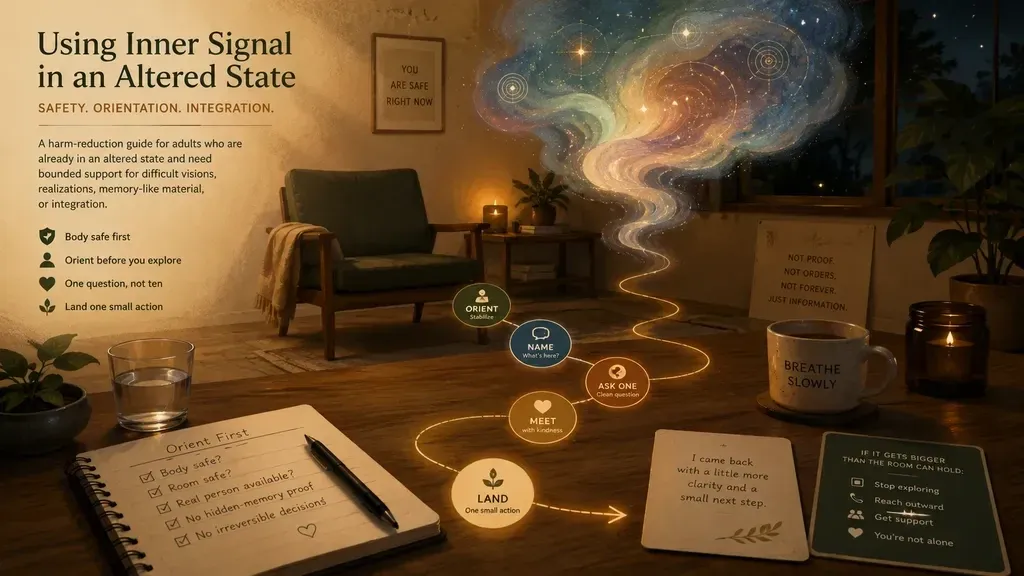
Altered-state use, not altered-state promotion
Inner Signal does not require an altered state. But if you are already in one, and you are medically safe and oriented enough to use a screen, the app can help you stay smaller, safer, and more honest with difficult material.
First question: is this safe enough for an app?
Inner Signal can only be useful if the body and room are safe enough. It cannot assess you medically, monitor your vital signs, identify a drug interaction, or protect you from danger in the room. If there is any reasonable doubt, involve a sober person, a clinician, poison control, emergency services, or a crisis line before using the app.
| If this is happening | Use Inner Signal? | Better next step |
|---|---|---|
| Chest pain, real trouble breathing, fainting, seizure, severe overheating, collapse, dangerous confusion, serious injury, uncontrollable shaking, constant vomiting, or possible poisoning / drug interaction. | No. | Use emergency medical help or poison control. Do not turn physical danger into inner work. |
| You may hurt yourself or someone else, have a plan, cannot stay safe, or feel pulled toward dangerous action. | No. | Use live crisis support, emergency services, or a trusted person physically nearby. The chat is not the safety plan. |
| The room feels unsafe: hostile people, wrong lighting/sound, no privacy, temperature problems, unwanted touch, phone/social chaos, or no bathroom access. | Not yet. | Fix the room first. Lower stimulation. Remove unnecessary people. Get a sitter or trusted person if needed. |
| You are medically okay, know where you are, can read/respond coherently, can stop, and are not trying to use the app as your only support. | Possibly. | Use the app in a stabilizing, non-coercive way: no forced memory, no big decisions, one signal, one small action. |
If you are medically okay but something difficult is happening
Altered states can bring up visions, grief, shame, old fear, memory-like scenes, spiritual realizations, hostile presences, body sensations, and sudden “I understand my whole life now” moments. Inner Signal is useful here only if it helps you relate to the material without forcing, inflating, obeying, or treating it as proof.
Difficult visions
The app can help you ask, “What is needed now?” instead of fighting the image, worshiping it, or trying to decode everything while you are still open.
Hard realizations
The app can help you preserve the truth without turning a temporary state into an irreversible command.
Memory-like or trauma material
The app can help you care for present distress while refusing to treat images, dreams, sensations, or certainty as proof of what happened.
How to use it during a difficult altered state
Do not begin by asking for a deeper trance. Start with the smallest stabilizing route. The right mode is often no-trance inner-child reparenting, protector-first dialogue, or a very short integration prompt.
- Orient first. Name the room, the date, your body position, and one ordinary object. If you cannot do that, do not continue inward.
- Name the category. Is this body danger, room danger, emotional material, memory-like material, a protector, a vision, an inner directive, or too much openness?
- Meet the guard first. If something says “this is fake,” “don’t trust this,” “I’m scared,” or “get me out,” treat that as data. Do not push past it.
- Ask only one clean question. Try: “What needs care right now?” or “What would make this one inch safer?”
- Do not prove the past. If a scene, dream, body sensation, or image appears, hold it as inner material. Work with the feeling and known facts, not recovered-memory certainty.
- Do not obey the command. If the state says to quit, confess, confront, give everything away, end a relationship, start a relationship, or make a huge move, write it down and wait until ordinary baseline returns.
- Land one small action. The action should be simple enough to do today: drink water, text one safe person, write one sentence, go outside for five minutes, eat, sleep, or set a boundary tomorrow.
What to ask Inner Signal when visions are frightening
Some altered states create hostile, demonic, alien, or “not me” imagery. Inner Signal should not debate the metaphysics of that in the middle of the state. It should help you stabilize, keep your body boundary, and relate from adult presence rather than panic or bravado.
Safer prompts
- “Help me come back to the room before interpreting this.”
- “Help me set a firm body boundary without fighting.”
- “If this is a protector wearing a scary face, what might it be protecting?”
- “What is the smallest loving stance I can reach without pretending?”
Avoid prompts like
- “Take me deeper into it.”
- “Tell me if it is objectively real.”
- “Teach me how to fight or banish it.”
- “What hidden trauma does this prove?”
When a realization feels holy, urgent, or absolutely true
Altered states can produce insights that are real and important. They can also produce intensity, inflation, magical thinking, and premature certainty. Inner Signal’s job is not to flatten the experience. Its job is to help the adult self stay in the council.
If it is true, it can survive sleep, food, time, humility, and one grounded conversation with someone who knows you.
A good use of the app is: “Help me write down the signal without acting on it yet.” A bad use is: “Confirm that I must do this irreversible thing right now.”
When memory-like material or trauma material appears
If the state brings up a childhood scene, a body flash, a dreamlike image, a sense of “something happened,” or a named person, slow down. Inner Signal should not confirm that the image is a recovered memory, identify a perpetrator, or lead you into more suggestive digging.
Better questions are:
- What do I know for sure?
- What am I feeling now?
- What boundary, distance, grief, or support would help whether or not I ever know more?
- Is this too much to hold alone?
- Would this be better brought to a qualified trauma-informed clinician rather than explored further tonight?
Stable altered state: maximizing the therapeutic benefit without chasing intensity
There is a second, different use case. Sometimes a person is already altered but calm, oriented, coherent, and emotionally open. They are not panicking. They are not medically unsafe. They are not trying to prove a memory or obey a command. They simply have more access to compassion, imagery, body signal, or inner dialogue than usual.
In that case, Inner Signal can help preserve the benefit by making the opening specific, bounded, and livable.
| Instead of | Ask for | Why |
|---|---|---|
| “Make this state stronger.” | “Help me notice what is already here without chasing it.” | Preserves receptivity without state-chasing. |
| “Show me the root trauma.” | “Help me meet the part that is ready to be met today.” | Protects against forced memory and overwhelm. |
| “Tell me what this means for my whole life.” | “Help me find one phrase, one body signal, and one small action.” | Turns insight into integration instead of grandiosity. |
| “Keep me here forever.” | “Help me anchor a trace I can bring into ordinary life.” | Builds continuity without dependency on the state or app. |
A stable altered-state session template
Use this when you are already open and steady enough to choose. Do not use it if you are panicking, medically unwell, dissociated, unable to orient, under 18, or alone with serious risk.
- Confirm baseline. “I know where I am. My body is safe enough. I can stop. I am not making major decisions tonight.”
- Choose a mode. Prefer no-trance or light accompaniment. Do not stack a new induction on top of a strong chemical or spiritual state.
- Invite only what is stabilizing. “Only what is true, kind, useful, and integratable is welcome right now.”
- Listen briefly. Pause for one to three minutes. A word, image, sensation, emotion, blankness, or “no” is enough.
- Meet the protector. If resistance appears, thank it and ask what would make this safer by one inch.
- Extract one signal. One phrase. One body signal. No theory yet.
- Land one action. Choose one small thing that ordinary-you can actually do within 24 hours.
- Exit cleanly. Eyes open, hands move, feet on floor, room named. Write the signal down. Sleep before big interpretations.
If someone else is sitting with you
A sitter can use Inner Signal more safely than a very altered person staring at a screen. The sitter’s role is not to steer, interpret, diagnose, or hunt for catharsis. It is to keep the person safe, reduce stimulation, read one clean question, and stop if the person becomes overwhelmed.
Good sitter use
- “Do you want the app, silence, or real-world support?”
- “Let’s fix the room first.”
- “One question, then space.”
- “No big decisions tonight.”
Bad sitter use
- Interpreting visions for the person.
- Pressing for hidden trauma.
- Arguing about whether entities are real.
- Using the app instead of medical or crisis help.
After the altered state
Do not rush to turn the experience into identity, diagnosis, accusation, spiritual status, or a life plan. First: sleep, eat, hydrate, walk, clean up the room, and talk to one grounded person. Then ask:
- What was body/environment/dose/state, and what was meaningful inner material?
- What actually changed how I want to behave?
- What needs therapy, medical care, recovery support, apology, rest, or a practical boundary?
- What is one small action I can take before I create a big story?
Quick prompt card
Copy this into a note before any planned altered-state work, or print it for a sitter:
Body safe? Room safe? Real person available? No hidden-memory proof. No irreversible decisions. One phrase, one body signal, one small action. If it gets bigger than the room can hold, stop and reach outward.
Evidence and harm-reduction note
This page follows a harm-reduction stance: safe setting first, sitting rather than steering, support rather than interpretation, and live medical/crisis help when the situation is beyond peer or app support.
- Zendo Project / MAPS. Four Principles of Psychedelic Harm Reduction.
- Fireside Project. Psychedelic Support Line.
- America’s Poison Centers. Poison Help: 1-800-222-1222.
- 988 Suicide & Crisis Lifeline.
- World Health Organization. Ethics and governance of artificial intelligence for health.
How this page uses the evidence: Inner Signal should remain a bounded self-practice and integration tool. It may support meaning-making when a person is already safe and oriented, but it should route away from app use when medical danger, crisis risk, derealization, severe destabilization, minors, dependency, or forced-memory risk appears.
Use the app to land the state, not chase it.
When you are stable enough, Inner Signal can help turn difficult or beautiful inner material into one grounded next step.