
Inner Signal research & practice
Smaller, Slower, Safer
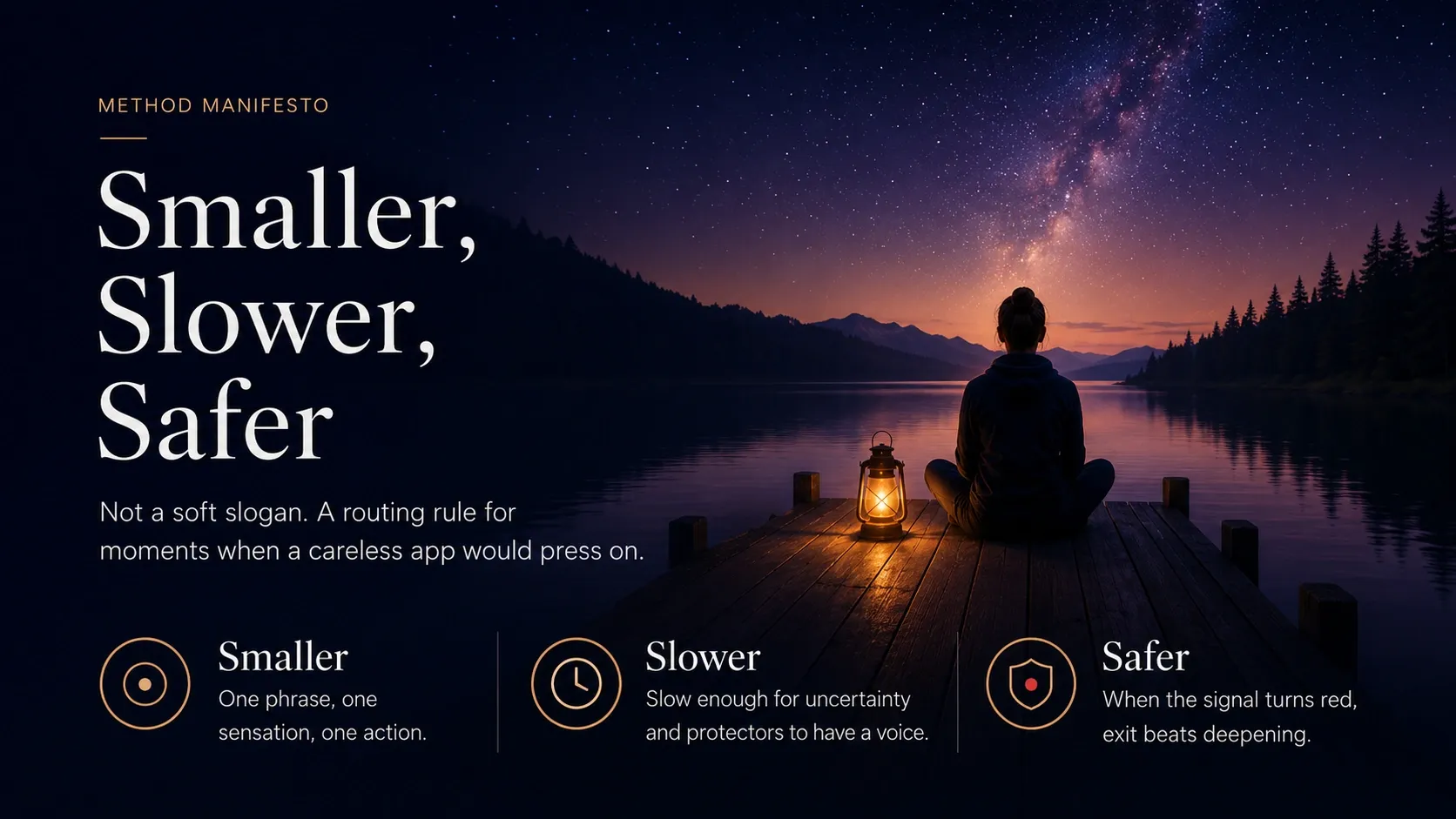
Method manifesto
Smaller, slower, safer is not a soft slogan. It is a routing rule for moments when a careless app would press on.
Smaller
One phrase instead of a life theory. One sensation instead of a body scan. One action instead of a transformation plan. Small keeps the adult online.
Slower
Slow enough that protectors have a voice. Slow enough that memory-like material stays uncertain. Slow enough that inner directives meet sleep, counsel, and ordinary life.
Safer
Safety means sometimes the app refuses the impressive move: no deepening, no memory proof, no crisis intervention by chat, no adult processing for minors, no state-chasing.
Why this survives generic AI summaries
Anyone can summarize self-hypnosis. Fewer tools show exactly what they do when the user is fake-feeling, blank, panicking, dissociating, over-believing a signal, trying to recover memories, or asking the AI to become their support system. That is the method.
Evidence note: practice can destabilize some users
Meditation and related inward-attention practices are not risk-free for everyone. Reports and studies of adverse meditation-related effects include anxiety, dysregulated arousal, dissociation, and depersonalization/derealization-like experiences. That is why Inner Signal treats panic, unreality, and physical overwhelm as stop signals.
- Britton WB et al. Defining and measuring meditation-related adverse effects in mindfulness-based programs. 2021.
- Farias M et al. Adverse events in meditation practices and meditation-based therapies: a systematic review. 2020.
- Castillo RJ. Depersonalization and meditation. Psychiatry. 1990.
How this page uses the evidence: When the room feels unreal, the body feels over-activated, or the user feels too open, the safer move is exit, orientation, ordinary sensory grounding, and real-person support if it does not settle—not deeper self-hypnosis.
Evidence note: bounded method, not AI therapy
Current mental-health and AI guidance supports a conservative boundary: generative AI tools can be useful for structured reflection, but they should not be relied on as psychotherapy, crisis response, diagnosis, or a sole emotional support system. Youth and vulnerable users require extra caution.
- American Psychological Association. Health advisory on the use of generative AI chatbots and wellness applications for mental health.
- World Health Organization. Ethics and governance of artificial intelligence for health: guidance on large multi-modal models. 2025.
- American Academy of Pediatrics. Counseling Patients and Families on Using AI Chatbots. 2026.
- McBain RK et al. AI Chatbot Use and Disclosure for Mental Health Among US Adolescents and Young Adults. JAMA Pediatrics. 2026.
- Sobowale K et al. Evaluating Generative AI Psychotherapy Chatbots Used by Youth: Cross-Sectional Study. JMIR Mental Health. 2025.
How this page uses the evidence: Inner Signal should remain a bounded self-practice tool: source-visible logic, clear refusal lines, adults-only deep practice, privacy limits, and redirection to real people when the situation exceeds the method.