
Inner Signal research & practice
Panic, Dissociation, and Going Too Deep
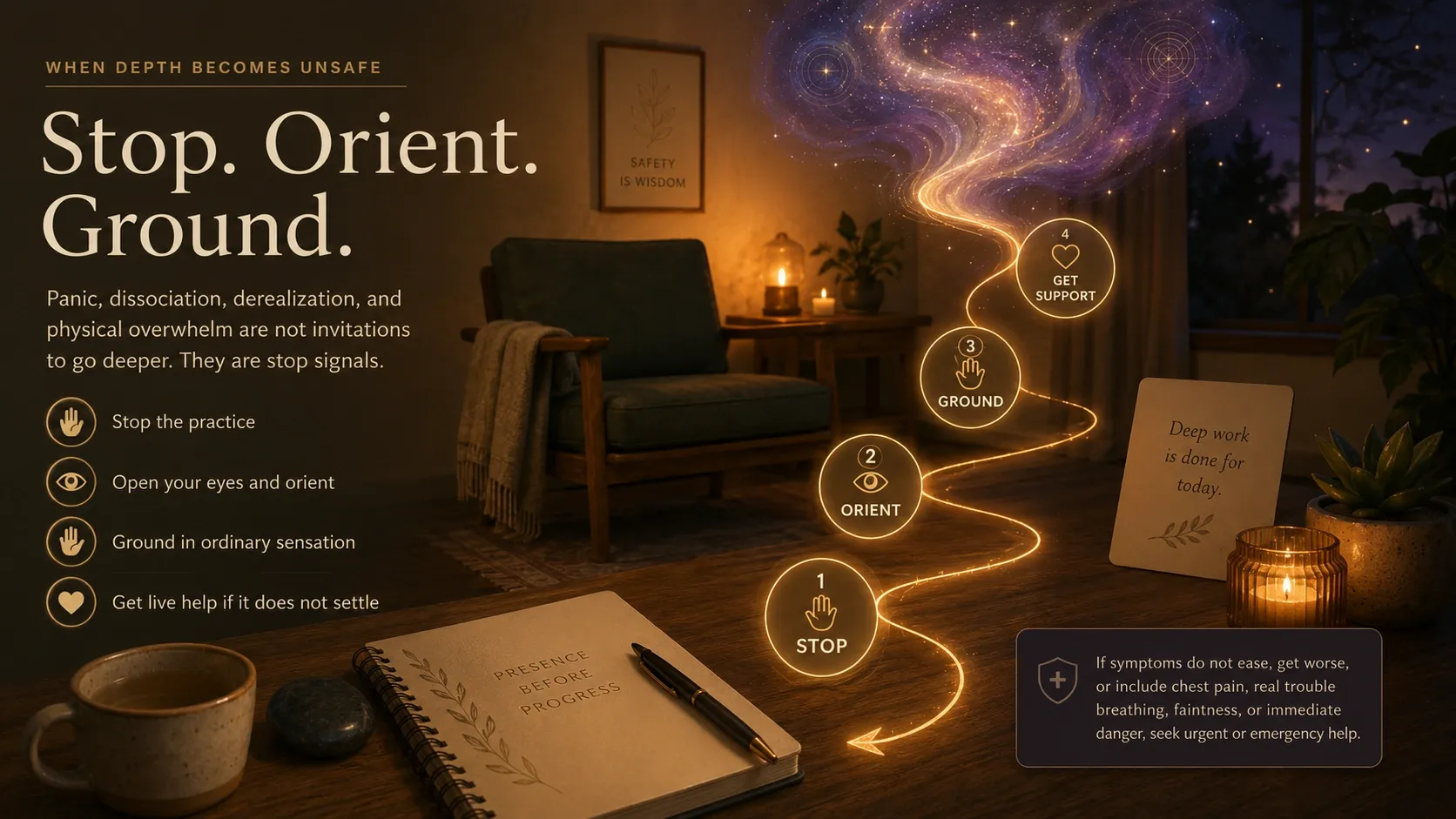
When depth becomes unsafe
Panic, dissociation, derealization, and physical overwhelm are not invitations to go deeper. They are stop signals.
If the body gets too activated
Stop the practice. Do not restart it. Let the out-breath be slightly longer than the in-breath and place attention on something neutral outside the chest: feet, chair, a sound, a cup, a wall.
If symptoms do not ease, get worse, or include chest pain, real trouble breathing, faintness, or medical concern, use urgent or emergency medical help.
If the room feels unreal
Open the eyes. Move the hands. Press feet into the floor. Touch a textured object. Name five things you see, the date, and where you are. Deep work is done for today.
If you are too open
Do not mine the opening. Let the old sadness or tenderness wait. Grounding does not destroy what is real; it gives it a safer floor.
If a first grounding step fails
Do not stack ten techniques. Use fewer inputs and involve a real person if the state is not settling. The point is not a perfect exercise. The point is not being alone with a state that is too big.
Evidence note: crisis means live support, not more inner work
When someone may be in immediate danger or at risk of self-harm, the safest role for an app is narrow: stop the practice, name the limit, point to live human help, and encourage distance from lethal means. The app should not become the safety plan.
- 988 Suicide & Crisis Lifeline. If you need to talk, the 988 Lifeline is here.
- Suicide Prevention Resource Center. Reduce Access to Means of Suicide.
How this page uses the evidence: Acute self-harm, danger in the room, serious medical symptoms, or inability to stay oriented should route away from self-hypnosis and toward emergency services, crisis lines, or a nearby trusted person.
Evidence note: practice can destabilize some users
Meditation and related inward-attention practices are not risk-free for everyone. Reports and studies of adverse meditation-related effects include anxiety, dysregulated arousal, dissociation, and depersonalization/derealization-like experiences. That is why Inner Signal treats panic, unreality, and physical overwhelm as stop signals.
- Britton WB et al. Defining and measuring meditation-related adverse effects in mindfulness-based programs. 2021.
- Farias M et al. Adverse events in meditation practices and meditation-based therapies: a systematic review. 2020.
- Castillo RJ. Depersonalization and meditation. Psychiatry. 1990.
How this page uses the evidence: When the room feels unreal, the body feels over-activated, or the user feels too open, the safer move is exit, orientation, ordinary sensory grounding, and real-person support if it does not settle—not deeper self-hypnosis.