
Inner Signal research & practice
How to Choose: Guided Self-Hypnosis, No-Trance Reparenting, or Grounding
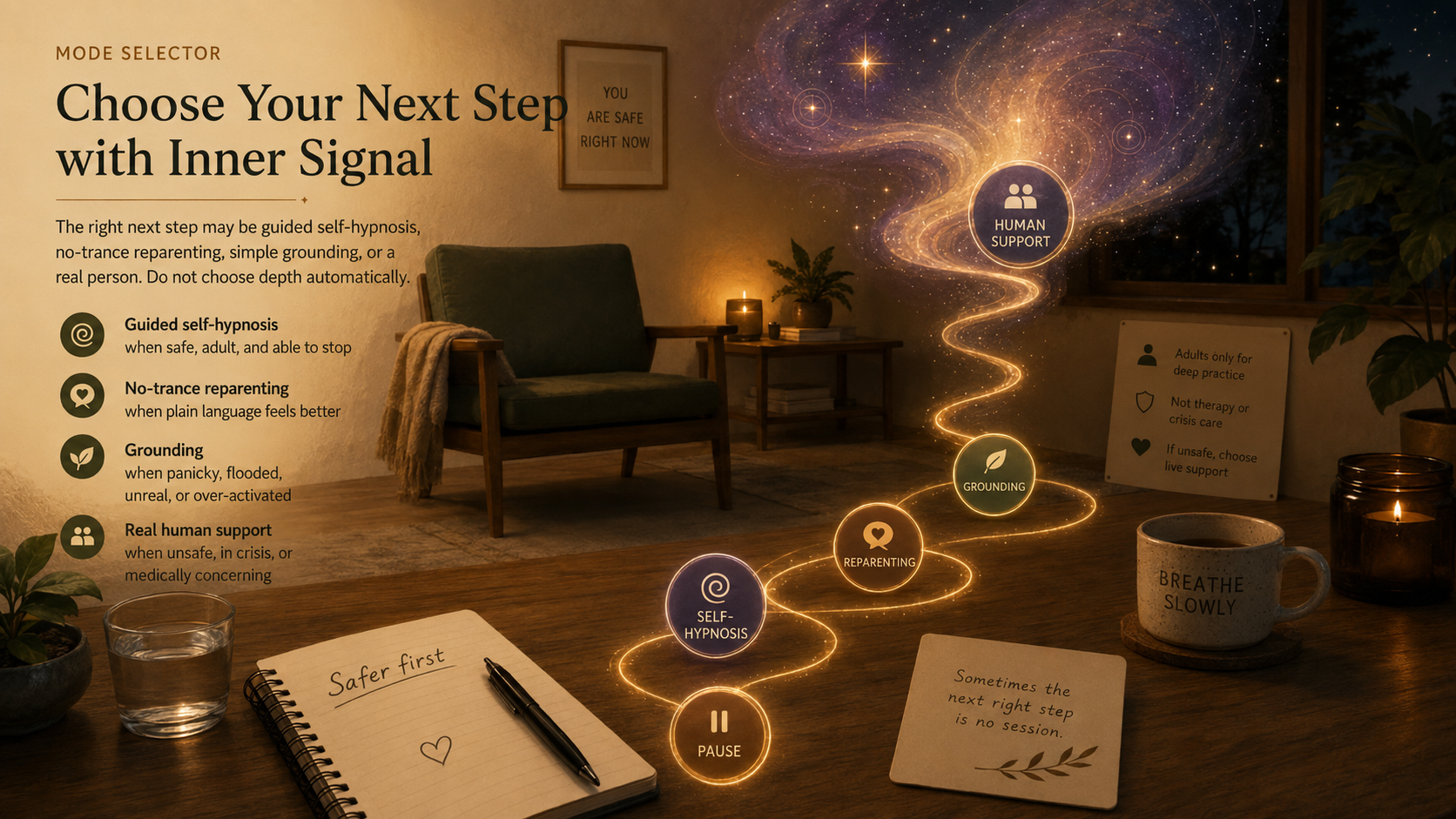
Mode selector
The right next step may be guided self-hypnosis, no-trance reparenting, simple grounding, or a real person. Do not choose depth automatically.
Choose guided self-hypnosis when
- you are 18+
- you are physically safe and not driving
- you can sit upright for a short session
- you want a focused inward container
- you can stop if things become too much
Choose no-trance reparenting when
- trance feels fake, too intense, sleepy, or unnecessary
- a protector is present
- you need plain language more than altered state
- you want to turn toward a younger part without visualizing
Choose grounding when
- you feel unreal, panicky, too open, floaty, or flooded
- you are chasing a good state
- the body is over-activated
- you need ordinary life: food, water, sleep, movement, light, or a person
Choose real human support when
- you are in crisis or unsafe
- danger is outside you
- you have concerning medical symptoms
- you are under 18 and need support
- you need therapy, medical care, domestic violence support, or emergency help
If you are already in an altered state
Do not automatically add trance on top of trance. First ask whether you are medically safe, oriented, able to stop, and using the app for stabilization or integration rather than intensity. If the answer is yes, use a small no-trance or light accompaniment route. If the answer is no, choose grounding, a sitter, crisis support, poison control, or emergency care instead.
Read the altered-state use guide →
Smaller, slower, safer does not always mean a smaller session. Sometimes it means no session.
Evidence note: crisis means live support, not more inner work
When someone may be in immediate danger or at risk of self-harm, the safest role for an app is narrow: stop the practice, name the limit, point to live human help, and encourage distance from lethal means. The app should not become the safety plan.
- 988 Suicide & Crisis Lifeline. If you need to talk, the 988 Lifeline is here.
- Suicide Prevention Resource Center. Reduce Access to Means of Suicide.
How this page uses the evidence: Acute self-harm, danger in the room, serious medical symptoms, or inability to stay oriented should route away from self-hypnosis and toward emergency services, crisis lines, or a nearby trusted person.
Evidence note: practice can destabilize some users
Meditation and related inward-attention practices are not risk-free for everyone. Reports and studies of adverse meditation-related effects include anxiety, dysregulated arousal, dissociation, and depersonalization/derealization-like experiences. That is why Inner Signal treats panic, unreality, and physical overwhelm as stop signals.
- Britton WB et al. Defining and measuring meditation-related adverse effects in mindfulness-based programs. 2021.
- Farias M et al. Adverse events in meditation practices and meditation-based therapies: a systematic review. 2020.
- Castillo RJ. Depersonalization and meditation. Psychiatry. 1990.
How this page uses the evidence: When the room feels unreal, the body feels over-activated, or the user feels too open, the safer move is exit, orientation, ordinary sensory grounding, and real-person support if it does not settle—not deeper self-hypnosis.
Evidence note: bounded method, not AI therapy
Current mental-health and AI guidance supports a conservative boundary: generative AI tools can be useful for structured reflection, but they should not be relied on as psychotherapy, crisis response, diagnosis, or a sole emotional support system. Youth and vulnerable users require extra caution.
- American Psychological Association. Health advisory on the use of generative AI chatbots and wellness applications for mental health.
- World Health Organization. Ethics and governance of artificial intelligence for health: guidance on large multi-modal models. 2025.
- American Academy of Pediatrics. Counseling Patients and Families on Using AI Chatbots. 2026.
- McBain RK et al. AI Chatbot Use and Disclosure for Mental Health Among US Adolescents and Young Adults. JAMA Pediatrics. 2026.
- Sobowale K et al. Evaluating Generative AI Psychotherapy Chatbots Used by Youth: Cross-Sectional Study. JMIR Mental Health. 2025.
How this page uses the evidence: Inner Signal should remain a bounded self-practice tool: source-visible logic, clear refusal lines, adults-only deep practice, privacy limits, and redirection to real people when the situation exceeds the method.