
Inner Signal research & practice
What to Do When Nothing Happens in Self-Hypnosis
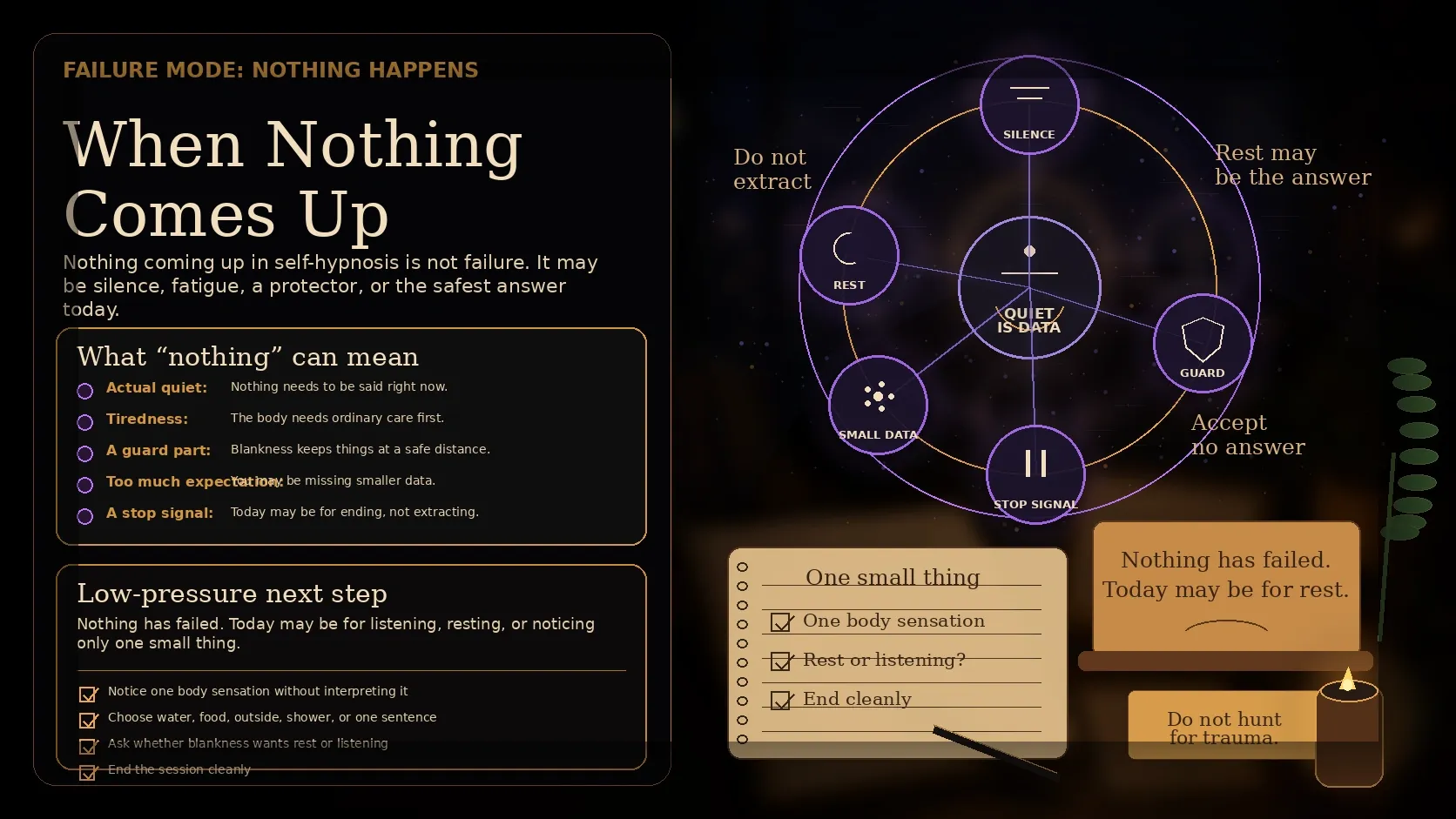
Failure mode: nothing happens
Nothing coming up in self-hypnosis is not failure. It may be silence, fatigue, a protector, or the safest answer today.
The mistake is to turn blankness into a demand: produce an image, produce a feeling, produce a childhood scene, produce proof. That pressure usually makes the system go flatter.
What “nothing” can mean
- Actual quiet: there is nothing that needs to be said right now.
- Tiredness: the body needs food, sleep, movement, or ordinary care more than inner work.
- A guard part: blankness is keeping things at a safe distance.
- Too much expectation: you are waiting for a voice, image, or breakthrough and missing smaller data.
- A stop signal: today may be for ending, not extracting.
A low-pressure next step
Nothing has failed. Today may be for listening, resting, or noticing only one small thing.
Choose just one:
- notice one body sensation without interpreting it
- choose one ordinary action: water, food, outside, shower, one sentence
- ask the blankness whether it wants rest or listening
- end the session cleanly
What not to do
Do not keep asking for shapes, colors, timelines, memories, or meanings if the system is already uncertain. Do not treat blankness as a wall to break. Do not go hunting for trauma because nothing obvious came.
When blankness is a protector
Ask gently: “What would happen if you let me feel even one inch more?” Then accept the answer — including no answer. Respect is the intervention.
Evidence note: bounded method, not AI therapy
Current mental-health and AI guidance supports a conservative boundary: generative AI tools can be useful for structured reflection, but they should not be relied on as psychotherapy, crisis response, diagnosis, or a sole emotional support system. Youth and vulnerable users require extra caution.
- American Psychological Association. Health advisory on the use of generative AI chatbots and wellness applications for mental health.
- World Health Organization. Ethics and governance of artificial intelligence for health: guidance on large multi-modal models. 2025.
- American Academy of Pediatrics. Counseling Patients and Families on Using AI Chatbots. 2026.
- McBain RK et al. AI Chatbot Use and Disclosure for Mental Health Among US Adolescents and Young Adults. JAMA Pediatrics. 2026.
- Sobowale K et al. Evaluating Generative AI Psychotherapy Chatbots Used by Youth: Cross-Sectional Study. JMIR Mental Health. 2025.
How this page uses the evidence: Inner Signal should remain a bounded self-practice tool: source-visible logic, clear refusal lines, adults-only deep practice, privacy limits, and redirection to real people when the situation exceeds the method.