
Inner Signal research & practice
Self-Hypnosis Feels Fake? Treat Doubt as Data
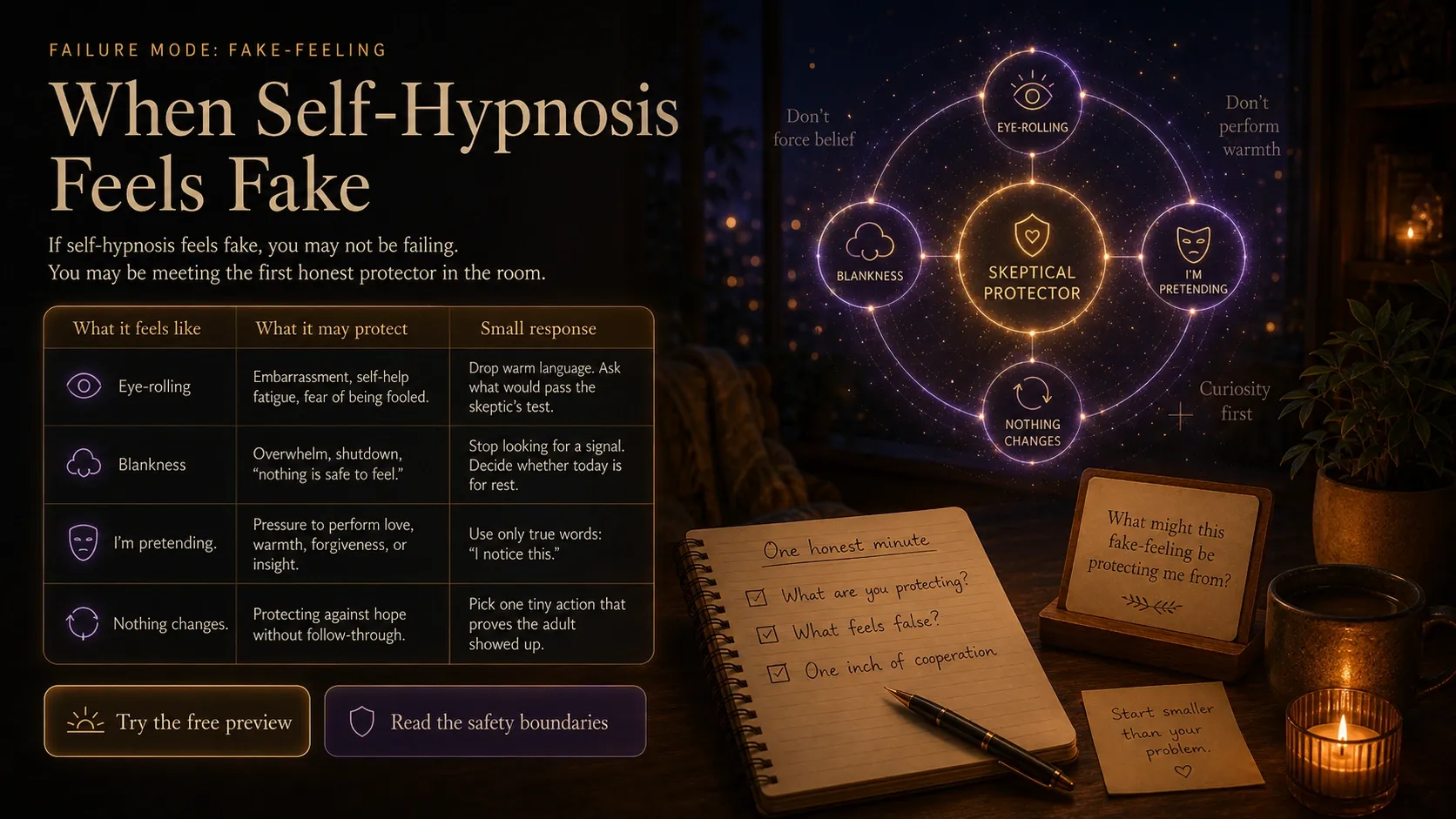
Failure mode: fake-feeling
If self-hypnosis feels fake, you may not be failing. You may be meeting the first honest protector in the room.
“This is stupid.” “I’m just making it up.” “This sounds like a poster in a therapist’s office.” Inner Signal treats those lines as data, not as resistance to crush.
Why fake-feeling matters
A fake-feeling part may be protecting you from embarrassment, disappointment, false hope, emotional performance, spiritual pressure, or the particular pain of trying sincerely and getting nothing back.
That part may have evidence. Maybe journaling did not change the pattern. Maybe gentle language was used around you while nothing real changed. Maybe “healing” became another way to blame you for not feeling better.
The first move is not to believe harder
What might this fake-feeling be protecting me from?
The practice begins by respecting the guard. It does not ask the skeptical part to go away. It asks what would make this worth one honest minute.
Four kinds of fake
| What it feels like | What it may protect | Small response |
|---|---|---|
| Eye-rolling | Embarrassment, self-help fatigue, fear of being fooled. | Drop warm language. Ask what would pass the skeptic’s test. |
| Blankness | Overwhelm, shutdown, “nothing is safe to feel.” | Stop looking for a signal. Decide whether today is for rest. |
| “I’m pretending.” | Pressure to perform love, warmth, forgiveness, or insight. | Use only true words: “I notice this.” |
| “Nothing changes.” | Protecting against hope without follow-through. | Pick one tiny action that proves the adult showed up. |
A no-performance script
I am not asking you to believe this. I am not asking you to feel warm. I am asking what you are protecting, and what one inch of honest cooperation would look like.
When to stop
If the fake-feeling turns into pressure, frustration, dissociation, panic, or compulsive proof-seeking, stop. Fake-feeling is workable only when there is enough steadiness to stay curious.
Evidence note: bounded method, not AI therapy
Current mental-health and AI guidance supports a conservative boundary: generative AI tools can be useful for structured reflection, but they should not be relied on as psychotherapy, crisis response, diagnosis, or a sole emotional support system. Youth and vulnerable users require extra caution.
- American Psychological Association. Health advisory on the use of generative AI chatbots and wellness applications for mental health.
- World Health Organization. Ethics and governance of artificial intelligence for health: guidance on large multi-modal models. 2025.
- American Academy of Pediatrics. Counseling Patients and Families on Using AI Chatbots. 2026.
- McBain RK et al. AI Chatbot Use and Disclosure for Mental Health Among US Adolescents and Young Adults. JAMA Pediatrics. 2026.
- Sobowale K et al. Evaluating Generative AI Psychotherapy Chatbots Used by Youth: Cross-Sectional Study. JMIR Mental Health. 2025.
How this page uses the evidence: Inner Signal should remain a bounded self-practice tool: source-visible logic, clear refusal lines, adults-only deep practice, privacy limits, and redirection to real people when the situation exceeds the method.
Start smaller than your problem.
Try the preview when you are stable enough for gentle self-practice. Use one phrase, one body signal, and one small action. No breakthrough required.