
Inner Signal research & practice
Self-Hypnosis vs Meditation: What’s Actually Different?
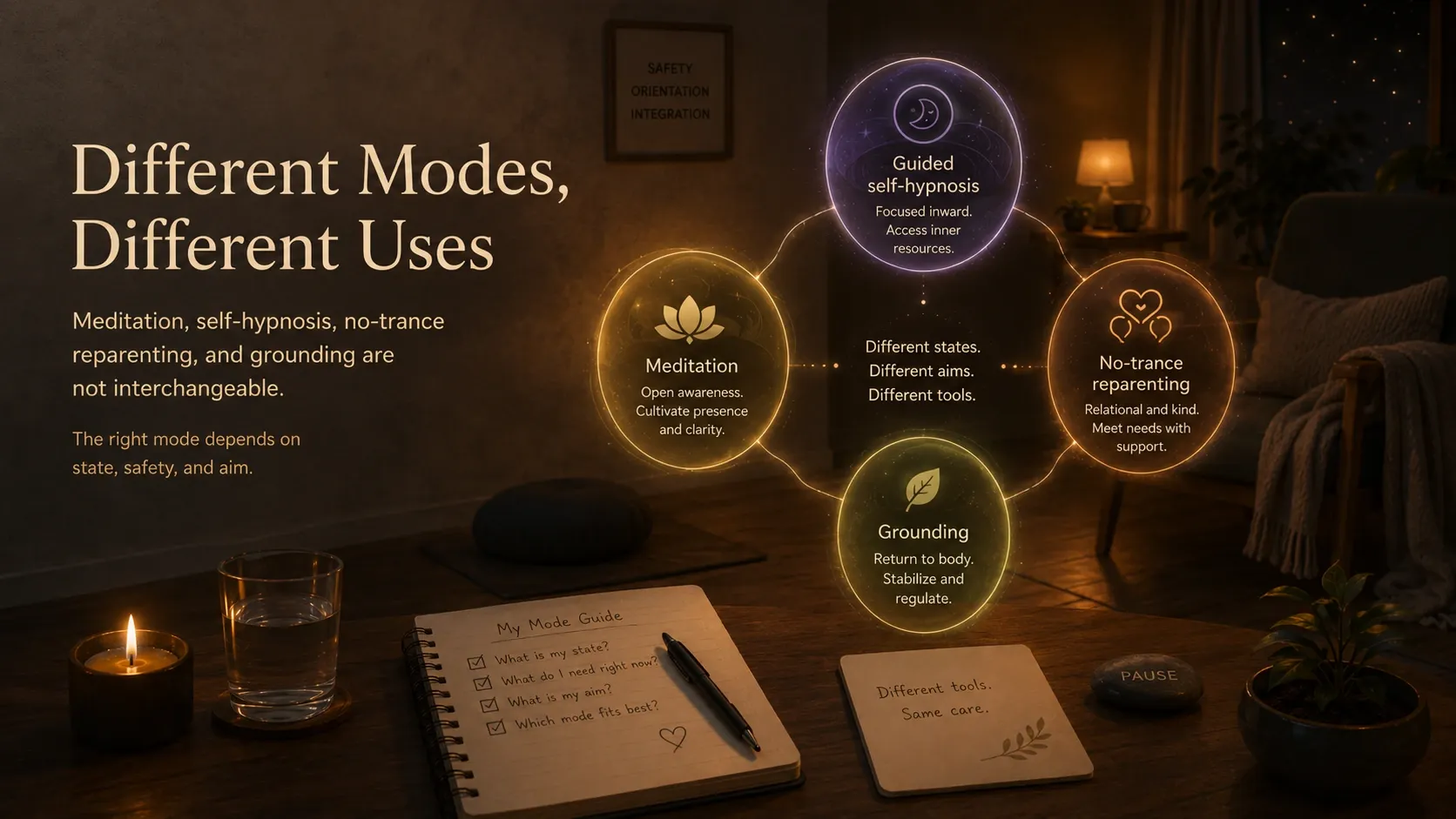
Mode choice
Self-hypnosis, meditation, no-trance reparenting, and grounding are not interchangeable. The right mode depends on state, safety, and aim.
| Mode | Best for | Not for |
|---|---|---|
| Meditation | Noticing experience, awareness, non-reactivity, ordinary presence. | Forcing inner-child dialogue or proving memories. |
| Guided self-hypnosis | Focused inward listening with a clear beginning and exit. | Driving, crisis, dissociation, medical overwhelm, memory recovery. |
| No-trance reparenting | Plain dialogue with younger parts and protectors. | Acute danger or states needing real-world help. |
| Grounding | Returning to room, body, ordinary reality, and safety. | Interpreting inner material or opening more content. |
The simplest rule
If inwardness makes you more present, it may be useful. If inwardness makes you less real, less safe, or less connected to life, ground or reach outward.
Why Inner Signal includes two modes
Some days benefit from a focused hypnotic container. Other days need ordinary language and no state shift. The no-trance mode is not a lesser version; it is the safer fit when trance would be too much, too fake, or too floaty.
Evidence note: practice can destabilize some users
Meditation and related inward-attention practices are not risk-free for everyone. Reports and studies of adverse meditation-related effects include anxiety, dysregulated arousal, dissociation, and depersonalization/derealization-like experiences. That is why Inner Signal treats panic, unreality, and physical overwhelm as stop signals.
- Britton WB et al. Defining and measuring meditation-related adverse effects in mindfulness-based programs. 2021.
- Farias M et al. Adverse events in meditation practices and meditation-based therapies: a systematic review. 2020.
- Castillo RJ. Depersonalization and meditation. Psychiatry. 1990.
How this page uses the evidence: When the room feels unreal, the body feels over-activated, or the user feels too open, the safer move is exit, orientation, ordinary sensory grounding, and real-person support if it does not settle—not deeper self-hypnosis.