
Inner Signal research & practice
Protector First: Why Resistance Is Not Failure
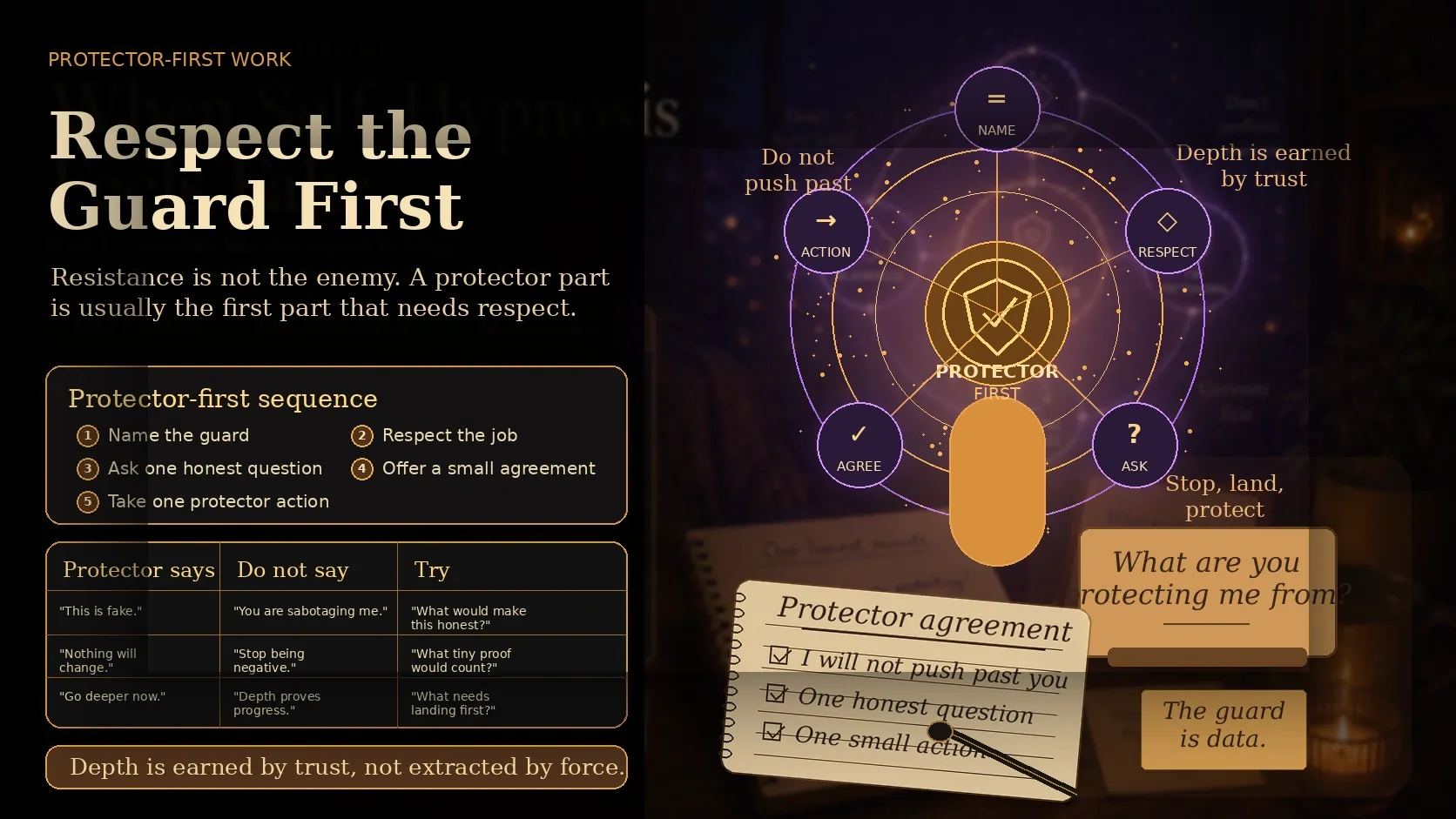
Protector-first work
Resistance is not the enemy. In Inner Signal, a protector part is usually the first part that needs respect.
A protector part can appear as skepticism, numbness, irritation, distraction, analysis, fantasy, fatigue, over-control, or a blunt “no.” If you push past it to reach the inner child, the system learns that the adult is still not trustworthy.
What protectors protect
- the younger part from hoping and being disappointed
- the body from flooding or dissociation
- the adult from embarrassment, gullibility, or spiritual bypass
- the relationship system from needing more than others can give
- ordinary life from being overturned by an inner directive
The protector-first sequence
- Name the guard. “Something in me is skeptical / blank / braced / irritated.”
- Respect the job. Assume it is protecting something, even if the strategy is costly.
- Ask one honest question. “What are you protecting me from?” or “What would help you trust one inch more?”
- Offer a small agreement. “You do not have to stand down. I will not push past you.”
- Take one Protector action. Stop, drink water, write one sentence, set a boundary, or choose not to go deeper.
Examples
| Protector says | Do not say | Try |
|---|---|---|
| “This is fake.” | “You’re sabotaging me.” | “What would make this honest instead of performative?” |
| “Nothing will change.” | “Stop being negative.” | “What real-world proof would count, even a tiny one?” |
| “Go deeper now.” | “Depth proves progress.” | “What needs landing before more depth?” |
| “Obey this vision.” | “The vision must be right.” | “What survives sleep, humility, and real-world counsel?” |
Protector work is not avoidance
Meeting the guard does not mean never going deeper. It means depth is earned by trust, not extracted by force. The guard is often waiting for proof that the adult can stop, land, and protect in ordinary life.
Evidence note: bounded method, not AI therapy
Current mental-health and AI guidance supports a conservative boundary: generative AI tools can be useful for structured reflection, but they should not be relied on as psychotherapy, crisis response, diagnosis, or a sole emotional support system. Youth and vulnerable users require extra caution.
- American Psychological Association. Health advisory on the use of generative AI chatbots and wellness applications for mental health.
- World Health Organization. Ethics and governance of artificial intelligence for health: guidance on large multi-modal models. 2025.
- American Academy of Pediatrics. Counseling Patients and Families on Using AI Chatbots. 2026.
- McBain RK et al. AI Chatbot Use and Disclosure for Mental Health Among US Adolescents and Young Adults. JAMA Pediatrics. 2026.
- Sobowale K et al. Evaluating Generative AI Psychotherapy Chatbots Used by Youth: Cross-Sectional Study. JMIR Mental Health. 2025.
How this page uses the evidence: Inner Signal should remain a bounded self-practice tool: source-visible logic, clear refusal lines, adults-only deep practice, privacy limits, and redirection to real people when the situation exceeds the method.