
Inner Signal research & practice
No-Trance Inner-Child Reparenting for Skeptics
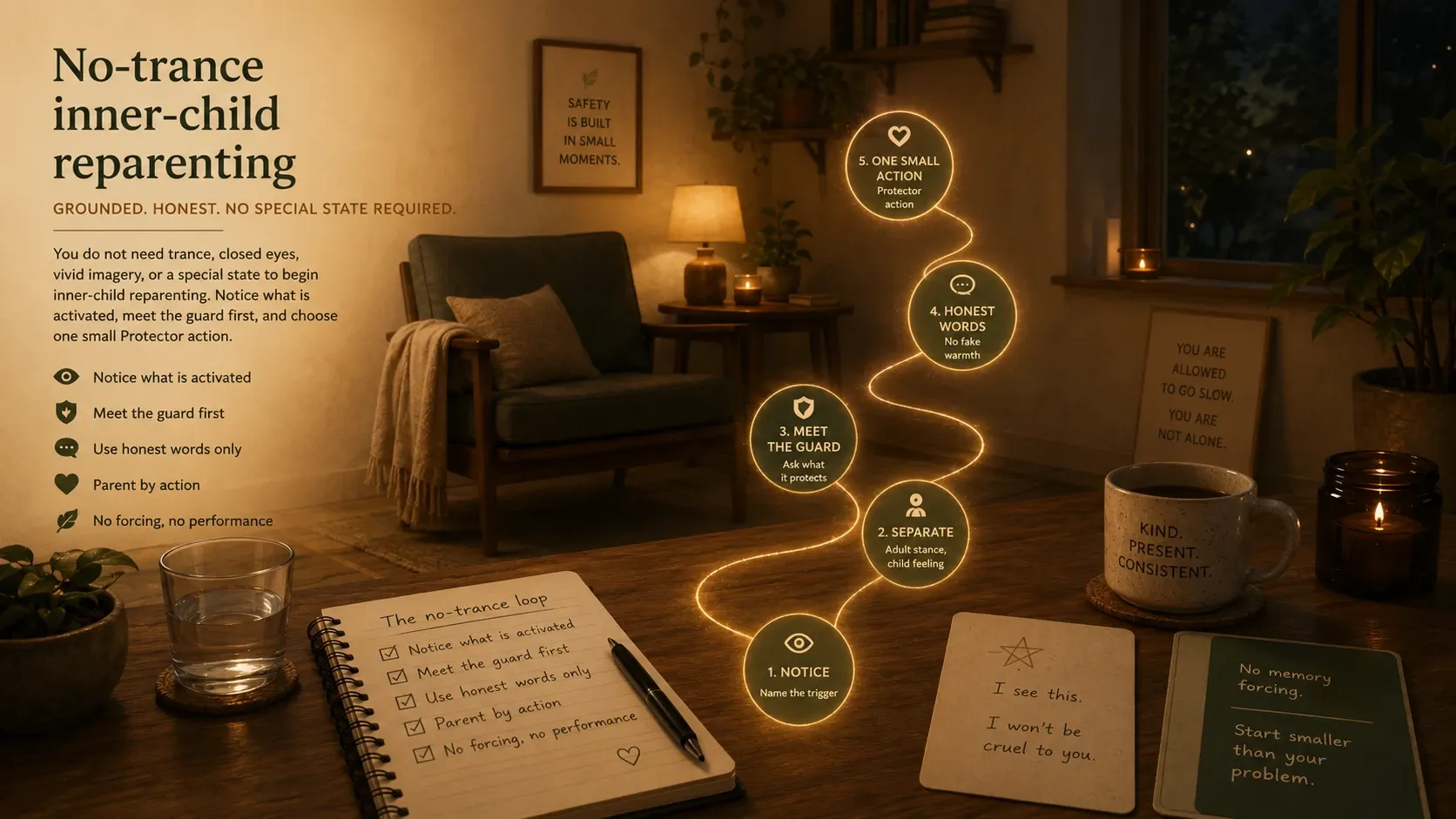
No-trance inner-child reparenting
You do not need trance, closed eyes, vivid imagery, or a special state to begin inner-child reparenting.
No-trance mode is for days when induction would be too much, too sleepy, too performative, or simply unnecessary. The method stays in ordinary language: notice what is activated, turn toward the younger part, meet the guard first, and choose one small Protector action.
The no-trance loop
- Notice the trigger. “Something in me just got young, scared, ashamed, or braced.”
- Separate stance from feeling. You may still feel the child’s pain, but the adult begins to turn toward it.
- Meet the guard. If weirdness, skepticism, or numbness appears, ask what it protects.
- Use honest words only. “I see this.” “I won’t be cruel to you.” “I don’t know what to do yet, but I’m here.”
- Parent by action. A glass of water, a pause before replying, a text to a real person, or stopping is parenting.
What not to force
- Do not force warmth.
- Do not force a child image.
- Do not force a memory.
- Do not force forgiveness.
- Do not force tears or catharsis.
When no-trance is the safer mode
Use no-trance when you are tired, skeptical, prone to dissociation, working with a protector, easily pulled into fantasy, or simply wanting grounded inner dialogue. Use grounding or real support instead when you are overwhelmed, unsafe, medically concerned, or in crisis.
The goal is not to become the child. The goal is to become the adult who can turn toward the child.
Evidence note: bounded method, not AI therapy
Current mental-health and AI guidance supports a conservative boundary: generative AI tools can be useful for structured reflection, but they should not be relied on as psychotherapy, crisis response, diagnosis, or a sole emotional support system. Youth and vulnerable users require extra caution.
- American Psychological Association. Health advisory on the use of generative AI chatbots and wellness applications for mental health.
- World Health Organization. Ethics and governance of artificial intelligence for health: guidance on large multi-modal models. 2025.
- American Academy of Pediatrics. Counseling Patients and Families on Using AI Chatbots. 2026.
- McBain RK et al. AI Chatbot Use and Disclosure for Mental Health Among US Adolescents and Young Adults. JAMA Pediatrics. 2026.
- Sobowale K et al. Evaluating Generative AI Psychotherapy Chatbots Used by Youth: Cross-Sectional Study. JMIR Mental Health. 2025.
How this page uses the evidence: Inner Signal should remain a bounded self-practice tool: source-visible logic, clear refusal lines, adults-only deep practice, privacy limits, and redirection to real people when the situation exceeds the method.
Start smaller than your problem.
Try the preview when you are stable enough for gentle self-practice. Use one phrase, one body signal, and one small action. No breakthrough required.