
Inner Signal research & practice
How to End a Self-Hypnosis Session Safely
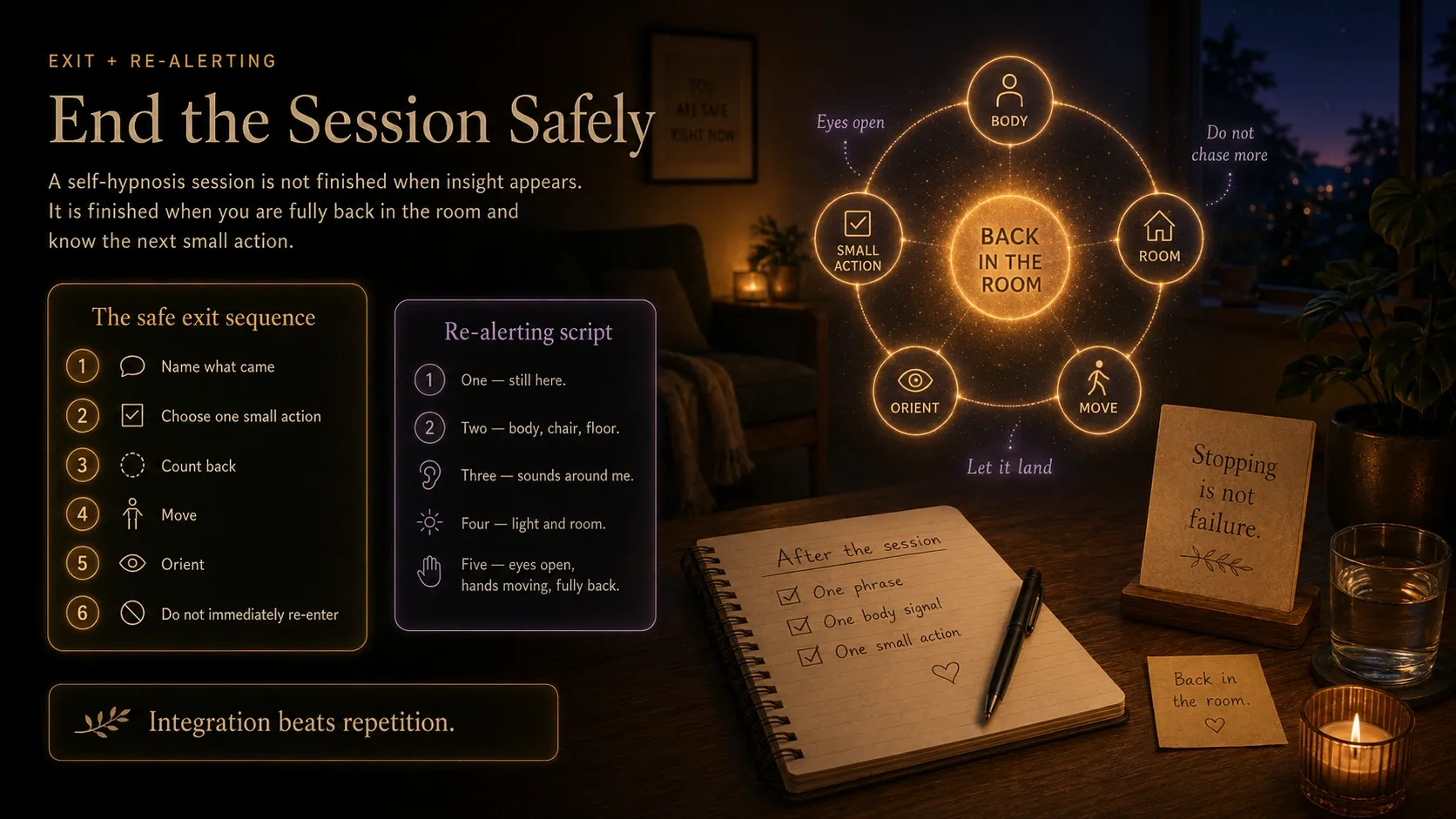
Exit + re-alerting
A self-hypnosis session is not finished when the insight appears. It is finished when you are fully back in the room and know the next small action.
The safe exit sequence
- Name what came. One phrase and one body signal, not a whole theory.
- Choose one small action. Something concrete, doable today, with a clear stop.
- Count back. One to five, not to intensify, but to re-alert.
- Move. Hands, feet, shoulders, eyes, head. Let the body know the session is over.
- Orient. Name the room, the date, and five ordinary objects if needed.
- Do not immediately re-enter. Let the session land before chasing more.
A simple re-alerting script
One — still here. Two — body, chair, floor. Three — sounds around me. Four — light and room. Five — eyes open, hands moving, fully back.
When the exit needs more grounding
If you feel floaty, unreal, too open, or pulled to go deeper, keep your eyes open. Touch something textured. Drink water. Stand up. Do an ordinary task. Text a real person if you are not settling.
Do not use ending as punishment
Stopping is not failure. Sometimes stopping is the Protector finally doing its job. A safe method must let the adult end the session before the system becomes flooded.
Integration beats repetition
After a good session, the temptation is often “let’s do it again.” Inner Signal should usually help you anchor the trace instead: where in tomorrow can five percent of this become ordinary?
Evidence note: practice can destabilize some users
Meditation and related inward-attention practices are not risk-free for everyone. Reports and studies of adverse meditation-related effects include anxiety, dysregulated arousal, dissociation, and depersonalization/derealization-like experiences. That is why Inner Signal treats panic, unreality, and physical overwhelm as stop signals.
- Britton WB et al. Defining and measuring meditation-related adverse effects in mindfulness-based programs. 2021.
- Farias M et al. Adverse events in meditation practices and meditation-based therapies: a systematic review. 2020.
- Castillo RJ. Depersonalization and meditation. Psychiatry. 1990.
How this page uses the evidence: When the room feels unreal, the body feels over-activated, or the user feels too open, the safer move is exit, orientation, ordinary sensory grounding, and real-person support if it does not settle—not deeper self-hypnosis.