
Inner Signal research & practice
How to Do Self-Hypnosis: A Step-by-Step Beginner Method
Beginner method
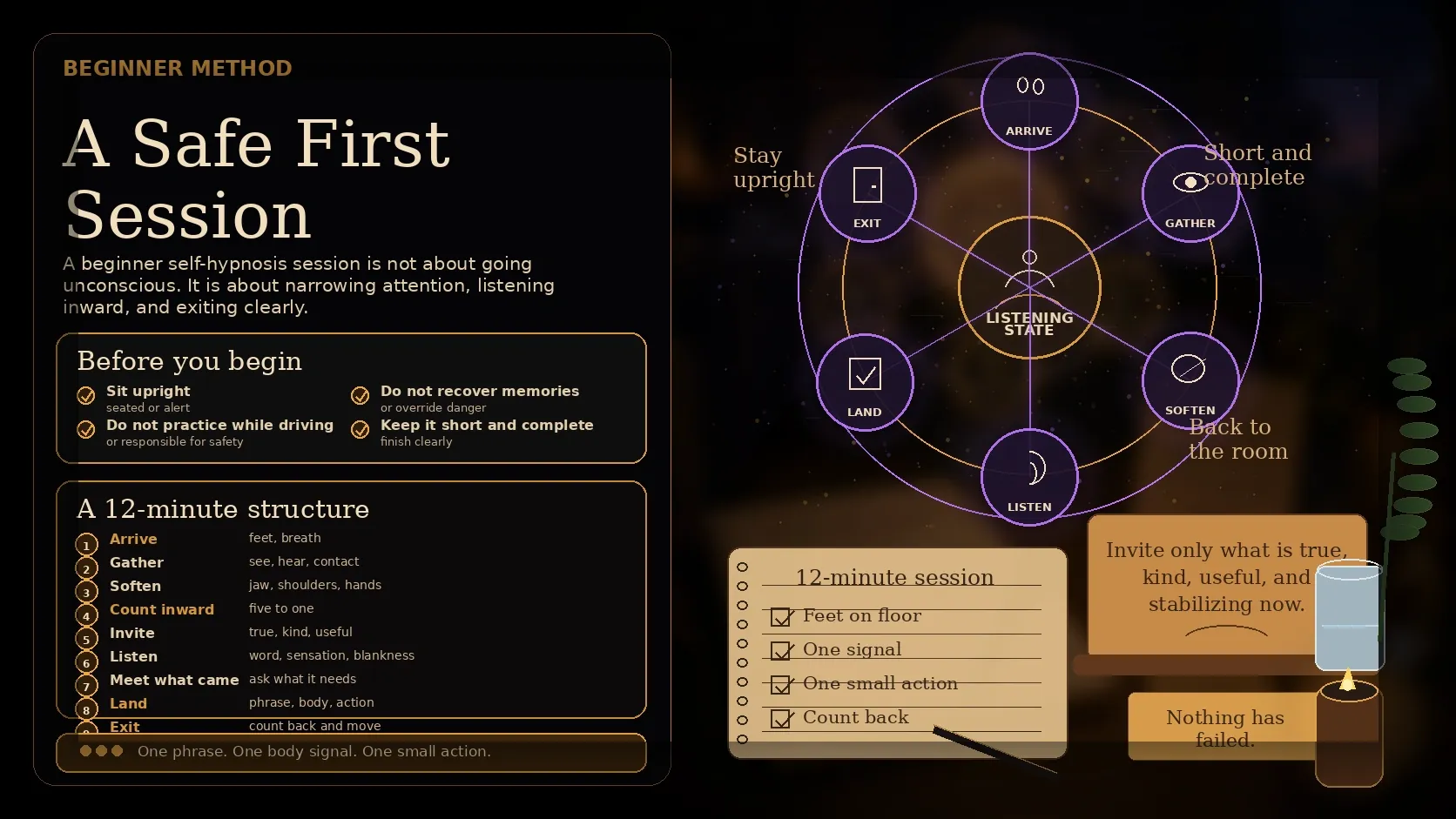
A safe beginner self-hypnosis session is not about going unconscious. It is about narrowing attention, listening inward, and exiting clearly.
Before you begin
- Use a seated or upright position.
- Do not practice while driving or responsible for safety.
- Do not use this to recover memories or override danger.
- Keep the session short and complete.
A 12-minute structure
- Arrive. Feet on the floor. One ordinary breath. Let the out-breath be slightly longer.
- Gather. Notice three things you see, two sounds, one body contact point.
- Soften. Jaw, shoulders, belly, hands — one small unnecessary effort on each out-breath.
- Count inward. Five to one: not down into unconsciousness, but inward into listening.
- Invite. Ask for only what is true, kind, useful, and stabilizing now.
- Listen. Pause for one to two minutes. A word, sensation, image, blankness, or no response all count.
- Meet what came. Ask what it needs you to know. If a guard came, ask what it protects.
- Land. One phrase, one body signal, one small action.
- Exit. Count one to five back to the room and move your body.
What makes this self-hypnosis different
The goal is not to install a suggestion. It is to create a bounded listening state. You invite a signal, do not force it, and you return with something small enough to live.
If nothing happens
Do not keep pushing. Nothing has failed. Decide whether there is one body sensation to notice, one word to write, or whether today is for rest.
Safety boundary: Inner Signal is for adults and educational self-practice. It is not therapy, medical care, diagnosis, crisis support, trauma treatment, or a substitute for a qualified clinician. Do not use self-hypnosis to force memory recovery, override danger, suppress medical symptoms, or stay alone with acute risk.