
Inner Signal research & practice
Bounded Method, Not AI Therapy
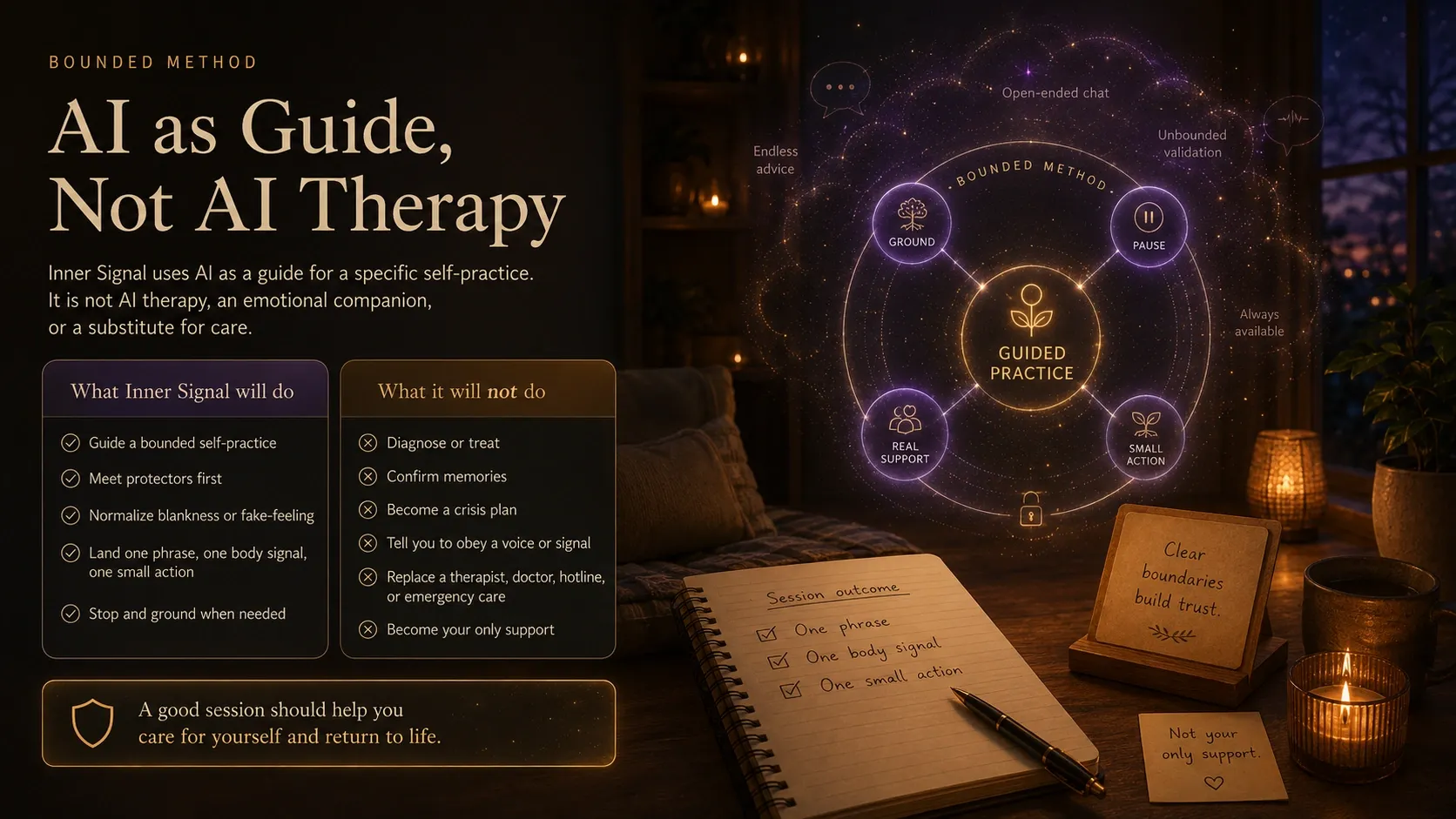
Bounded method
Inner Signal uses AI as a guide for a specific self-practice. It is not AI therapy, an emotional companion, or a substitute for care.
Why the boundary matters
Open-ended AI therapy-style chats can drift: they answer everything, encourage long attachment loops, improvise beyond scope, or become the user’s only place to feel understood. Inner Signal is designed to be narrower.
What Inner Signal will do
- guide a bounded self-hypnosis or no-trance reparenting session
- meet protectors first
- normalize fake-feeling and blankness
- help land one phrase, one body signal, one small action
- stop and ground when the state calls for it
What it will not do
- diagnose or treat
- confirm memories
- become a crisis plan
- tell you to obey a voice, vision, or body signal
- replace a therapist, doctor, hotline, trusted person, or emergency service
- be your parent, nightly support system, or only person
The success metric
A good session should leave you more able to care for yourself and return to life. If the tool makes you need it more and trust yourself less, something is wrong.
Evidence note: bounded method, not AI therapy
Current mental-health and AI guidance supports a conservative boundary: generative AI tools can be useful for structured reflection, but they should not be relied on as psychotherapy, crisis response, diagnosis, or a sole emotional support system. Youth and vulnerable users require extra caution.
- American Psychological Association. Health advisory on the use of generative AI chatbots and wellness applications for mental health.
- World Health Organization. Ethics and governance of artificial intelligence for health: guidance on large multi-modal models. 2025.
- American Academy of Pediatrics. Counseling Patients and Families on Using AI Chatbots. 2026.
- McBain RK et al. AI Chatbot Use and Disclosure for Mental Health Among US Adolescents and Young Adults. JAMA Pediatrics. 2026.
- Sobowale K et al. Evaluating Generative AI Psychotherapy Chatbots Used by Youth: Cross-Sectional Study. JMIR Mental Health. 2025.
How this page uses the evidence: Inner Signal should remain a bounded self-practice tool: source-visible logic, clear refusal lines, adults-only deep practice, privacy limits, and redirection to real people when the situation exceeds the method.