
Inner Signal research & practice
Hearthwork Peer-counseling PAIRS manual
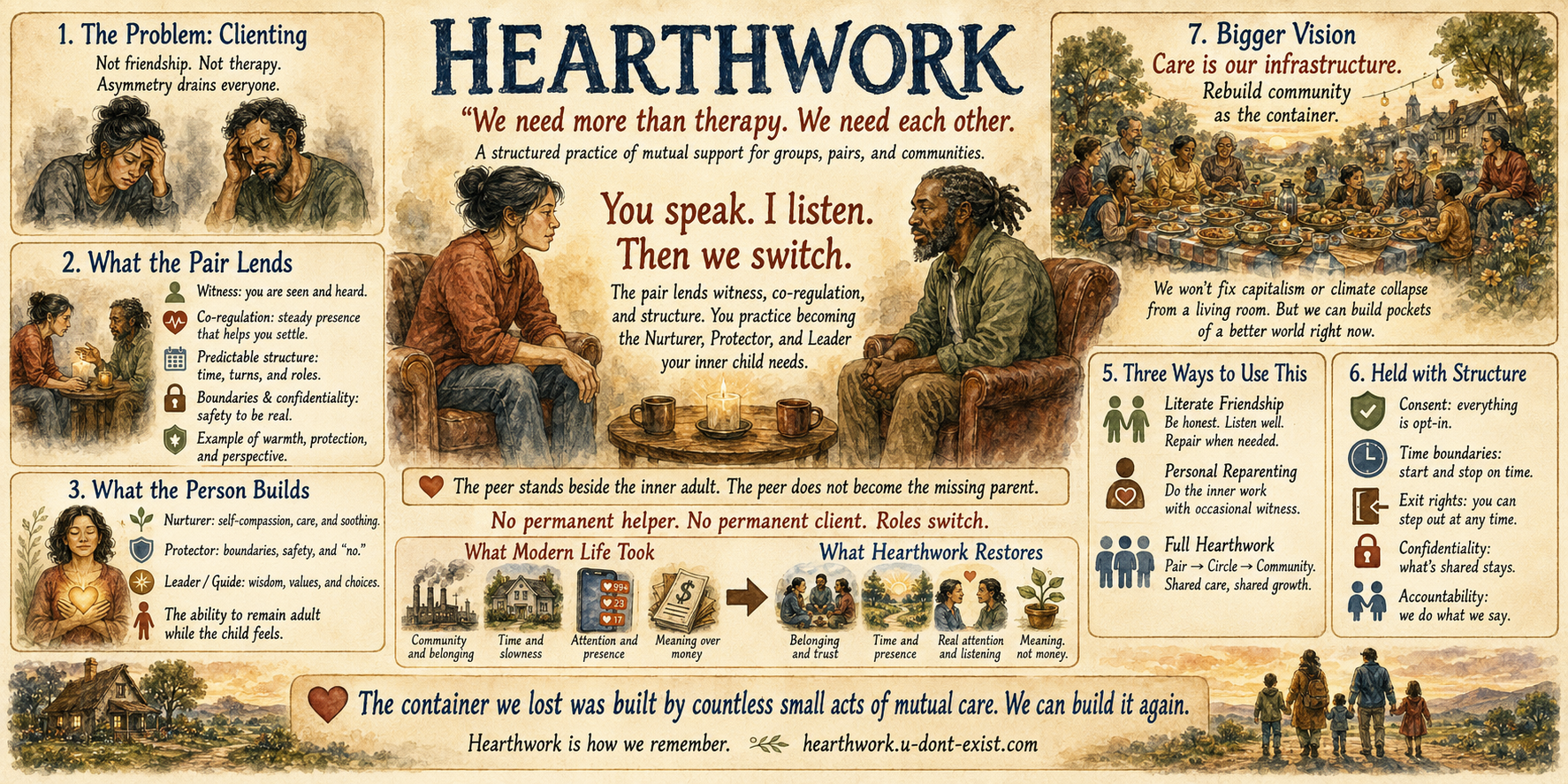
Hearthwork for Pairs
This is the shorter manual for two people practicing together. For the main guide and the manual for groups and communities, return to the Hearthwork guide.
Open the main guide and find the groups/community manualA standalone practice for two people who want to support each other, with or without a wider circle
By Joel and Key, with contributions from others named in the preface
Simplified Approaches To Begin With
Hearthwork can be used lightly, deeply, or somewhere between. Choose the smallest container that does what you need.
Literate friendship. Learn to notice clienting, ask before unloading, schedule hard conversations, and bring in another kind of support when friendship has reached its limit. The Hearthwork article is enough for this level.
Personal reparenting with a witness. Two people meet regularly, give each other equal time, practice attention, and help each other keep the promises made to the inner child. This manual is mainly for that level. You can use the pair without joining a larger group.
Full Hearthwork. Weekly pairs become part of a circle with shared training, rotating roles, conflict practice, and accountability. The longer community manual covers that container.
Reparenting remains the center at every level. A friend can listen and a therapist can help, but the present-day adult still has to learn how to love, protect, and guide the inner child. The pair provides witness, co-regulation, and a real relationship in which that adult capacity can grow.
Contextual Risk vs Benefit Expectations
Hearthwork is a recent synthesis. It draws from Re-evaluation Counseling, inner-child reparenting, Gendlin Focusing, Quaker clearness committees, restorative circles, somatic trauma practice, and several community traditions. Each source contains methods worth keeping and failure modes worth remembering.
Re-evaluation Counseling developed disciplined equal-time listening and discharge, while giving too little guidance for protectors, reparenting, and concentrated authority. Many inner-child traditions understand reparenting but lack a rigorous peer container. Restorative circles address harm between people; they do not repair the relationship inside one person. ZEGG and Tamera learned a great deal about witnessed group process and also show how boundary failures and charismatic authority can damage a community.
Hearthwork grew out of those gaps. Reparenting accompanies discharge because release without a trustworthy inner adult can repeat abandonment. Exit rights and outside accountability matter because healing communities have repeatedly protected their leaders instead of their members. The pair switches roles because permanent helpers and permanent clients eventually distort each other.
No manual can guarantee that a pair will flourish. The result depends on the people, their timing, their honesty, the surrounding culture, and whether they recognize the edge of peer scope. Some pairs will last for years. Some will discover quickly that they should not be paired. The practice has to remain revisable by the people using it.
Hearthwork also treats interpersonal malice described as witchcraft, experiences of entity attachment, and damage from unjust social systems as real sources of suffering. Participants may understand those experiences through different metaphysics. The pair begins by respecting the experience, strengthening the inner adult, and using the person’s own spiritual, cultural, and professional resources where needed.
About this manual
This manual teaches Hearthwork for pairs: equal time, attention without interpretation, advice, or fixing. You speak. I listen. Then we switch. Presence, Warmth, Discipline, Confidentiality.
The name points to the home fire—the place where people return, sit down, and become known across time. Hearthwork rebuilds that kind of mutual care deliberately, between two adults who agree to hold it with discipline.
The manual draws from Re-evaluation Counseling, inner-child reparenting, Gendlin Focusing, somatic trauma practice, and adjacent peer traditions. It keeps only what a pair can responsibly hold without a class or wider circle.
Authorship. The manual is by Joel and Key, with contributions named in the longer version. Key developed much of the identity-formation, self-differentiation, and Leader/Guide/Guru material. Her public self-therapy writing is at keygoddess11.substack.com.
Use this manual when:
- Two people want a regular mutual-support practice.
- An existing friendship needs clearer roles and limits.
- A small group wants its pairs to have a shared method.
- The pair meets by phone or video and can protect privacy.
A pair can hold a great deal. Group conflict, serious accusations, acute crisis, severe dissociation, and material aimed directly at the pair partner may require another person or another kind of support. The manual names those limits where they appear.
Part 1: What Hearthwork is
Hearthwork begins with one agreement: two adults give each other equal time and full attention. One uses the client role while the other takes the counselor role. Then they switch. The roles belong to the session; neither person becomes the other’s permanent patient or helper.
The practice sits beside ordinary friendship and professional therapy. Friendship remains free to be mutual and spontaneous. Therapy keeps its clinical role. Hearthwork creates scheduled reciprocal attention with clear limits, so difficult material has somewhere to go without taking over the friendship.
Why structure matters
Hard conversations between friends often slide into familiar patterns:
- Both people vent and neither receives full attention.
- One person becomes the fixer and the other becomes the problem.
- The conversation drifts away when discomfort rises.
- One person keeps giving until care turns into resentment.
Equal time and temporary roles interrupt those habits. The client does not have to manage the listener. The counselor does not have to solve the client. Both know when the role begins, when it ends, and when their own turn arrives.
The basic structure
Meet for 30, 60, or 90 minutes and divide the time exactly in half. Begin with a short silence. One person uses the first half; the other listens. Switch at halftime. Close on time and return to ordinary life.
The counselor: stays present, warm, and disciplined. They do not interpret, advise, reassure, diagnose, or turn the client’s material into their own story.
The client: decides how to use the time. Talking, silence, tears, laughter, body awareness, journaling, or one clear practical question can all belong.
After the switch, the new client uses their own time. They do not answer the previous half or continue the other person’s story. Each half receives a fresh field.
Why pair work — two structural realities
Two reasons make another person useful.
Solo reparenting can become a closed loop. The inner adult learned from the same family that shaped the wound. Without outside examples, people can repeat the original pattern in kinder language and call it healing. A steady pair partner brings a different nervous system, different family knowledge, different questions, and a lived example of care the person may never have seen at home.
Regulation develops in relationship. Children learn to settle through repeated contact with somebody who can remain present. Adults who missed enough of that often reach a ceiling in solitary practice. A pair partner cannot repair everything, but their calm attention can be borrowed, practiced with, and gradually internalized.
The pair therefore supplies more than accountability. It opens the closed loop and gives the nervous system a relationship in which a new pattern can become believable.
Part 2: Setting up the pair relationship
Choosing a pair partner
The most important question: can we be honest with each other? Pair work depends on it.
Other useful questions:
- Do we have similar enough lives that we can hold each other's material without overwhelm?
- Do we have different enough lives that we won't merge into one perspective?
- Is there a power difference between us (employer/employee, teacher/student, romantic, financial dependence) that would compromise the work?
- Are we similarly committed to keeping this going?
Avoid pairing with:
- A current or recent romantic partner — the dynamics conflict
- Someone you depend on financially, or who depends on you
- A close family member — the family-of-origin material is tangled with the relationship itself
- A therapist or coach you've worked with — the role asymmetry doesn't reset
- Someone you're actively in conflict with — pair counseling isn't conflict mediation
Useful in pairs:
- Friends who are stable and can handle each other's material
- People who met in a class or group setting and want to continue
- Online connections that have been built over time
- Same-gender, mixed-gender, and non-gender-conforming pairings all work; awareness of erotic charge if it arises (see below)
Initial agreements
Before you start, talk through and agree on:
Logistics.
- How often will we meet? (Weekly is the default; bi-weekly or twice-weekly also works)
- For how long each session? (60 minutes total, 30 each, is standard)
- In person or remote? If remote, what platform?
- Who initiates each meeting?
- What happens if one of us cancels? Do we reschedule, skip, or check in?
Container.
- We keep what's said confidential — names, stories, identifying details. We may discuss our own experience of the work, but not the other person's material.
- We don't record sessions. We don't enable AI notetakers if we use video.
- We don't use ChatGPT, Claude, or other AI tools to analyze each other's material with identifying details. (Using AI for our own reflection on our own material is fine.)
- Pair material doesn't enter group chats or other social contexts.
Roles.
- We'll meet for [agreed total time]. We'll start with [name] as client. Halfway through, we switch.
- The counselor doesn't interpret, advise, reassure, or fix. The counselor offers warm attention.
- The client uses the time however they want, including silence.
- We don't continue session material outside session time, unless explicitly agreed in the moment.
Edges.
- Either of us can pause a session if we need to ground.
- Either of us can end a session early if needed.
- Either of us can take a break from the pairing for life reasons (illness, travel, overwhelm) without explanation.
- Either of us can end the pairing entirely with a brief, clear conversation. No lingering obligation.
Re-pairing if needed.
- If romantic or erotic charge develops between us, we stop the pairing. We can decide separately whether to pursue anything personal; the pair container can't hold both.
- If we discover a power difference we didn't see (one of us hires the other for something, becomes their client professionally, etc.), we end the pairing.
- If repeated rupture-and-repair conversations don't resolve and the pair feels unsafe, we end the pairing without further attempts.
These agreements are most powerful when written down — even informally, in a shared note — and revisited every few months.
What you each commit to
The single most important commitment: show up reliably. Pair counseling that's haphazard rarely produces sustained benefit. A 30-minute session every week for a year produces more change than five 3-hour sessions in the same year. Consistency is the active ingredient.
Other commitments worth naming:
- I will not show up to sessions intoxicated or high.
- I will not bring you my crisis on demand. If I'm in crisis, I will tell you, and we'll figure out what's possible — but I do not assume you're on call.
- I will hold my own life. Pair counseling is a piece of how I take care of myself, not the whole of it.
- I will be honest with you about how the pairing is working. If something isn't, I'll say so before it becomes a rupture.
Part 3: How a session goes
Opening
A few seconds to a few minutes of silence to arrive. The silence helps everyone arrive. The body needs a moment to switch from whatever you were doing into the session. If you skip this, the first ten minutes of the session is often spent unconsciously regulating; if you take a minute or two of silence first, the whole session is available.
Then a brief check-in: "I'm here. I'm bringing this." Two or three sentences each. Not the session's content yet — just an arrival.
Decide who's client first if you haven't already. (A regular pattern works well — alternate by session, or one person always starts.)
The client's half
The client speaks, sits, breathes, cries, laughs, gestures, does whatever serves them. The counselor pays attention.
Some clients arrive knowing what they want to use the time for: "I want to work on my anger at my brother." Others don't: "I don't know what's there."
Both are fine. The counselor doesn't push for a topic.
If the client doesn't know where to start, the counselor can offer a menu — not a direction. "Would it help to start with what's in your body, or what's been on your mind, or just to sit for a moment?" The client picks. Or doesn't, and stays in silence until something arises.
If silence stretches long, the counselor stays present without pressure. A minute of silence in a session is a long time and feels longer. Five minutes of silence in a session is rare but completely valid. Ten minutes is unusual but sometimes is the work.
The counselor's half
When time is up, switch. The counselor is now client, the client is now counselor. The new client uses their own time for their own material — not to continue or react to what the previous client said. That's done.
This switch is genuinely hard at first. The new client often wants to comment on the previous half. Resist. The session gives each person uninterrupted time; pollution between halves erodes both.
Closing
End on time, or close to it. Going over by a few minutes happens; going over by twenty minutes regularly is a sign the structure is breaking down.
Brief check-out, even briefer than check-in: a sentence each on how you're leaving. Anything you need before you go.
Then ground. Look around the room (or the screen). Notice the present. Stretch, take water, switch contexts.
After the session, don't continue the conversation. Each person sits with their own material privately. If something comes up that you want to say to your pair partner, save it for next session.
Part 4: The core skill — attention
This is what makes pair counseling work. Most people, even practiced ones, are surprised at how hard it is to hold attention without doing one of the things you're supposed to not do.
What attention looks like
Body settled. Breath steady. Eyes available (not staring; not avoiding). Mind in the room.
Not on what you're going to say next. Not on whether you should be doing something. Not on your own similar story. Not analyzing what they're saying. Not planning your response.
Just here. With them.
The three urges to notice and not act on
The urge to interpret. "This sounds like your father." "What I'm hearing is..." Interpretation substitutes your hypothesis for their discovery. Even if you're right, you've taken the work from them. Even if you're wrong, you've planted a story they'll now have to argue with.
The urge to advise. "Have you tried..." "What I would do is..." Advice exits the work. The client wasn't asking for advice; they were trying to feel something. You've moved them out of feeling and into a problem-solving conversation.
The urge to reassure. "It's going to be okay." "You're doing so well." "I'm sure they didn't mean it that way." Reassurance feels kind but functions to end access to what's present. The client was about to feel the difficulty; reassurance closes the door.
When you notice these urges arising, that's the practice. You don't have to suppress them violently — just notice and let them pass without speaking. The urge to fix is the deepest one and never fully goes away. Practice is about not acting on it.
What you can say
Process prompts (focus on what's happening for the client, not on theory):
- "What do you notice?"
- "What's in your body right now?"
- "What's here?"
- "Take your time."
- "Stay with that."
- "I'm here."
- "Whatever wants to come is welcome at a pace that keeps you here."
Menus (when the client is stuck and wants direction):
- "Would it help to stay with this, or try something different?"
- "Would it help to leave the words and go to the body?"
- "Would it help to speak to that younger version of yourself?"
These are invitations, not interventions. The client says yes, no, or something else. The counselor follows.
Silence
Silence is valid work. Often more than valid — often the most useful thing you can offer.
The counselor's silence-tolerance is a skill that grows. Beginners feel pressed to fill silence; more experienced counselors can hold long silences without internal agitation. The agitation, when it shows up, is information about the counselor's own state, not about what the client needs.
If you're a counselor who finds silence uncomfortable, practice on your own: sit alone for ten minutes without filling the space. Then for twenty. The skill transfers.
Part 5: When the client doesn't know what to say
Beginners often arrive at pair counseling with a blank. This is normal and not failure.
A few approaches:
Start with the body. "What do you notice in your body right now?" — neck, shoulders, chest, belly. Often something is held there; describing it slows the mind down enough for material to surface.
Start with the day. What happened today, this week, recently. Not as story — as material. "I had a meeting and felt small in it." That's a session.
Start with what's been on your mind. Recurring thoughts, things you keep returning to. The thing you almost said and didn't.
Start with a question. "I keep wondering whether I should..." The question itself is material; you don't have to solve it in this session.
Start with whatever feels too small. What you'd dismiss as "not enough" is often where the work lives. The minor irritation, the passing sadness, the strange small moment. Pull on the thread.
Sit with not knowing. Sometimes nothing comes for a while, and then something does. Sometimes nothing comes at all and the session is just being witnessed in silence. Both are real.
The "fake" feeling. If what you're saying feels performative, name that: "this sounds fake to me." Naming the inauthenticity often dissolves it; what's underneath becomes available.
Part 6: Working with feelings
Discharge — the body's natural recovery
Crying, trembling, yawning, laughter, non-repetitive talking, shaking, sweating. These are the body's built-in ways of moving difficult material through. They aren't pathological; they're physiological.
In a session, when discharge arises, the counselor's job is simple: don't stop it, don't push for more, just be there. Soft eye contact. Steady presence. No commentary.
If a client is crying, you don't need to say "it's okay" or "let it out." Both interrupt. Just stay.
If a client is laughing in a way that seems to be releasing tension (not avoiding), let them laugh.
If a client is shaking, that's the body discharging stored arousal. Be steady. They'll come back.
Titration — the more important skill
Modern trauma-informed work has clarified that small movements through difficult material heal more reliably than big releases. A session with three short bouts of tears spread across the time, with returns to grounded calm in between, does more than a forty-minute sob. The forty-minute sob can actually retraumatize, leaving the person more dysregulated than when they started.
Titration means small doses with returns to resourced states.
The Window of Tolerance is the zone where difficult feeling is bearable and workable. Inside the window, the nervous system can process. Outside it, the system either floods (panic, overwhelm, escalating distress) or shuts down (numbness, dissociation, sudden tiredness, loss of words).
When the counselor sees the window closing, they invite a return to something resourced:
- "Let's pause for a moment. Can you feel your feet?"
- "Take a breath. What's solid in the room?"
- "I want to slow this down. What's in your hands right now?"
After grounding, the work can continue if the client wants — but more slowly, with smaller doses.
Signs the window is closing
Toward flooding (hyper-arousal):
- Voice rising, breath shallowing, words speeding up
- Affect escalating without shift — same intensity for many minutes, getting bigger
- Body tightening or thrashing
- "I can't" repeated
- Loss of orientation to the room
Toward shutdown (hypo-arousal):
- Voice flattening, eyes going distant
- Body still in a way that seems frozen, not relaxed
- Description of intense events with no affect
- Lost time in the session
- Sudden tiredness or "I don't know what I'm saying"
When you see these signs, gently invite return to present time. Don't push to keep going.
Discharge vs. rehearsal
A common mistake: thinking that emotional talk is automatically discharge. It isn't.
Discharge moves. The material shifts. New details surface. The body changes. The affect varies — anger gives way to grief, grief gives way to softness. The client looks tired but settled afterward.
Rehearsal loops. Same story, same tone, same conclusion, session after session. The grievance is rehearsed in identical form. The body doesn't change. The client looks more activated afterward, not less.
Rehearsal isn't bad — but it isn't healing the way discharge is. If a session is rehearsal-loop after rehearsal-loop, something else needs to happen.
Part 7: When the session gets stuck
The locator question
When you (as counselor) notice the client is looping, voice not shifting, material not moving, ten minutes of the same — try the locator:
"What seat are you in right now? Are you speaking as the wounded child, as the adult self, or as something in between?"
The three-option version matters. Sometimes what's speaking is a protector part — not the wound, not the adult, but a cynical or defended part that's standing in front of both. Forcing a binary choice misses this.
The locator is precise. Use it when you see the signal (looping, no shift). Don't use it during valid silence or active discharge — you'll interrupt work that's already happening.
Drop-the-story
When the cognitive mind is looping in a way that's not moving, the move is often to leave the narrative entirely:
"Would it help to drop the words for a while and just be with what's in the body?"
This works because looping rehearsal is often the cognitive mind defending against feeling. If the client puts down the story and goes to the body, the loop often breaks. Tears come. Or the body softens. Or new material arises that wasn't accessible while the story was running.
The two-door menu
When invitations aren't landing — locator hasn't helped, drop-the-story hasn't helped, the loop continues — name it directly and offer choice:
"I notice we've been going in circles. I want to be honest about that. Two things I can offer — we can drop the story entirely and go to the body, let whatever wants to come out come without words. Or we can pause this material for now and pick it up next session, maybe after some time has passed. What sounds right?"
The client picks, or asks for something else. You follow.
Closing early
If the menu doesn't help and the loop continues to feel stuck or harmful, end the session early. This is a legitimate move, not failure.
"I don't think I can serve you well with more of this right now. Let's close a bit early and pick it up next time."
Then ground, check out briefly, and end. The next session may pick up the same material; often, time itself moves what an in-session push couldn't.
Interrupting for safety
There's a sharper version of stopping when something is going wrong faster than the menu can handle. If the client is sliding into a shame spiral that's worsening, dissociating fast, or losing contact with present time:
- "I need you to pause. Take a breath with me."
- "Stop for a moment. Look around the room."
- "Let's slow down right now. Feet on the floor."
Direct, short, kind. This isn't harshness — it's the steady warmth that doesn't negotiate with a state that's escalating. After grounding, you can decide whether to resume slowly or end early.
The principle: warm attention is not silent endorsement. When silence is feeding a worsening state, interrupting is the caring act.
Part 8: Inner child work for pairs
Inner-child pl/ork—play + work—begins when the present-day person takes the adult position and reparents the younger self from there. The adult gives love, protection, and direction. The child remains alive inside the relationship rather than becoming the person’s whole identity.
The complete method is in my Inner Child Self-Love Reparenting Guide. The shorter video, Treasuring the Inner Child’s Gift, emphasizes something easy to lose in trauma language: the child carries gifts as well as wounds.
A pair partner witnesses and helps protect the container. They do not become the client’s parent, inner adult, guru, or rescuer.
Borrowed Adulthood When the Adult Voice Feels Fake
Take the “this feels fake” response seriously. It can mean several different things.
- The Nurturer has not developed enough warmth to speak credibly.
- The Protector has not made ordinary life safe enough for the child to trust the promise.
- A protective part is blocking access because it expects another intense healing project that will be abandoned.
- The authentic child-self had so little room to form that there is no clear voice or preference to meet yet.
Forcing a sentimental dialogue solves none of these. Begin with whatever actually appeared: awkwardness, cynicism, numbness, irritation, silence, or the desire to leave. That response belongs inside the session.
Sometimes the adult role itself is the missing capacity. The client may hear only the inherited critic, go blank, or feel like a child performing adulthood. Asking for a more convincing Nurturer can deepen the fake feeling.
Use borrowed adulthood as a provisional, author-developed bridge. The sequence joins familiar practices—witnessing, modeling, supported action, and gradual handback—without claiming that the complete sequence is a validated treatment on its own.
- Witness. Notice the younger state, guard, or blankness without demanding a parent voice.
- Borrow one function. The client chooses a safe adult, mentor, older sibling, future self, spiritual figure, value, or written plan. Borrow only the warmth, boundary, or direction needed now.
- Adult apprentice. The client writes or chooses the exact words and carries at least one part of the action.
- Handback. Name what was received and what five percent the client can now do without the borrowed figure.
The pair partner can lend Nurturer through presence and warmth and Protector through confidentiality, time limits, and respect for “no.” The partner does not choose the borrowed figure, improvise the client’s words, or supply the Guide. A question can help the client hear their own direction. The handback remains explicit: “What can you carry yourself after this session?”
The Parent You Inherited
One guard deserves its own name: the inherited parent—the internalized caregiver voice formed from how the child was treated. This manual uses Inner Adult for the Nurturer, Protector, and Guru you deliberately build, so the distinction matters.
For many people, the inherited parent begins as a critic or warden: don’t cry, don’t need too much, don’t get angry, don’t embarrass us, and don’t become too independent. It can compare the outward persona with an impossible ideal, then attack from both sides: you aren’t good enough, and whatever looks good is fake anyway.
A pair partner does not argue with this voice or replace it with forced positivity. Notice it, ask what it learned to prevent, and let the Nurturer and Protector build a different relationship through warmth and repeated action.
Building the Nurturer
The Nurturer receives pain with warmth. It does not demand insight, improvement, or a better mood.
Practice aloud while your partner witnesses:
- “It’s okay to feel this.”
- “You don’t have to do anything.”
- “I’m here, and I’ll keep coming back.”
- “We can stop whenever you need.”
Say only what you can begin to mean. A plain sentence with some truth in it is stronger than a beautiful speech the body does not believe. When the voice feels performative, name that too: “Part of me is saying the right words and doesn’t feel them yet.”
Building the Protector
The Protector makes the Nurturer believable through action. Set one boundary. Handle one avoided task. Leave one situation that keeps injuring you. Keep one small promise. Make the actual life safer.
Choose one specific commitment between sessions and report back honestly. Missing it is also material: what stopped you, what you feared, and what kind of support would make the next step real?
Internal soothing without external competence can sound like the same unreliable adult the child already knew. Trust grows when the present-day adult repeatedly does what they said they would do.
The Vow
A private written promise to the inner child. Yours alone — don't share it unless you want to, even with your pair partner.
Sample language to adapt:
"I know you're in there. I know I haven't always been there for you. You don't have to trust me yet. You don't have to do anything. My job, starting now, is to build a life that's safe for you. I will start listening. I will start protecting us. I am not going anywhere."
Renew it periodically — read it again, write a new version, sit with it.
Meet the guard before the child
The first voice may belong to a protector rather than the child. Cynicism, numbness, intellectualizing, distraction, anger, dissociation, and a sudden urge to drink, scroll, text, plan, fix, sleep, or leave can all be attempts to keep pain at a tolerable distance.
Some guards stay on duty all day: the skeptic, critic, performer, or watcher for humiliation. Others arrive only when pain comes close and push attention toward an escape. Both usually have a positive intention, even when their methods now cause trouble.
Do not push through them. Try:
“I notice you. You seem to be protecting something. I’m not going to force past you. What are you afraid will happen if you let me get closer?”
Then wait. The guard may be describing the person’s history accurately: “You start these practices and disappear,” “Feeling this will destroy us,” or “This will become another performance.” The Nurturer receives the fear. The Protector answers it over time through real behavior.
When a guard appears in bilateral journaling, let the guard use the non-dominant hand first. The child does not owe the session an appearance.
The baby-self practice
Find a photo of yourself as a baby or young child. If no photo exists, work from imagination — or from any small child as placeholder.
Look at the photo. Notice that this small person came into the world. They had hopes, needs, vulnerability. They had no choice about anything that happened to them. They are now you.
Imagine holding this baby. Not metaphorically — as if a real baby were placed in your arms. Notice the weight, the warmth, the breath. Notice how you'd hold them.
This baby is yours to care for now. What do you say to them? What do you promise? How will you protect them?
For most people, this practice opens warmth more reliably than abstract self-love work. It bypasses the cognitive defenses that block more theoretical approaches. The image of an actual baby — your baby, the one you were — calls forth recognizable parental warmth.
Use this in pair sessions, on your own, or both.
Calling on something larger
For those whose tradition includes it: ask. Ask the Divine, God, Allah, the Buddha, Kuan Yin, the ancestors, the sacred ground of being, the higher power as you understand it — for the love or strength you cannot generate alone.
This is not metaphor for self-talk. It's the structure of receiving from beyond the small self, which most religious and spiritual traditions have developed for millennia. It is closer to what reparenting actually does psychologically than self-generated affirmation.
Christian, Muslim, Jewish, Buddhist, Hindu, indigenous, traditional African, and secular spiritual traditions all have versions of this practice. Use what fits your path. If no path fits, the baby-self practice may be a more accessible entry point for now.
A note on the inner adult: Hearthwork doesn't insist on what the inner adult ultimately is. Christian, Muslim, Jewish, Theravada Buddhist, Mahayana Buddhist, Hindu, animist, and secular practitioners build it differently — drawing on connection to the divine, to ancestors, to refuge in spiritual community, on the cultivation of brahmavihārā (loving-kindness, compassion, sympathetic joy, equanimity), or simply on sustained psychological practice. All of these can do the parenting work. What matters is that the inner adult is trustworthy enough to hold the inner child with steady wisdom and love. The inner adult also builds through trusted reciprocal witnessing — pair counseling itself is one form of this — alongside solo practice. You and your pair partner are part of how each of you builds the inner adult, even when neither of you is doing inner adult work directly in a session.
Meeting the child
Once the Nurturer and Protector have some credibility—and once the guards feel heard—the child often becomes easier to reach.
Bilateral journaling. Write vulnerable material with the non-dominant hand. Answer with the dominant hand as the adult. When a guard appears, let that part speak before asking for the child.
Two-cushion practice. Move between an adult seat and a child seat. The pair partner witnesses without interpreting.
Scripted Nurturer role play. The client writes the exact words they want to hear. The counselor reads those words and does not improvise.
Baby-self practice. Look at a photograph or imagine the youngest version you can reach. Notice the age. An infant needs holding and presence; a four-year-old may need delight; an older child may need competence witnessed or autonomy respected.
Hard rule: the counselor never plays the abuser, cruel parent, critic, or another harmful figure. Return to names, date, place, body, and present time after any role play.
Communion, Not Command
The adult–child relationship becomes a loop of love and learning. The adult gives steadiness, protection, standards, and perspective. The child gives vivacity, silliness, originality, innocent trust, intuition, and the spark that makes a life worth protecting.
Healing therefore does not mean turning the child into a quiet subordinate. The adult leads without exiling the child, and the child remains free to surprise the adult.
The three adult functions also have outward equivalents in a good pair. Presence and warmth can lend Nurturer. Confidentiality, time limits, and respect for “no” can lend Protector. The pair partner does not supply the client’s Guide or decide what the experience means. A carefully timed question can help the client’s own Guide become audible without interpretation, advice, or authority over the answer. Then the roles switch.
When self-love practice feels empty
This framing comes from Key, drawing on Bowen and her own self-therapy work.
Reparenting often assumes there is a coherent child-self to meet. For some people—especially those raised in controlling families, rigid religious environments, or relationships where belonging required performing somebody else—that self had too little room to develop. “What do I believe?” and “What do I want?” may have no clear private answer because investigation was punished or made impossible.
“Love yourself” can then feel empty. The performed self does not feel real, and the less-practiced self is difficult to sense. This does not mean reparenting must wait until identity is finished. Reparenting and identity-building can proceed together: the Nurturer welcomes uncertainty, the Protector creates room for experiments, and the child gradually becomes easier to feel.
Possible signs include self-love practice feeling performative, preferences shifting dramatically with the people around you, agreeing before checking whether you agree, or being unable to imagine a choice that might disappoint somebody.
Early pair sessions may include private journaling without imagining a reader, Gendlin Focusing, time alone in nature, and the recovery of buried preferences—foods, activities, beliefs, feelings, and forms of play that appear when nobody else supplies the cues. Temporary, intentional distance from an overpowering family or group can help; indefinite isolation is not the goal.
From Survival to Experimental Play
When childhood is organized around avoiding pain and preserving attachment, attention goes into reading danger, meeting expectations, and keeping the bond. There is less room for the ordinary experiments that answer, “What do I like? What do I want to try? Who am I when nobody is grading me?”
Identity grows through trial and error: clothes, hobbies, friendships, roles, beliefs, and changing your mind. When curiosity or mistakes bring ridicule, punishment, or withdrawal of love, the performed self becomes practiced at survival while the exploratory self remains blurry.
Pair work can protect these delayed experiments. The client chooses what to try; the partner witnesses what happens without turning preference into another assignment.
Self-differentiation: disentangling from belonging programs
Identity formation isn't only internal investigation. It's also active disentangling — from family-emotional-systems, religious orthodoxies, group identities, political tribes, and individual relationships that pull you out of your own knowing.
Most belonging is conditional. Families want their members to be a particular kind of family member. Religions want particular beliefs and behaviors. Friendship groups develop unspoken rules about what's acceptable. The unparented inner child takes those bargains because belonging-of-any-kind feels like life or death.
When value is not felt internally, the person can become a human doer: worth has to be earned through beauty, athleticism, sexual desirability, intelligence, grades, money, status, a sophisticated spiritual identity, or becoming indispensable to everybody else’s problems. In its controlling form, caretaking can even keep other people dependent because being needed has become the caretaker’s main source of value.
Beauty, intelligence, achievement, spirituality, and caretaking can all be real gifts. They become belonging bargains when failure in the arena feels like loss of self.
The work of differentiation is noticing where belonging is being purchased with self-betrayal, and developing the capacity to choose your own ground when that happens. This isn't about leaving family, religion, or community. It's about being deeply embedded in them with your own ground intact, free to leave when staying would require disappearing. Pair sessions can be a place to track this: notice when you're performing rather than being yourself, what relationships require what kinds of self-betrayal, what would change if you stopped paying that price. The pair partner witnesses your work; they don't tell you what to do.
The Leader, Guide, or Guru: the third inner adult
This function comes largely from Key.
The Leader, Guide, or Guru gives direction. The Nurturer receives feeling. The Protector creates safety. The Guide holds standards, chooses education and experience, and asks what kind of life the child is growing toward.
Direction matters because comfort alone can become permissive. Screens, candy, avoidance, and endless self-explanation can all be presented as self-love. A good inner Guide asks for difficult things without contempt.
The inner critic often impersonates this role. The critic shames, compares, rushes, and attacks. The Guide orients, stays warm, and protects the child while requiring growth. A voice that despises the child has not become wise because it learned spiritual vocabulary.
The Guide also points beyond conditional social approval toward nature, existence, God, the divine, the Three Jewels, the Tao, or whatever the person recognizes as a deeper ground of belonging. That ground makes family, religion, friendship, and community less desperate. The person can remain close, disagree, or leave without disappearing.
Build this function later. Most people need Nurturer and Protector first. Direction introduced before warmth and safety easily becomes spiritual bypass or another form of control.
Grief for what didn't happen
There's a trap on the path to forgiveness that's easy to skip into: bypassing honest acknowledgment of what happened. Spiritual frameworks make this skip easy — loving-kindness, "everyone is doing their best," equanimity — these can become how the system avoids ever fully feeling that what happened was harmful and shouldn't have happened.
This isn't a recommendation to cultivate sustained anger; anger held as identity harms the one holding it. But there's a function people sometimes mistake for anger that's actually grief, and that function does need to be honored: clear-seeing of harm. Letting yourself fully know that what happened was not okay. Not as a story but as something the body registers. The infant who wasn't held should have been held. The child whose curiosity was crushed shouldn't have been crushed. Knowing this, in the body, without softening it, is part of what allows the inner child to feel believed.
When clear-seeing is allowed, what comes up is usually not sustained anger. It's grief — for what didn't happen, for the parent who wasn't there, for the love that didn't arrive. Many people skip this by going straight to forgiveness, or to "they did their best given their conditioning." Both of those framings can be true and still be premature. The wisdom that lets forgiveness arrive on its own grows out of grief that has been fully felt, not bypassed.
In pair work, grief work looks like: the client cries, possibly for a long time, possibly across many sessions, for the child they were and the love that wasn't there. The counselor witnesses without trying to fix or speed it up. The nervous system softens after this in a way it doesn't soften after performed anger. And the forgiveness that arrives downstream of fully-felt grief is real, where forgiveness reached for prematurely is performance.
On forgiveness
Healing eventually requires forgiveness — of those who hurt the inner child, and of oneself. Anger held indefinitely keeps the wound open and shapes the person around it. But forgiveness can't be willed directly; trying to force it produces spiritual bypassing rather than real healing. What works is inquiry, not effort: how did this harm-doer become someone who could do this? What was their inner child carrying? What wound was being passed through them?
When the wisdom lands — that hurt people hurt people, and given the totality of conditioning each person carries, their action was what their nature was going to produce — forgiveness arrives on its own. The harm-doer was almost always themselves a wounded child operating from unprocessed pain, conditioned into patterns they didn't choose. Even unharmed people can cause harm through ignorance — lack of awareness about their impact. The frame holds either way: action is the inevitable expression of accumulated nature, not a free choice the harm-doer should have made differently.
This doesn't remove accountability. The harm is still real. Boundaries stay appropriate. The harm-doer can be held accountable, kept at distance, never spoken to again, and forgiven simultaneously. What changes is the internal relationship to the experience — you stop carrying it as ongoing rage that defines you.
Self-forgiveness depends on the same wisdom. People who can't extend "given everything that shaped them, their action was what their nature was going to produce" to others can't extend it to themselves either. The wisdom moves both ways or neither.
A useful structure for self-forgiveness when you've harmed someone:
- Responsibility — acknowledge what was yours, not what wasn't
- Remorse — feel the legitimate signal that the action wasn't aligned with your values
- Rectify — make amends or change behavior so it doesn't repeat
- Release — stop holding yourself hostage to what's already done
Pair work supports this: the partner witnesses the inquiry without forcing conclusions. Premature forgiveness is the trap on one side; permanent resentment is the trap on the other. Stay with the question. The understanding builds slowly, and when it's real, it does the work.
Attachment style shapes reparenting
Inner child work isn't one thing. The shape of the wound determines the shape of the reparenting, and intervention that helps one type retraumatizes another. Worth knowing your own pattern.
Anxious attachment — wound is inconsistency. Reparenting needs predictable presence. Steady, reliable Nurturer voice. Show up at the times you said you would.
Avoidant attachment — wound is intrusion or absence. Intense Nurturer presence overwhelms; reads as the original intrusion. Approach with respect for autonomy: presence without demand. The avoidantly attached inner child often reaches first if you stop reaching for them.
Disorganized attachment — caregiver was both source of comfort and source of fear. Contradictory programming. Needs both predictable presence and respect for distance, sequenced carefully. Pair work hits limits faster here; this pattern usually benefits from skilled professional help alongside.
Earned secure — built in adulthood through corrective relational experience. Makes the work easier because the inner adult has internalized what consistent secure presence feels like. Sustained pair partnership can itself build this over time.
A treatment that fits one wound aggravates another. Notice the pattern. The inner child needs the kind of presence its specific wound calls for, not generic "love."
Let the Child Be Bad at Things
Reflection can reveal what was suppressed, but identity also needs experiments. Try painting, dancing, gardening, a language, a sport, volunteering, music, or something else with no obvious value to your résumé or social position. Notice what holds your attention when nobody is impressed.
The inherited parent may demand immediate talent. One awkward attempt becomes evidence that you are stupid, clumsy, or not “really” that kind of person. The adult protects the child from that verdict: “You are allowed to be bad at this. We are finding out whether we enjoy it, not proving our worth.”
Give a new interest enough repetitions to get past the humiliation of being a beginner. You may quit because you genuinely dislike it. You may also discover a part of yourself that never had permission to exist. This is pl/ork in its most literal form: play becomes part of identity formation.
Play, joy, and reparenting that isn't heavy
Reparenting also gives the child a life, not only a therapy program.
Draw badly. Play in water. Cook food you genuinely want. Spend time with animals. Sing when nobody is listening. Follow a strange interest. Look at clouds. Let one thing happen because some part of you wants it, with no lesson extracted afterward.
Pair sessions can hold delight too. Tell the story that makes you laugh. Share something beautiful. Let the counselor enjoy you. A practice that becomes uniformly grave is underfeeding the child it claims to serve.
Pacing — this is years of work
This part is dense. Read end to end, it can feel like "I should be doing all of this." That's a misreading. This is years of work, decades for some of it. The part is a map of territory, not a checklist.
Healing isn't linear. You'll revisit material you thought was finished. The activation that returns isn't proof the previous work was fake — it's the next layer of the same wound surfacing now that the system is strong enough to hold it. The pattern is more spiral than line.
Setbacks aren't failures. Periods of regression often precede consolidation. If you measure success by week-over-week progress you'll conclude you're failing when you're doing it correctly.
Trying to do everything at once burns out. Pick one or two threads. Stay with them. Add others when the first ones have integrated.
Some seasons are for the work; some are for living the life the work makes possible. The healing isn't the destination. If you're always healing and never living, the work has become the new performance.
There's no version of this where you finish. There's the version where you become someone whose relationship with your own material gets steadier and more spacious. That's the trajectory. Not completion. Capacity.
Part 9: Gendlin Focusing — when feelings won't form into words
Gendlin Focusing is a structured way to access pre-verbal felt experience. It's especially useful when the client is stuck in cognitive loops or when emotion is present but inarticulate.
The full arc of a Gendlin Focusing session moves through phases. Allow about 25 minutes for one full pass.
Clearing a space (about 5 min). Settle into the body. Let things on your mind set themselves down outside you, as if placing each concern gently on a shelf. Each thing acknowledged, then placed at a friendly distance. The aim is some inner room.
Asking what wants attention (2–3 min). Sense which issue, feeling, or area of life has the most charge — the most "alive" quality. Not deciding cognitively. Letting it surface.
Getting the felt sense (3–5 min). Let the bodily whole-feel of the chosen issue form. Usually mid-torso — chest, belly, throat. Not the emotion proper, not the thoughts. The body's whole-sense of the situation. Vague at first, often pre-verbal. Stay with it.
Finding a handle and checking (5–10 min). Let a word, phrase, or image rise from the felt sense. Could be ordinary ("heavy", "stuck") or unexpected ("a stone in a river", "something locked"). Then check it back against the body: does it fit? If not, wait. If close but not quite, ask what's missing. The handle is right when the body says yes — often a small physical settling, a breath, a sense of "that's it."
Resonating and asking (3–5 min). Stay with the handle that fit. Ask the felt sense gently — what's the worst of this? what does this need? what's behind this? — and wait for an answer to come from the body, not the head.
Receiving and protecting what came (2–3 min). Whatever surfaced is acknowledged and treated kindly, not analyzed away. Close gently.
In pair work, the counselor's prompts are minimal:
- "What's here now?"
- "What's the feel of the whole thing?"
- "Does that word fit, or is there something more?"
- "What would the felt sense like to say?"
No advice, no interpretation, no theory.
Some Gendlin Focusing sessions produce a clear shift — a release, a new understanding, a body-level "click." Others just produce more accurate contact with what's there, which is also valuable. Not every session ends with insight. Often the work continues across many sessions on the same issue.
You can also do Gendlin Focusing solo, between pair sessions. It's a portable practice.
Part 10: Rupture and repair
Pairs that meet over time will have ruptures. The counselor says something that lands badly. The client feels unheard. One person changes availability without acknowledgment. Misunderstandings compound.
Without a protocol, ruptures fester and pairs dissolve. With one, ruptures become a normal part of the work.
The protocol — Name, Own, Listen, Reconnect.
Name. The person who feels the rupture names it soon — not days later, not never. "Something didn't sit right with me last session" is enough to start.
Own. Each person takes responsibility for their own part. The usual frame is naming impact without global accusation: "when X happened, I experienced Y." Where genuine harm occurred — the other person did something actually harmful, rather than merely imperfect — direct naming is allowed. "You hurt me" can be accurate. A rupture protocol that forbids it sanitizes real harm.
Listen. Each person reflects back what they heard before adding anything new. Often the rupture dissolves at this step — "yes, that's what I meant" or "no, here's what I actually meant" clears most misunderstandings.
Reconnect. What does each need to continue? Could be: an agreement, a pause, a reconfiguration, an apology, a change in how something is held. Or it could be ending the pairing — that's also a legitimate outcome of repair.
Repair is not always reconciliation. Sometimes the right repair is parting cleanly. The rupture-and-repair process protects the relationship by making honest that something needs to change; it doesn't promise the change will be continuation.
Part 11: When something's beyond what pairs can hold
Pair work is powerful for a wide range of psychological and spiritual material. It is not sufficient for everything. Without a wider circle to call on, pairs need to be especially clear about their limits.
What pair work usually can hold
- Ordinary distress, grief, confusion
- Stuck patterns, recurring themes
- Inner child material (with the prerequisites built)
- Discharge of accumulated emotion
- Discernment about decisions
- Processing relationship dynamics with others
- Spiritual material that doesn't destabilize daily functioning
- Life transitions
What pair work struggles to hold
- Material that targets the counselor. When the client's material is about the counselor — accusing them of things, projecting old figures onto them, testing the relationship — the counselor cannot also be the witness. This needs a third person or a wider container.
- Acute crisis. Pair partners are not crisis services. If your pair partner is in an active crisis (suicidal with means, psychotic, in immediate danger), your role is not to hold the crisis alone.
- Repeated rehearsal that doesn't shift. When a particular pattern surfaces every session, every session, with no movement, something else is needed.
- Severe dissociation. When a client regularly dissociates beyond what grounding can recover, this needs specialized support.
- Active addiction. Pair work alongside recovery work is fine. Pair work as a substitute for recovery work doesn't work.
- Relationship harm or abuse. If your pair partner is being harmed in another relationship and the harm is acute, pair work can witness but cannot rescue. They need specialist support (domestic violence advocate, legal advocate, safety planning).
What to do at the limit
- Talk about it. Name what you're seeing. "I notice this pattern keeps coming up and I'm not sure pair work alone is enough for it. What do you think?"
- Don't carry the weight alone. If you're worried about your pair partner, your worry is information. You don't have to fix it; you do have to acknowledge it.
- Suggest other support, with care. Use the co-discernment frame (Part 12) — help them think about what kind of support might fit, without pressuring or abandoning.
- Maintain the pair. Other support can join pair work; it doesn't replace it. "I think you might benefit from a therapist and I want to keep doing this with you" is a fine sentence.
Active crisis protocol
If your pair partner is in immediate danger of serious harm to themselves or others, during or outside a session:
- Stay with them. Don't end the call or leave. If in person, don't leave the room.
- Ask directly. "Are you in immediate danger? Are you alone? Do you have means? Can you move them away while we talk?"
- Invite contact with someone else. A therapist, a sponsor, a trusted family member, a crisis line. Make the call together if they want company.
- Use the least coercive option that preserves safety. Most acute moments resolve at this step.
- If danger is genuinely imminent and no safer option exists, contact emergency services. This is rare but sometimes necessary.
After: don't process the event publicly without their consent. Check in privately. Decide together what continuing the pair work looks like, if at all.
Confidentiality has limits. This is true even in pair work. You don't agree to keep imminent risk secret; confidentiality does not cover imminent danger. Your pair partner should know this from the start, before they share — the first time you talk about agreements, name it: "if you're in immediate danger, I will help you find help, even if that means breaking the privacy we'd otherwise hold."
Part 12: Working with outside helpers
When something exceeds pair scope, the response is usually finding additional support. The challenge: how do you find good support? Many therapists and healers are excellent, many are mediocre, and some cause real harm. Credentials don't immunize. Their absence doesn't condemn.
The pair-friendly approach is co-discernment: instead of "go find a therapist," you help each other think through who might fit and how to evaluate them.
Questions to ask in co-discernment
When considering any practitioner — licensed therapist, healer, coach, group leader, spiritual teacher:
- How did you find them?
- What training or lineage do they come from?
- What does a session look like?
- What's the cost structure? Any escalation?
- How do they handle it if you want to stop?
- Have you talked to others who've worked with them?
- What would make you leave?
- What felt off? What felt right?
Red flags, regardless of credential
- Financial pressure, fee escalation, discouraging second opinions
- Sexual or romantic contact, or hints toward it
- Claims of unique indispensability ("no one else can help you")
- Diagnoses used as leverage rather than clarifying frames
- Boundary violations framed as the client's growth edge
- Anger or defensiveness when asked about methods or limits
- Inability to name what they can't do
These apply whether the practitioner is a licensed PhD, a traditional healer, a yoga teacher, an energy worker, or anyone in between. Behavior is what tells.
Some starting points (apply discernment to each)
- Sliding-scale therapy directories (Open Path Collective and others)
- Modalities to look for by need:
- Trauma: Somatic Experiencing, EMDR, IFS, Brainspotting
- Addictive patterns: 12-step programs (AA, NA), SMART Recovery (secular, CBT-based), Recovery Dharma (Buddhist-informed, peer-led), LifeRing (secular, abstinence), Women for Sobriety, Moderation Management, HAMS (harm reduction)
- Spiritual emergency: Spiritual Emergence Network, Cheetah House
- Relational trauma: IFS, attachment-based therapy
- Couples: EFT, Imago, Gottman
- Free or low-cost options: training clinics at graduate programs, group therapy (often more affordable), peer warmlines, free self-led IFS materials, somatic exercises online
The list is starting points, not endorsements. Co-discernment applies.
Part 13: When the pair includes a digital group
Some pairs operate within a wider digital group — a WhatsApp group, Signal group, Discord server, or similar. This isn't quite a circle (a circle implies sustained shared presence and deeper agreements) but it's more than two isolated people.
A digital group can hold some of what a circle holds, not all of it. Be honest about the trade-offs.
What works in digital groups
- Logistics and scheduling. Coordinating when pairs meet, sharing calendars, organizing occasional group video calls.
- Light social contact. Memes, life updates, small celebrations, condolences. Building the kind of warm familiarity that supports deeper work elsewhere.
- Asking for support. "Going into a hard pair session today, holding me in mind would help." Brief, low-stakes, doesn't ask for response.
- Sharing resources. Articles, books, practitioners (with co-discernment frame), practices.
- Vow renewals or appreciations. Public moments of accountability or warmth.
- Anonymous feedback channel (separate from the main group chat — see below).
- Monthly group video circle. Schedule a recurring video call for the whole group, with structure: opening silence, check-in round, a main practice (Gendlin Focusing in pairs, brief discharge time, a clearness committee for one person), closing.
What digital groups struggle with
- Real-time co-regulation. Nervous systems regulate each other through physical presence. Video helps; text barely touches it.
- Held silence. A 30-second silence in person feels normal; in a group chat, it doesn't exist as a phenomenon.
- Conflict resolution. Difficult dynamics in digital groups tend to escalate, get misread, and split into private subgroups. Conflict needs voice and presence to resolve well; text alone usually compounds it.
- Witnessing depth. Someone sharing something raw in a group chat is exposed in a way that feels less held than in a circle.
- Casual drift. Group chats become low-quality social spaces if container agreements aren't held — gossip, attention-seeking, drama.
Container agreements for the digital space
If you're starting a digital group around pair work, agree from the start:
Confidentiality. What's said here stays here. No screenshots. No forwarding. The group is part of the container; same agreements as pair sessions.
No AI in the chat. No notetakers, no auto-summarizers, no shared session content fed to AI tools. (Personal AI use for your own reflection on your own material is your call.)
No recording video calls. Including AI summaries during calls (Zoom AI, Otter, etc.). Disable before each call begins.
One-to-one pair material doesn't enter the group. What's said in a pair session is between the pair.
Subgroup chats forming privately is a warning sign. If three of you are processing dynamics in a side chat that the rest of the group isn't seeing, raise it back to the group.
Anyone can leave the group at any time. Leaving the group isn't ending pair relationships — those continue or don't based on the people, not the group.
Conflict gets brought back to voice. If something's tense in text, switch to voice or video. If two people disagree, schedule a call rather than continue the text exchange.
Roles that help
In a small digital group (4–8 people), a few rotating roles support sustainability:
Host. For each scheduled group video call: opens, holds the arc, closes. Rotates each call.
Keeper. Light stewardship of the group — when do we meet, who's overdue, are agreements being held. Rotates every few months. The keeper doesn't have authority over the group; they hold the rhythm.
Anonymous channel. A separate form (Google Form with anonymous responses, anonymous SMS service, or a designated rotating person who collects unsigned messages) where anyone can submit grievances, suggestions, or concerns without identifying themselves. Read aloud at group calls without filtering — though identifying details about specific people are redacted, with the substance preserved.
Anonymous feedback specifically
Even small groups need a way to surface what people can't yet say directly. The reasons are real — power dynamics, fear of retaliation, social cost. An anonymous channel is a safety net, not a replacement for direct speech.
Set it up at the start, not after a problem. Possible forms:
- Anonymous Google Form linked from the group, results visible to a rotating "keeper" who reads them aloud at group calls
- Anonymous SMS service (Google Voice, anonymous email, etc.) that the keeper checks
- Designated rotating person who receives unsigned messages by any means and presents them to the group
Rules:
- Anonymous content is read aloud verbatim or near-verbatim, not filtered for comfort
- Identifying details about specific people are redacted (the substance is preserved)
- Serious allegations of harm by a named person don't go through the anonymous channel — they go to direct conversation, with witnesses if needed
- Retaliation against people for feedback is a disqualifying offense
When digital-only isn't enough
Some material genuinely needs in-person presence. If you're carrying something deep and the digital group can't hold it, this is information — about the material, about the limits of digital, and about whether you need to find an in-person container (a class, a retreat, a therapist) to do the deeper work.
Pair work via video is real work. Group video calls are real circle. Both have ceilings, and recognizing the ceiling is part of working well.
Part 14: Sustaining the practice
Maintenance rhythm
For pairs working without a wider circle:
Weekly pair sessions. This is the engine. Skip a week occasionally for life; don't let it lapse for months without re-establishing.
Monthly self-reflection. Once a month, take a session for yourself (not in pair format) to reflect on what's working, what isn't, what you're noticing about your own patterns. This is solo work — journaling, walking, sitting, whatever surfaces.
Quarterly check-in on the pair itself. Every three months, take part of a session to talk about the pairing as a thing. How is it serving each of you? What needs to change? Is the rhythm working? Are there ruptures un-named? This isn't optional — pairings drift if not tended.
Annual reset. Once a year, consider whether to continue, restructure, take a break, or end. Even a working pair benefits from this reflection. Some pairs run for years; others serve their season and end. Both are fine.
Common drift patterns to watch for
- Sessions getting shorter. 60 minutes becomes 45 becomes 30. Often a sign of avoiding something.
- Sessions getting more cognitive. Pure conversation, no body, no silence, no discharge. Often a sign of de-skilling or fear.
- The same material every session. Pattern not shifting. Time to bring the locator, drop-the-story, or wider support.
- Increasing reliance on the pair partner outside sessions. The pair becoming the primary emotional support of life. This isn't sustainable; pair work is one piece of a healthy life, not the whole.
- Erotic or romantic charge developing. Re-pair before it compounds.
- One person consistently more "client" than the other. Imbalance compounds. Re-establish equal time and equal depth, or end the pairing.
- Conflict avoidance. Things that aren't being said. This is what the rupture-and-repair protocol is for; use it before drift becomes dissolution.
When the pair ends
Pairs end. Some after a few months when one person realizes it's not the right fit. Some after years when life moves people in different directions. Both are okay. A pairing that ran for a year and helped both people is a complete thing, not a failure.
When ending, do it cleanly:
- A direct conversation, not ghosting
- Acknowledgment of what the pairing was, what it gave, what's done now
- Clarity about the future relationship (continued friends? no contact? something else?)
- No lingering obligation to keep doing the work
Endings done well preserve the dignity of what was built. Endings done by attrition (canceled sessions, vague excuses, fading away) often leave residue.
Finding new pairs
If you end a pair and want to find another:
- Within an existing class or group, name what you're looking for
- Through trusted friends who know the work
- Through online communities focused on peer support, Gendlin Focusing, IFS, or related practices
- Slowly. A pair partnership benefits from initial caution; rushing in to fill the gap of a recent ending tends to repeat patterns.
Part 15: Touch and the limits of pair work
Affectionate physical touch is a real human need that pair work does not address, and that's worth being clear about up front.
The research on touch is consistent: deprivation is associated with anxiety, depression, elevated cortisol, and chronic stress. There's a more specific finding worth knowing: touch from romantic partners predicts neuroendocrine health in ways that touch from friends or family does not replicate. Same-sex platonic touch addresses real needs and Western men in particular are starved of it. Pair-bond touch addresses different needs that platonic touch does not fully substitute for. Both deficits are serious. For unpartnered participants, this is part of what reparenting helps you carry, not what reparenting solves.
The pair partner touch policy. Hearthwork is not "no touch" — that would be culturally absurd in many places. The honest rule is about what kind of touch and what it's feeding:
- Brief culturally-normal affectionate touch is fine: greeting hugs, handshake, kiss on cheek where culturally appropriate, hand on shoulder for support
- Sustained physical touch that's feeding romantic or sexual craving is not appropriate within the pair container: long hugs, prolonged hand-holding, sustained physical closeness with erotic charge
- The body usually knows the difference. Honesty with yourself is the practice. If touch with your pair partner is satisfying a romantic-touch hunger, that's a signal — name it, address it, don't act on it within the pair container
Romantic/sexual relationships between current pair partners are off-limits. If romantic interest develops, name it, end the pair partnership cleanly, allow at least six months of cooling-off before deciding outside the peer-counseling context whether to pursue something. Decisions made inside the residue of pair-counseling attachment are not made cleanly.
External touch sources. Pair work doesn't provide daily touch and cannot. Other contexts can address some of the deficit: contact improvisation, partner dance like tango or salsa, partnered yoga, bodywork, cuddle parties (real, structured, consent-based events), or — where culturally available — same-gender platonic touch through men's circles, women's circles, sauna culture. The complication: in small communities, the people at these touch contexts are often the same people in your Hearthwork circle. Your pair partner is not someone you do structured-touch practices with. Find your touch contexts among non-pair-partner people. In genuinely small communities where this isn't possible, you may have to choose between deeper pair work and shared touch practices.
In practice: touch is one of the things Hearthwork doesn't solve. Reparenting helps you build the inner adult that can sit with the deficit and connects you to whatever same-gender platonic touch your community can offer. It doesn't replace what a daily pair-bond provides. For people in long unpartnered seasons, the deficit remains real, and Hearthwork's offer is dignity in carrying it rather than resolution of it.
Part 16: Hearthwork across cultures and contexts
Two adults can do this work together in nearly any cultural context. But the work travels differently in different places, and a few honest notes are worth including.
On disclosure
A common worry, especially in tightly networked societies where what you say in one room can travel: "people won't tell their secrets." The worry is real. Confidentiality between two peers is a thinner protection than the manual implies, especially in communities where everyone knows everyone's family.
Disclosure of content is not necessary for Hearthwork to work. The body's recovery processes — crying, trembling, breath, laughter, shaking — release stored emotional material whether or not the cognitive story is shared. A client can sit in silence for the whole session, breathe, cry without saying why, work somatically with the felt sense, do bilateral journaling privately while the partner only witnesses, look at a baby photo and reparent without speaking. All of this is real Hearthwork. Verbalization is one possible doorway. It is not the only one, and for some material, it is not the best one.
If you're in a context where disclosure feels risky, build the practice around its non-disclosing modes — somatic discharge, Gendlin Focusing, the baby-self practice, bilateral journaling, the Vow held privately. The work still happens. Words are optional.
On indigenous traditions
Hearthwork is mostly Western and Western-adjacent in origin. If you come from a culture with strong traditional practices for grief, decision-making, conflict resolution, or spiritual emergency, those practices often handle their territory better than this manual does. Use them.
What Hearthwork uniquely offers — what most traditional cultures don't have a developed practice for — is inner child reparenting, somatic titration, the felt-sense work, and the specific peer-pair micro-skills. The wounding addressed by reparenting (harsh discipline, neglect, premature responsibility, the small daily failures of imperfect parents) was often produced by traditional cultures without language for repair. This is a twentieth-century discovery about an ancient need. It's not a Western frill on universal practice. It's something genuinely new.
Use Hearthwork for what it does. Use your traditions for what they do better. The two don't compete.
On gender and emotional suppression
Most cultures suppress emotion along gendered lines. Men in most cultures are taught to suppress fear, sadness, vulnerability, and tenderness — to harden, handle it alone, protect status by not being seen needing. Women in most cultures are taught complementary patterns — anger, ambition, sexual desire, the right to take up space without earning it. The contents differ by culture; the gendering is nearly universal.
This affects pair work. What cannot be felt cannot be discharged, and emotional material that has been suppressed for decades often cannot surface in a mixed-gender pair, because the original suppression activates in the presence of the other gender. A man who has spent fifty years not crying in front of women may not be able to cry in front of a woman pair partner. A woman who has been taught not to express anger in front of men may not access it with a male partner.
If you're a man, consider pairing with another man. If you're a woman, consider pairing with another woman. People who don't fit the binary cleanly should make whatever container serves them — sometimes mixed-gender, sometimes queer- or trans-specific, sometimes solo. Mixed-gender Hearthwork is not the only valid form, and for some people it isn't the most effective form. Choosing a single-gender container is not a regression to old patterns; it's recognition that what's been suppressed has to be unsuppressed in a context where the original suppression isn't reactivated.
The use of single-gender containers (and constituency-based groups more broadly) is an RC inheritance — RC has practiced gender, race, and class liberation groups for decades. Hearthwork follows that pattern where it serves.
On possession, oppression, and what reparenting reaches
Some readers come from cultures that recognize spirit possession, witchcraft attack, generational entity burdens, or the crushing weight of unjust social structures as primary sources of psychological suffering. Mainstream Western therapy generally doesn't acknowledge these phenomena; Hearthwork does.
The short version of how reparenting addresses them:
On possession and entity attachment. Traditional remedies (exorcism, ritual, sacred texts) often work in the moment but don't last because the underlying vulnerability — the unparented inner child seeking attachment of any kind — leaves the door open. Reparenting closes the door over time by giving the inner child a safer attachment to the inner adult, and by building the love that hostile forces cannot abide. Love is the actual remedy, not force. Exorcism-style approaches that meet hostile force with hostile force often intensify the entity's grip. But love can only be sent powerfully outward by someone who has first developed deep love for their own inner child. Without that foundation, love-as-technique is unavailable. Traditional remedies and reparenting work together; Hearthwork doesn't replace cultural healing practices but complements them.
On shadow vs. entity. Some material that feels foreign is actually disowned shadow; some is actually unbound burden; often it's both, entangled. The discernment is itself a practice. The question is not "is this shadow or entity?" but what happens when I bring my inner adult and its love into relationship with this? What softens and integrates is shadow. What remains foreign with its own clear agenda but cannot bear the love is more in entity territory. The deeper your practice, the finer the discernment.
On structural oppression. Reparenting doesn't make unfair structures okay. It restores the capacity to act — to soothe, plan, leave, organize, resist, or endure with dignity — that the structures themselves work to destroy. From a grounded internal place, real choices become possible rather than reactive flailings. The longer Hearthwork manual treats the political dimension of this in more depth, including why frontal assault on oppressive structures often fails when the underlying tensions haven't been addressed at the inner level.
Pair work alone may not be sufficient for severe entity material or for serious structural oppression; the response in those cases combines reparenting practice with whatever external resources the practitioner's tradition and circumstances make available — traditional healers, religious community, therapeutic specialists, organized political support. Pairs can hold a great deal but not everything, and knowing when to seek further support is part of the practice.
Practice cards
The cards below are reference reminders for use during sessions. They condense the core practices into glanceable form. They are not substitutes for the full teaching in the relevant parts; they are aids when you already understand the practice and want a quick orientation in the moment.
The discipline: presence, warmth, non-interference.
- Am I here, or am I planning what to say?
- Is my body settled? Breath steady?
- Am I about to interpret? Pause.
- Am I about to reassure? Pause.
- Am I about to advise? Pause.
- Silence is valid work.
- "I don't know what to say" is information, not failure.
- The client leads. I hold the frame.
If the counselor's job is hard right now, that is the work — not a sign you're failing at it.
When the client is in inner child territory and direction is unclear:
- "Are you speaking as the child, as the adult, or as something in between?"
- "Who in you is saying this?"
- "Is there a part of you that's noticing this part?"
- "What does the child need from the adult right now?"
- "Can the adult be present here, even briefly?"
- "Is there a safe person, value, future self, or written plan whose warmth or protection you want to borrow for one moment?"
- "What exact sentence or action do you choose to borrow?"
- "What five percent can you carry yourself after this session?"
The three-option frame matters. Sometimes what's speaking isn't child or adult but a Protector part — a defender who learned to step in when the child wasn't safe. Naming it as "in between" honors what it is without forcing premature integration.
The locator lets the client orient themselves. The pair partner does not choose the source, supply the words, or become the Guide.
When the window is closing — flooding or shutting down:
- "Let's pause for a moment. Can you feel your feet?"
- "Take a breath. What's solid in the room?"
- "I want to slow this down. What's in your hands right now?"
- "Look around. Name three things you can see."
- "Notice the chair holding you."
Signs to pendulate: escalating affect that doesn't shift, racing thoughts, fast breath, or flatness, glazed eyes, sudden tiredness, talking from far away.
Discharge moves. Rehearsal loops. If the same story is being told the same way for the third time, the window has closed and pendulation is needed.
- Notice what appeared. Do not force past it.
- “I see you. I know you are protecting something.”
- Ask what it expects will happen if it steps back.
- Acknowledge the fear before answering it.
- Let the Protector build trust through one real-world action.
- Invite the child only after the guard feels heard.
The guard is part of the pl/ork. A session does not fail because the child stayed hidden.
- Name. Soon, not days later, not never. "Something didn't sit right with me last session."
- Own. Each takes responsibility for their part. "When X happened, I experienced Y." Where genuine harm occurred, direct naming is allowed: "you hurt me" can be accurate.
- Listen. Each reflects back what they heard before adding anything new. Often the rupture dissolves at this step.
- Reconnect. What does each need to continue? Agreements, pauses, reconfigurations, apologies, ending the pairing — all legitimate outcomes.
Repair is not always reconciliation. Sometimes the right repair is parting cleanly. The protocol protects the relationship by making honest that something needs to change; it doesn't promise the change will be continuation.
The cycle can repeat. A partial Reconnect may surface new material that needs a fresh Name.
- Slow down. Your steadiness is the most important variable. Settle your own breath first.
- Orient to present time. "Are you here with me? Can you feel your feet? Look around the room."
- Ask direct questions, calmly. "Are you in immediate danger?" "Are you alone right now?" "Do you have means with you? Can we move those away while we talk?"
- Stay with them. Don't leave the call or the room until you're sure they're stable enough or someone else is with them.
- Co-discern next steps. A trusted person? A crisis line? Emergency services? Co-decide rather than dropping them at a number.
- Follow through. Check in within hours, not days.
Witnessing acute distress is itself activating. Get your own consultation afterward. Aftercare is for everyone, including you.
Part 17: A word on what you're doing
Two people will not replace the village. They can begin one habit the village needs: equal time, honest limits, attention without fixing, and repair when either person gets it wrong.
Keep the pair ordinary. Show up. Switch. Tell the truth about capacity. Stop when the relationship becomes coercive, romanticized, chronically draining, or unsafe. Bring in another person when the material has begun targeting the pair itself.
A good pairing may last for years or serve one season and end. Its value is measured by what both people learned to carry, not by whether it lasted forever.
Quick Reference
Basic agreement
- Equal time. One speaks, one listens, then switch.
- Presence, Warmth, Discipline, Confidentiality.
- No interpretation, advice, reassurance, diagnosis, or fixing.
When the client is blank or stuck
- Wait. Silence is valid.
- Offer a menu instead of a direction.
- Ask what is happening in the body.
- Use the locator: child, adult, or protector?
- Leave the story and follow the felt sense when words are looping.
When inner-child contact feels fake
- Begin with the neutral witness if no adult function is accessible.
- Let the client choose one safe figure, value, or written plan and borrow one narrow function.
- Ask what five percent they can carry themselves after the session.
- Meet the guard before asking for the child.
- Let ordinary actions make Nurturer and Protector credible.
- Investigate whether a coherent self first needs room to form.
When intensity rises
- Slow down and orient to feet, room, breath, and present time.
- Interrupt a worsening shame spiral or dissociation.
- End early when continuing would cause harm.
When the pair has a rupture
- Name. Own. Listen. Reconnect—or end cleanly.
Always
- Show up reliably and sober.
- Keep the other person’s material private.
- Respect the limits of peer scope.
- Let the pair remain reciprocal.